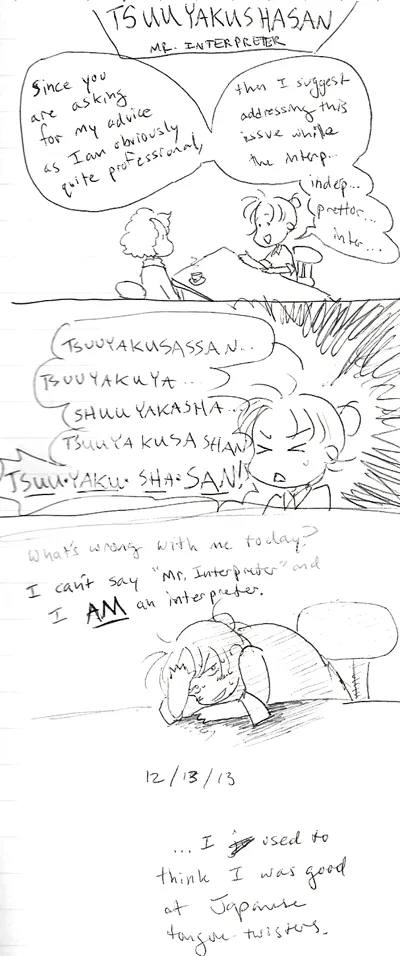
There were better ways to phrase this, and that makes it all the more embarrassing.

I was recently asked by a new CIR how longs it takes to see an improvement in your Japanese. Usually when people compliment my Japanese I bring up one of my first big slip-ups on the job as a humorous counter example, but while I was trying to reassure this new CIR, I was forced to reflect on how many embarrassing mistakes I still repeatedly make.

I’m certainly a lot more confident at interpreting and answering the phone now that I was two years ago, but all it takes is a TV camera in my face to bring out the weirdest in my grammatical mistakes and bumbling conjugation or too serious attempts at saying something clever that come out like I’m an airhead or just exposing my airheadedness altogether and making it look like I don’t understand Japanese at all. Actually, that doesn’t even require a TV camera, it usual just requires me opening my mouth.

The keyword in all of these experiences is 悔しい–kuyashii, so vexing, so regrettable!

But there has been improvement since I started life out here, despite thinking I was pretty good at Japanese beforehand. There’s been an increase in knowledge, but perhaps an even bigger increase in comfort. I don’t completely agree that you have to live in an environment seeped in whatever language you’re trying to learn in order to learn it–serious self-study can and does go a long way–but it certainly makes a big difference in naturalness and eloquence.

While I’m not going to go into my usual set of language-learning advice here, I have just a few tidbits of wisdom to share:

1. You can’t become more comfortable speaking a language if you’re uncomfortable with making mistakes.

2. If your foreign language use is frequently exposed through the media, try to avoid consuming that media. I have yet to watch any of my television appearances because for as much as I notice awkward phrasing as I’m saying things or after I’ve said them, I’d notice them even more once they’re aired and that would make me more nervous about making mistakes–and therefore, more likely to slip up–in future television appearances.

3. Tongue-twisters in foreign language are fun and handy and help redeem yourself if you’ve lost face for some simple slip-ups. They’re even more fun when you can best your native-speaker radio co-hosts with them.

4. 通訳の方 (tsuuyaku-no-kata) or 通訳の人 (tsuuyaku-no-hito) works a lot better than 通訳者さん (tsuuyakusha-san).

I’ve written about other Tamatsukuri Onsen sweets in the past, but today I’d like to introduce my favorite. It might seem more like a summery treat, but even in cold weather I usually treat myself to these. Hence, as a little break from the incoming summer heat, I have some photos from later winter and early spring trips to the onsen area. Even on cloudy evenings, the cherry blossoms there are lovely, after all.

Although there are places in Tamatsukuri famous for their fresh seafood, cute cafe atmosphere, or even for takoyaki, my favorite is this pair of stalls directly across the Tamayu River from Yu~yu, the cheapest option for a day trip to the onsen if you’re not staying overnight at a ryokan. Although I try to visit a different day trip (higaeri) onsen every time I go for a dip instead of just passing through the area, just because Yu~yu is cheap doesn’t mean it feels cheap. Out of all the ¥400 or so price ranged places I’ve been to, the magatama motifs in the design of the indoor/outdoor baths, the waterfalls, and both dry and wet saunas make Yu~yu feel plenty ritzy so long as you don’t mind having the sky to gaze at instead of a traditional garden. However, the overall design of the building makes me think of a fishbowl in the sky. Yu~yu is not only a primary spot in the onsen area for a somewhat cheaper bathing experience, but also a spot to buy local food products (both fresh and packaged to take home and hand out as gifts), as well as an event space, a spot to buy towels if you forgot to bring them for the outdoor ashiyu (foot onsen), and it’s also one of the biggest parking areas right in the middle of the strip of fancy ryokan–just be forewarned that the parking lot can full up pretty fast on the weekend! There are additional parking lots a little further down the street as well.

Now back to the important topic–sweets. No wait, before that–I just want to add that on a really cold visit to the onsen area, the vegetable and fruit juice vendor sells some really, really nice vegetable soup in a light broth. Sipping that soup while bundled up and sitting at the ashiyu with your friends and watching the snow fall is lovely. See? I don’t just love sweets, I love veggies, too.

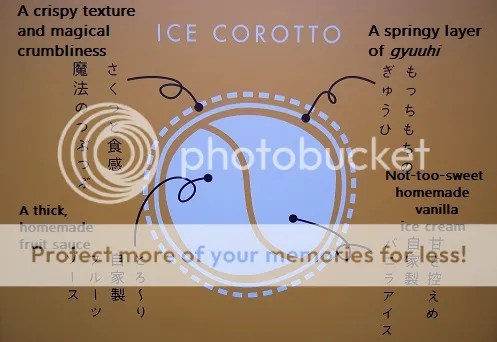
Now back to sweets. Allow me to introduce you to the Ice Corotto, an addictive mix of textures and complimentary refreshing flavors that change with the seasons and local availability.

Gyuuhi is very similar to mochi in that it is rice-flour based and soft and stretchy, but it is more delicate in texture, more like a Turkish Delight. I don’t always like the chewing involved for a mouthful of mochi and therefore don’t typically like to eat the ice cream balls wrapped in mochi that I know so many people adore around the world whenever they can get their hands on them at grocers that supply Japanese snacks. However, I have developed quite a soft spot (get it?) for gyuuhi, and I inwardly cheer everytime we have a wagashi at my tea ceremony lessons wrapped in the stuff.

Although gyuuhi is already wonderfully made use of in traditional style Japanese confections, it also matches a more western style sweet like vanilla ice cream very well. Just vanilla ice cream and gyuuhi would be lacking in some flavor, which is where the fruit sauce comes in. The fruit sauce is not limited to fruit–in honor of the local tea culture matcha is a pretty typical flavor, and I recall seeing Izumo ginger on the menu, too. There are usually four to five local flavors to choose from on the hand-decorated menu. Local strawberries and blueberries and grapes and figs and, while we’re at it, kiwis and mangos are all nice, but this particular day I decided to take pictures of the lovely little experience, I went with an uplifting matcha and orange combination.

Although I do like the soft and delicate, springy texture of the gyuuhi and the creamy texture of the ice cream and the thick, icy texture of the fruit sauce, the crumb coating really does pull it all together. It’s sort of like the addictive and satisfying combination of crunchy and soft textures in a Take 5 candy bar, only it’s not so sweet that it makes you feel ill–rather, it’s just sweet enough to be refreshing without being overwhelming. It does plenty to satisfy my sweet tooth.

They are ¥500 for four balls of your flavors of choice, or ¥300 for two. I find two perfectly satisfying. Although there are many charms throughout the onsen area, for me, even if I’m not taking a full bath, it’s just not a trip to Tamatsukuri without a couple little mouthfuls of these and at least a quick dip in my favorite of the free ashiyu available–this is one is right down the stairs to the spot at the Tamayu River in between the vegetable/fruit juice (and soup!) and ice corotto stalls. Just watch out, this is the hottest of the ashiyu in the area, and at its source it’s the hottest onsen water I’ve ever experienced anywhere!

The Izumo-no-Kuni-Fudoki (Chronicles of Ancient Izumo, 713-733 AD) is among one of the original encyclopedias of Japan, written for each province to describe local geography, culture and customs, plant life and everything.

When the researchers came to the Lake Shinji area, they found that all the locals were partying in the baths, young and old, all together–but everyone had beautiful, youthful skin. The term “fountain of youth” was not so big a buzzword back in the those days, but they instead spoke of the water and its benefits for beautiful skin.

Today, the waters are still known as the baths of the gods, there is a line of skin products made with the water, and there is a spring from which you can draw water to bring home with you. You can buy little spray bottles by the spring if you didn’t bring a container with you, which I see many ladies do. Just a little onsen tip–the heat does make a difference. Instead of just spritzing the water on your face for a home treatment, the more recommended practice is to heat up the water, soak a towel in it, and then rest it on your face for three minutes (laying it on your face such that you can breath, of course!).

Although I know this advice, I’m a bit lazy with it. I usually go to an onsen for the experience and relaxation, not the supposed skin benefits. You probably won’t notice much after one occasional dip in the onsen–however, after those happy weekends when I’ve gone two or three times, I am quite pleased to find that, “hey, I guess this water really does make your skin feel nice!”

Besides actually relaxing in the bath, I like hanging out outside in the onsen area, too. I’ll introduce one of my favorite little bits of Tamatsukuri next time.

Continued from Part 5


That’s totally in reference to Kumano Taisha.


Yup. That’s totally a reference, too.
Continued in Part 7

A few weeks ago, a friend and I had an afternoon open, so we figured we would go check out the Tottori Hana Kairou (Tottori Prefectural Flower Park) garden I’ve always heard so much about.

Turns out it’s not just one garden, it’s a series of several gardens. The flowers and trees seemingly stretch on forever, taking advantage of the natural surrounding hills and valleys and view of Mt. Daisen to create the illusion that the series of little worlds stretches out into more and more and more little worlds.


The flowers in this area vary according to season, but for this season I couldn’t help but hear the Wicked Witch of the West in my head.

I didn’t take enough photos to do it proper justice, as I was busy using a number of my senses to enjoy the park. This sign outside the herb garden made me quite happy–these people encourage enjoying plants like I enjoy plants! Quite often their textures get ignored in favor of their appearances or scents, and I get weird looks for touching the leaves and petals (for whatever seems it won’t damage me or the plant, anyway). At least the people in this part of the garden won’t think I’m weird, right?

I didn’t even take any pictures of the lilies, the signature flower of the garden, which were already in a bright bloom. The rose were taking center stage in many areas, especially with a temporary rose exhibition going on. As one small part of that, in encouraging people to interact more with their flower subjects, they had a set of very perfumed roses showing of the different types of scents roses carry.

That’s not to forget the orchids.

It was such a pleasant world of color that I don’t have too much else specific to report about the gardens (just an overwhelming sense of “oooh, pretty!”), but a couple non-floral things of note:

1. Concept benches! Along the elevated track circling the gardens, they had a number of creative benches designed and constructed by schools and other organizations.


2. Ice cream! Following up on a recent post about local specialties produced in ice cream form, I couldn’t pass up the park’s Tottori 20th Century Pear soft serve. Pear wouldn’t usually be my flavor of choice, but I’ve had these pears once before, and they were among the tastiest fruits I’ve ever eaten. I found it refreshingly tasty, but my friend more comments–that it was more like a sherbert, and that that halfway through she detected a flavor like apple juice.

And now for a little more prettiness:


Allium in flower language: “the correct assertion” or “infinite sorrows.” Would one of those sorrows happen to be that it can smell like onion?


Around 300 years before construction on Matsue Castle started, a nearby mountain was chosen as the highly defensible spot for a castle that would see its share of battle: Gassan Toda Castle, on Mt. Gassan in modern day Yasugi.

Originally built by the Sasaki clan in the 14th century in the Kamakura era, it is more commonly associated with the Amago clan, which stemmed from the Sasaki clan. This branch of the family started when Sasaki Takahisa, orphaned at the age of 3, was raised by a nun. In respect for her, he used the name Amago (尼子), which means “child of a nun.”

When you hear the term “Amago clan” (aka Amako clan), it is usually paired with the term “Mori clan.” In the Sengoku (Warring States) period of Japanese history, stated as spanning 1467~1573. There were plenty of battles before and after this period, but this is when Japan was split up amongst several warlords as opposed to power being split between only a few factions. The development was not sudden–many of the clan rivalries were based off of previous loyalities and rivalries leading up to that point, and power was gradually consolidated as clans began pledging allegiance to the more prominent warlords, and these prominent warlords gained the territories that previously been long fought over. Here in the San’in region as well as in other parts of western Japan, the Amago and Mori clans had a long and colorful history of going head to head against each other out here, but many other clans were involved as well, including the clans these clans served, or the clans that served these clans. (Still with me? Good.)

One such servant of the Amago clan was Yamanaka Yukimori, aka Yamanaka Shikanosuke (1545~1578), a famous general loyal to Amago Katsuhisa (1553~1578). He’s a celebrated local hero here in the Izumo region, especially in Yasugi, where there are big campaigns for having one of NHK’s annual Taiga drama based on his life.

The fact that he and his master have the same year of death might have tipped you off that they met a tragic end. Indeed, in was their misfortune to have been active towards the decline of the clan. After Katsuhisa’s father and brother were killed by an internal scuffle and the Mori clan effectively defeated the clan, he abandoned his monkly ways to fight, but was defeated and sought refuge on the Oki Islands. Upon his return, he captured a couple provinces, including what is now eastern Tottori. As the continued their battles with their limited armies, Shikanosuke sought an alliance with Oda Nobunaga, only to find that had only been used and no one came to their aid.

In the end, he and Katsuhisa were defeated by the Mori clan. Katsuhisa was forced to commit ritual suicide there, while Shikanosuke surrendered, but was supposedly captured and killed shortly afterward by the Mori clan anyway. As for surrending instead of following his master in suicide, some say that he sold Katsuhisa out as part of his offer to surrender, and others say that Katsuhisa willingly went along with this plan in an effort to save their remaining men. Whether they displayed cowardice or bravery in defeat, we can at least bet that a Taiga drama would build up an appropriate amount of drama around the end of an otherwise very heroic character.

With the fall of the Amago clan Gassan Toda Castle soon fell to the Mori clan as well, though it had proved to have strong defense until that point. Amago Haruhisa, the leader of the clan, successfully withheld a seige by the Ouchi clan in 1542~1543. It was a major defeat for the Ouchi clan which lead to internal struggles, and the Ouchi clan wound up being wiped out by the Mori clan later. Haruhisa went on to control territories like modern day eastern Shimane, western Tottori and the Oki Islands, but remember how Katsuhisa’s father and brother were killed? That was Haruhisa’s fault.

The Amago clan was wiped out, and although the Mori clan continued to thrive, they were on the losing side of the Battle of Sekigahara and lost control of their territory in the San’in region (but they remained in the San’yo region).

Enter the Horio clan! Horio Yoshiharu, who was with the winning side, was granted control of the Izumo domain. He moved into Gassan Toda Castle, and although it was in a highly defensible location, it wasn’t in a good spot for raising a bustling economy around it. Thus, they decided to build a new castle in a better location, and Matsue Castle was completed four years later in 1611. Matsue Castle remains one of the 12 last original castles of Japan, but Gassan Toda was not only abandoned, but pieces of it were dismantled and used in the construction of Matsue Castle.


You can, however, still climb Mt. Gassan and see what remains of the castle walls. It has been left fairly quiet, and while there is no longer a castle at the top, there is a little shrine to Ookuninushi (the same god as at Izumo Taisha) at the 197 meter summit. That seems to be a little abandoned though, too…


That said, I tend to really like the allure of things you just happen to stumble upon in the forests.


It’s a quite, peaceful mountain, and Horio Yoshiharu–who died months before the completition of Matsue Castle–was buried in Iwakuraji Temple at the foot of the mountain. However historically inaccurate, the city of Matsue still honors their founder by recreating his march into (what would become) the town and on into the castle keep with the annual Musha Gyoretsu Warrior Parade.

Click for source

While I don’t suggest taking quite that deep of a rest, you can rest up after the short hike up the mountain by visiting Hirose Onsen at the Toda Gassou facility for a nice view of the town. It’s a surphulric onsen–rich in radium-sodium, calcium chloride, and sulfide–and acts as a natural toner that gives your skin elasticity.

Click for source

I can attest to the nice view and smooth skin afterward! I wonder if the Amago clan and the warriors who served them ever had many chances to enjoy the Hirose waters?

I don’t have pets, but I do have a giant tortoise in the neighborhood.

No, not like the floods of turtles in the canals. Those ones are charming. Those ones aren’t likely to smash or devour you. Those ones didn’t do anything to receive punishment.

My neighbor is and did.

Long lived as many tortoises are, this guy has been around since before Lafcadio Hearn moved here:

…the most unpleasant customer of all this uncanny fraternity to have encountered after dark was certainly the monster tortoise of Gesshoji temple in Matsue, where the tombs of the Matsudairas are. This stone colossus is almost seventeen feet in length and lifts its head six feet from the ground. On its now broken back stands a prodigious cubic monolith about nine feet high, bearing a half-obliterated inscription. Fancy—as Izumo folks did—this mortuary incubus staggering abroad at midnight, and its hideous attempts to swim in the neighbouring lotus- pond! Well, the legend runs that its neck had to be broken in consequence of this awful misbehaviour. But really the thing looks as if it could only have been broken by an earthquake.

(Lafcadio Hearn’s “Glimpses of Unfamiliar Japan,” 1894.)

Hearn’s left a lot of common details out of this brief description. First, let’s address its home, Gesshoji Temple, frequently mentioned in this blog for its famous hydrangea and for being home to the graves of the Matsudaira fuedal lords, such as Naomasa and Harusato (aka Fumai). Each grave is decorated in different ways, including detailed carved gates in Chinese style, often reflecting the taste and hobbies of the lord buried within. It’s always a quiet place, set apart as if in its own world by the thick forest growing in and around it. Francine Prose describes the atmosphere very accurately in this Smithsonian Magazine article:

Something about the temple grounds—their eerie beauty, the damp mossy fragrance, the gently hallucinatory patterns of light and shadow as morning sun filters through the ancient, carefully tended pines—makes us start to speak in whispers and then stop speaking altogether until the only sounds are the bird cries and the swishing of the old-fashioned brooms a pair of gardeners are using to clear fallen pink petals from the gravel paths.

While wandering among the hydrangea–at their height quite soon–and hopefully not slipping on the bumpy old rock paths made slick by hundreds of years of foot traffic and by the fresh rainfall, anticipating the matcha and wagashi waiting for you back towards the entrance of the temple when you’re done with your stroll, and contemplating the peaceful world where the lords’ remains remain, you suddenly run into it.

Better that than it running into you.

I’ve heard a couple versions of the legend aside from Hearn’s relatively innocent version. Sure, the tortoise probably made a big mess of the lotus pond while splashing around in there or just wandering away from his post to geta drink. Constantly being on guard around the graves is bound to make even a stone gaurdian thirsty. But this gaurdian apparently also got bored–and entertaining himself required running amock among the neighborhood, flattening townspeople in the process. In another version of the story, he would even gobble some townspeople up.

Naturally, no one dared to attack the tortoise. What match would samurai swords be for a tortoise made of stone–a seven foot tortoise, at that? At last, a monk came and bound the tortoise to its spot by driving this sealing plaque down its back.

I haven’t heard of it moving around since, and today there is another legend that says it is good luck to rub its head, as that will bring longevity. This seems sure and safe enough during the day, but thankfully the temple usually is closed after dark–if it’s gotten hungry since it’s gotten stuck in place, then perhaps standing so close to it wouldn’t bode well for your longevity.

I’ve frequently been asked what the first thing I noticed in Japan was. The answer was easy: “It’s humid.”

On more trips that not when I’ve entered Japan, it’s been in summer. While August–considered the height of summer–is said to be hot and relatively dry, I certainly don’t find it dry. Well, I don’t find most of the months dry, except the depths of winter, that’s usually because indoor spaces dry out easily with the artificial heating. Even in winter, however, we have snowfall here in the San’in region, and when it’s not snowing, it’s raining.

Oh yeah. Rain.

This region gets a lot of rainfall. We don’t get as many typhoons because they tend to peeter out after leaving the Pacific shores, but they still have plenty of water to expend when they get here. In response to the amount of precipitation, a common trait of Izumo style Japanese gardens is that the stepping stones will be relatively high so as not the get the tips of your kimono unnecessarily wet.

This is one of the entrances to Kangetsu-an, a tea house inside of Fumon-in Temple which was one of Lord Fumai's favorites.

This is one of the entrances to Kangetsu-an, a tea house inside of Fumon-in Temple which was one of Lord Fumai‘s favorites.

Although people in Japan will proudly declare that Japan has four seasons, you’ll also find that tsuyu–the rainy season, also sometimes called baiu–tends to be declared as a season of its own, so it’s more like five seasons. But even that can get much, much more complex, so you could have 24 seasons instead. In the Chuugoku region at the western tip of Honshu (including both the San’in and San’yo areas), this typically starts on or around June 7. This year it officially started on June 4 according to the Japan Meteorological Agency.

I wouldn’t mind rain if it wasn’t so wet.

There are some upsides to tsuyu here, though. In Matsue, the rain is known as Enishizuku, the droplets that bind us all together in common fate. Or, you know, there are invisible strings in the rain droplets in Matsue that lead you to someone you have yet to meet–who knows who will drop into your life with the rain? I wonder if the En-musubi in the water has anything to do with Izumo–home of the ultimate En-musubi power spot, Izumo Taisha–being “from whence clouds come” (出雲: “emit” “clouds”)?

There are Enishizuku themed drinks at bars around the city only available on rainy days, but you’d be more likely to find me at a tsuyu matcha cafe inside Karakoro Art Studio making leaf boats.

Or I might be at Gesshoji Temple, enjoying a cup of matcha while observing the famous hydrangea or teasing a monster tortoise and slipping on the old stone paths.

Or I might be gratefully dashing through puddles while using a Dan-Dan umbrella. These are part of a program in which they took the umbrellas people forget in public and mark them specifically for public use. I’m certain I’ve contributed at least a couple umbrellas to this program, but I’ve more than reaped the benefits when I’ve been walking around without my forgotten umbrellas. The “Dan-Dan” in the title means “thank you” in Izumo dialect.

Or I might be inside grumbling about how I can’t get my hair to behave in the additional humidity.

Continued from Part 4


That’s a sly little reference to a giant serpent there, Onamuji.

Hint hint, those snakes are in Unnan. Or at least we know where the heads are kept.


Continued in Part 6

While population density is one of the first things that comes to mind when people are thinking about life in Japan, it’s important to note that there is a big difference between the toshi (city) and inaka (rural) ways of life. Most people will tell you these are the two faces of Japan, but people in Tokyo might tell you that there is only Tokyo and inaka.

We’re talking stumbling upon an old bus in the middle of mountain rice fields while you’re lost and hunting for a somewhat mythological shrine kind of inaka.

While comparing the mindsets of Tokyoites and Osakans, or comparing the mindsets of Kyotoites and everyone else is always fun, there is also perspective to be gained within other regions as well. For example, the term “U-turn” refers to young people who move away to the big city for a while, but soon find themselves returned to their inaka hometowns. On a smaller scale, an aquaintance here once boasted that even if this region seems far away, living close to an airport means that it’s easy to fly out to Tokyo for a weekend to play and shop, and that is just enough time to receive a shock and be happy to come back home just as easily.

While many, many prefectures in Japan would proudly describe themselves as inaka, only the San’in region, facing the Sea of Japan and nestled behind the Chugoku mountain range as if hiding from the rest of the country, gets to boast of the lowest population of all the prefectures. Tottori Prefecture, to the east, wins in a lot of these contests: lowest population, as well as the last prefecture to get a Starbucks. Shimane Prefecture, to the west, only has the second lowest population and was only the second to last prefecture to get a Starbucks (as of about a year ago–we more recently got a Godiva right across from it, though!).

Furthermore, just as people enjoy trying to find any kind of unique(ish) claims to fame for US states, you find the same of push for fame for each prefecture in Japan. I heard of a list labeling each prefecture for something it is famous for, and while Shimane was quite appropriately named Shinwa-ken (Mythology Prefecture), Tottori was named Nashi-ken (Pear Prefecture). Tottori pears are indeed very, very, very tasty, but the problem with this nickname is that the word for pear (梨) is synonymous with the word for “nothing” (無). It doesn’t seem people were insulted. Rather, they laughed and took it with a sense of ironic pride–“Haha, that’s right, there is nothing in Tottori! We’re as inaka as it gets!”

That’s not true, though. Tottori is famous for–within Japan–very unique sand dunes, as well as for being the home prefecture of many famous mangaka, such as Mizuki Shigeru (who wrote Gegege no Kitaro), and Aoyama Gosho (who wrote Detective Conan). Thus, one of Tottori’s other nicknames is “Manga Kingdom.” If anything, because of Tottori’s reputation for being the most inaka of the inaka (and indeed, in many manga I’ve read where they want very a inaka setting, Tottori tends to be a popular choice), it’s kind of famous in its alleged “nothingness.”

And alas, Shimane, being second to Tottori in inaka-ness, is often overshadowed by Tottori’s supposed void. We joke that we’re the 47th most popular prefecture. Irony tends to be a strength of the region, though, as evidenced by Yoshida-kun, our scowling volunteer ambassador who tells it like it is and therefore doesn’t sugar-coat what really does make Shimane a cool place.

To break down regional attitudes a little further, I’ve written before about how the western portion of Shimane (Iwami) and the eastern region of Shimane (Izumo) tend to have different mindsets (and notice that this is completely ignoring the rather large, unique Oki Islands), illustrated in little things like offering and accepting tea:

A person from the Iwami region (western Shimane) goes to visit a friend in the Izumo region (eastern Shimane). The Izumo friend asks, “Do you want another cup of tea?” and the Iwami friend replies, “no thank you, I’ve had enough.” The Izumo friend then prepares another cup of tea, and the Iwami friend is surprised and then forces himself to drink it so as to be polite.

A person from the Izumo region goes to visit a friend in the Iwami region. The Iwami friend asks, “Do you want another cup of tea?” and the Izumo friend replies, “no thank you, I’ve had enough.” The Iwami friend pours no more tea, and the Izumo friend sadly wonders why he isn’t getting another cup of tea but says nothing so as to be polite.

Even breaking down the Izumo region even further into small cities and towns, you find even more different mindsets despite the higher level of integration. For example, the two largest cities in the Izumo region are Matsue City and Izumo City, respectively on the east and west sides of Lake Shinji, comprising the Shimane Peninsula. They are connected by various roads and train lines on both the north and south sides of the lake, and visitors to one city usually do not pass up the other. When it comes to tourism, however, you notice some of the following ways of viewing each other (I’ve emphasized and compiled general passing comments I’ve heard over my time here).

Matsue, when viewed from Izumo’s perspective:

Matsue is so lucky. They have Matsue Castle and all the samurai era history and festivals that go with it, the iconic Horikawa Sightseeing Boat weaving through the canals around town, and generally being a very walkable, welcoming place for visitors, always eager to show off its history with pride. What’s more, if they want to start a new city wide festival or even put on a weekend event in a shopping area, they have enough people that they can generally count on people attending! It’s just too quiet and spread out here for us to be able to put on big themed parades over five times a year… sure seems lively over there across the lake.

Izumo, when viewed from Matsue’s perspective:

Izumo is so lucky. They have Izumo Taisha! Everyone knows Izumo Taisha! Everyone comes here for Izumo Taisha. Everyone goes to Izumo Taisha for En-musubi. We have En-musubi too, you know! Sniffle… I wish we could have Izumo Taisha. Sure, we have Miho Shrine and Kamosu Shrine and Kumano Taisha and Sada Shrine… but nobody knows them like they know Izumo Taisha!!

So maybe I’m exaggerating a bit, but you get the idea.

It’s okay, Matsue, you are loved and known.
Click photo for Facebook source and share the love for Matsue.

However, even within Matsue, you find that there is still some leftover cultural differences from before the 2005 and 2011 mergers with surrounding small towns and villages (there was a big push for mergers all over inaka Japan around this time). At the far northeast, Mihonoseki retains its Mihonoseki culture and pride, as does Shinji at the far southwest, though they are all collectively Matsue now.

However, I frequently hear comments about those oddballs out in the Yatsuka district–otherwise known as Daikonshima, the large island on Lake Nakaumi. The island didn’t use to be accessable by car, so the little peony and ginseng kingdom combined its occasional influences from Sakaiminato (a fishing port) and Yonago (a business area, the San’in region’s “Little Osaka”), Mihonoseki, and central Matsue to create a strange cultural mix and even stranger dialect. While you hear varying amounts of Izumo-ben (Izumo dialect) in the city center and in the outskirts of Matsue, or in Izumo, or the famous folk songs of Yasugi, or in the little mountain villages of Unnan and Okuizumo… you don’t hear Yatsuka-ben anywhere but the Yatsuka district. I haven’t actually spent enough time on Daikonshima talking with locals or anyone outside of Yuushien Japanese Garden to have noticed, but I certainly hear the people in the rest of Matsue talk about how weird it is.

And who knows… maybe the locals on Daikonshima talk about their weird neighbors on the even smaller island, Eshima.

Design a site like this with WordPress.com
Get started