With careful attention spent on the first times you do many regular activities, I thought I would post a couple more of my firsts for 2013.

I had originally intended to wake up and watch the Hatsuhi or Hatsuhi-no-de (first sunrise) but I fell asleep. Oh well, the San’in region is better know for its setting sun than rising sun, right? (Nevertheless, my fellow CIR got some very nice pictures of the Hatsuhi from near here!

Then I saw my Hatsuyume (first dream), in which I went to Izumo Taisha and ate some array of pickled vegetables. It’s so fitting with the Japanese New Year theme that it’s almost boring! But what can I say, these things were on the brain. (I’ll get to the vegetables in the next post.)

Before I went to sleep, though, I wrote my Kakizome (first calligraphy), as well as my less standardized first rakugaki (doodle).

"Ishi"

“Ishi”

Hmm. My calligraphy could use a little work. A lot of work.

I went with “willpower” as my first writing of the new year to help reinforce one of my resolutions. It’s probably one of the most commonly chosen and commonly broken of resolutions, but I need to cut some sugar out of my diet. Sure, it has a bit to do with being a little healthier, but perhaps it has more to do with my addiction to dessert cafes–of which Matsue has plenty! It’s so easy to go run some errands and wind up sitting around at a cafe and reading a book and trying out different kinds of teas and desserts and running out of whatever cash I brought with me.

This one had a nice looking lunch menu, too! I'll have to try that sometime...
Had a tasty panini at this one first
Honestly, I came looking for lunch at this one! But they didn't serve any, so I had to eat a dessert sampler instead.

And these are only a small sample of the western style ones! Matsue still has a thriving green tea and wagashi (traditional Japanese confectionery) culture, after all. I suppose I don’t need to deny myself at those establishments, right? Right!? There goes my ishi now…

Following up the previous post about the first shrine and temple visits of the new year, this is a report on my visit to Kamosu Shrine.

Not that it looked like this when I visited at night. Thanks, Wiki!

Kamosu Shrine (an Izanami shrine–and one that the people of Matsue are most proud of) is the oldest shrine with Taisha-tsukuri architecture, which is particularly known for its roof design unlike that of the curved roofs of temples borrowed from Chinese style. Like most Shinto shrines, it is not just one shrine–rather, many little houses for different Kami, with a primarily one facing the entrance of the shrine. Vistors don’t enter them, but instead stand in front and peer in from windows or doors, if they happen to be open. Furthermore, the main focal point for the offerings isn’t even the true shrine itself. Instead, the main shrine (the honden) is behind this room and elevated. Kamosu’s honden is a National Treasure.

One of the key points about Taisha-tsukuri shrines is that based on the angle of the ends of the crossed sections on top, you can tell whether the diety being honored is male or female. That doesn’t make much sense in words, so take a look at a couple of the smaller shrines within Kamosu:

Click to follow to photo source and more photos of Kamosu Shrine (Japanese)

After watching the end of Kouhaku Uta Gassen–the biggest musical event of the year, over 4 hours of popular performers in a men-versus-women singing competition–and bringing in the new year with soba noodles and watching the ringing of the joyonokane on TV (a Buddhist ritual to cleanse humanity of the 108 sins and temptations), we set out at around 12:30am on January 1st to do our visit. It was like shrine visits any other time of the year–rinsing your hands before entering, tossing money before the kami, then praying in the bow-twice-clap-twice-wishful-thinking-bow-again style, and repeating the process at any of the smaller kami houses throughout the shrine.

Here's a little of my pocket money. Now can I get rich this year, please?

Also like any other time of the year, you can buy o-mamori (good luck charms and talismans) and draw omikuji fortunes, but the ones being sold at New Years are new, and many people return the previous year’s good luck charms so they can be burned.

Time to pick out this year's omamori...

Nevertheless, heavy emphasis is placed on many firsts of the year, and the visit felt special. It helped that the weather created a certain mood–it was a windless night with slowly falling snow, the moonlight was hazy, and the features of the shrine seemed to glow under a light layer of snow. Unlike larger shrines around Japan that were packed with people even at midnight, Kamosu was nearly silent. Even the miko (shrine maidens) offering New Years amazake (sweet rice wine) moved silently with sweet smiles, and spoke in soft voices like whispers.

Would you care for some sake and brown rice?

Oh, but this was different. Brown rice was being offered with the sake? We asked the miko what the significance of this was, and their pleasant atmosphere seemed to shatter into confusion. These miko probably had no idea why they were serving rice–after all, contrary to what popular culture might lead one to believe about the fine upbringing of holy maidens, these girls were most likely high schoolers who took on a part time job for the New Year season.

After our brief visit, we took a drive over to the Tamazukuri Onsen area to take a 1am visit to the outdoor ashiyu (hot spring foot bath) as the snowfall gotten thicker. We stayed under a covered roof for this visit, but it’ll be nice to go back when the weather is warmer to use the ashiyu in the stream! This was my first time at trying out the waters at Tamatsukuri, which are said to have some of the best minerals for your skin in all of Japan (on that note, according to POLA research done last year, Shimane is the best prefecture in Japan for beautiful skin!).

Our local hot springs--highly recommended!

Today is my first day back at work, but the season of firsts will still go on until about January 15th or so. I still have time to write another entry about my other firsts of the year and how else I celebrated Japan’s most important holiday of the year!

New Years is Japan’s most important holiday of the year–and like many important holidays, it usually is celebrated over the course of several days. While there are plenty of traditions associated with this season (decorating with and eating rice cakes, playing special games and reciting seasonal poetry, etc), today I’d like to introduce Hatsumode, the first shrine and temple visits of the New Year.

This is a list of major shrines and temples for Hatsumode in the San’in region that are especially well known for the following special intentions. While certain strains of Buddhism may resemble other world religions moreso in the personal salvation aspect, the Kami of Shintoism are generally happy to grant more worldly requests. Not that they always do so out of any innate goodness–many of them are unwilling to help unless you pay up, and when you do ask for something, you have to tell a lot of them your name and address or they won’t be able to find you later and grant your request. Kami may be powerful, holy beings, but they do have their limits!

The following special intentions are just suggestions. While a matchmaking kami wouldn’t necessarily turn down a request for financial prosperity, your odds might be better if you chose your Hatsumode shrine carefully.

1. 出雲大社 Izumo Taisha
Izumo, Shimane
Special intentions: matchmaking, fertility, other general intentions

2. 須佐神社 Susa Jinja
Izumo, Shimane
Special intentions: safety for one’s family, prosperous business, traffic safety, other general intentions

3. 長浜神社 Nagahama Jinja
Izumo, Shimane
Special intentions: Good luck in meeting challenges

4. 日御碕神社 Hinomisaki Jinja
Izumo, Shimane
Special intentions: Protection from evil, matchmaking, matrimonial harmony, prosperity for one’s family, safety on the seas, etc.

5. 一畑薬師 Ichibata Yakushi
Izumo, Shimane
Special intentions: Healing of eye diseases, safety for one’s family, safe childbirth, prosperous business, and any other general intentions

6. 宇美神社・平田天満宮 Umi Jinja / Hirata Tenmangu
Izumo, Shimane
Special intentions: General good luck, fruitful studies, avoiding misdeeds

7. 熊野大社 Kumano Taisha
Matsue, Shimane
Special intentions: Matchmaking, protection from evil

8. 平濱八幡宮 武内神社 Hirahama Hachimangu Takeuchi Jinja
Matsue, Shimane
Special intentions: Longevity, avoiding bad luck, prosperous business, safety for one’s family, traffic safety, etc.

9. 菅原天満宮 Sugawara Tenmangu
Matsue, Shimane
Special intentions: Passing exams, fruitful studies, avoiding bad luck

10. 八重垣神社 Yaegaki Jinja
Matsue, Shimane
Special intentions: Matchmaking, matrimonial harmony, fertility, safe childbirth, avoiding misfortunes and disasters

11. 神魂神社 Kamosu Jinja (This is where I went!)
Matsue, Shimane
Special intentions: Getting rich, prosperous business

12. 佐太神社 Sada Jinja
Matsue, Shimane
Special intentions: Guidance, good luck, traffic safety, safety on the seas

13. 美保神社 Miho Jinja
Matsue, Shimane
Special intentions: Safety on the seas, satisfactory fishing, prosperous business, flourishing crops, safe childbirth

14. 清水寺 Kiyomizu-dera
Yasugi, Shimane
Special intentions: Safety for one’s family, prosperous business, passing exams, good health, traffic safety, making dreams come true, life-long good luck, safe childbirth, etc

15. 勝田神社 Kanda Jinja
Yonago, Tottori
Special intentions: Prosperous business, safety for one’s family, and other general intentions

16. 宗形神社 Munakata Jinja
Yonago, Tottori
Special intentions: Life-long good luck on the battlefield, safety on the seas

17. 名和神社 Nawa Jinja
Saihaku, Tottori
Special intentions: Life-long good luck on the battlefield

18. 金持神社 Kamochi Jinja
Hino, Tottori
Special intentions: General good luck, but especially good financial luck

Seeing as I’m out here in Shinto country, I’ll be taking part in this tradition–possibly moreso to see the crowds! I’ll report on the experience in a few days, but until then, I have some vacation days to enjoy.

In the meantime, here is a Kadomatsu (traditional New Years decoration) set out in front of Matsue Castle. Some Kami will come and live in those bamboo stalks for a few days to bring good luck–but not to worry, they’ll be released a little later in January when those decorations are burned.

Pine is traditionally associated with January, too.

Happy Year of the Snake!

Rather than sending Christmas cards, the custom in Japan is to send nengajou: New Years greeting cards. While not necessarily so, they typically feature the Chinese zodiac animal for the upcoming year.

What better way to celebrate the passing of the Year of the Dragon to the Year of the Snake than with everyone’s favorite eight-headed serpent? The Yamata-no-Orochi made his (their?) home out here in the San’in region, after all! Consider this a preview for the next installment in my Kojiki-retelling, which I plan on starting in late January or sometime in February.

Until then, there are plenty of New Year firsts to keep me busy. In the spirit of Japan’s most important holiday, let’s welcome this year with special attention to the first sunrise, our first smiles, and our first dreams~

Start reading about the legend associated with this piece!
The Yamata-no-Orochi

See the other Nengajo!
2014
2015
2016

See the Kojiki a.t.b.b. masterlist!
The Kojiki Myths in Manga Form

Horio Yoshiharu (1542-1611) (personal name Mosuke) is the founder of Matsue. To say why, we need a brief overview of the period of history he lived in.

Prior of the long period of peace and development in the Edo era (1603-1868), Japan was composed constantly warring fiefdoms, and notable samurai lords such as Toyotomi Hideyoshi, Oda Nobunaga, and Tokugawa Ieyasu gradually gathering enough supporters to become major figures in shaping Japanese history. Their activity eventually led up to the decisive battle of Sekigahara in 1600, and over 200 years of nationwide stability followed.

Yoshiharu was drafted into military service at a young age, when Toyotomi Hideyoshi heard about young Mosuke wrestling with a wild boar. Why he was wrestling with the boar, we can only guess.

These guts proved very useful to Hideyoshi, as Yoshiharu went on to thwart high-profile enemies over the course of Hideyoshi’s campaigns against Oda Nobunaga, and he was awarded land to rule over near Mt. Fuji in the old Totomi Province after major victories. That was how the samurai warlord system worked–if you wanted to rule over multiple fiefdoms, you did so by rewarding the people who serve you. Well-accomplished warriors would rule directly, but still take orders from their overlords. Everyone was happy! If they were samurai, anyway–farmers were probably just happy with whoever wouldn’t terrorize them.

Hideyoshi didn’t live to see the end of the warring states period, though, and after he died Yoshiharu entered Tokugawa Ieyasu’s service, earning property in the old Echizen province facing the Sea of Japan (but still pretty far east of the San’in region). Though he was phasing some of his position over to his son Tadauji at that time, Yoshiharu’s services on and off the battle field were still necessary.

A particularly notable example was at a dinner party he attended with Mizuno Tadashige (an ally) and Kaganoi Shigemochi (a fremeny, if you will–his family had previously served the Oda clan until they surrendered to Hideyoshi and recieved land from him to rule over). Shigemochi got drunk and killed Tadashige, and Yoshiharu therefore killed Shigemochi, thus wiping out the Kaganoi clan and putting the territory fully in Ieyasu’s control. That land would have been in the way of a military manuever enacted soon after, but having Shigemochi out of the way was a big help to Ieyasu.

Though that raised Yoshiharu’s status, he was injured in the battle with Shigemochi, and therefore could not personally partake in the Battle of Sekigahara two months later. Tadauji, however, was present and won honors in his father’s stead. Once Ieyasu took effective control of the country and needed to organize it in such a way that would cement the central government’s control over all the provinces, Horio received his final property to rule over: the Izumo Province.

Here comes Lord Horio, marching through the streets of modern-day Matsue in the annual Musha Gyouretsu (Warrior Parade)!

Yoshiharu and Tadauji hurried out here to the San’in region, stayed in an old castle in present day Yasugi City, and started making plans for building a more suitably located castle. That process is a story for another entry, but you can read about the naming of Matsue right now.

Yoshiharu ruled until he died in 1611, the same year construction on Matsue Castle was completed. He was well-liked and known for having the temperment of a Buddha, and therefore nicknamed “Hotoke no Mosuke” (the Mosuke Buddha).

Looks like I’ll be eating 和食 (Japanese cuisine) for Christmas this year!

The typical Japanese way to celebrate Christmas is by eating Christmas Cake (a very pretty, very expensive sponge cake that doubles in size when you add whip cream and strawberries), which kids are very surprised to find out is not an American tradition (eating KFC on Christmas is also more a Japan-born tradition). I celebrated this year by doing four Christmas presentations, including one cooking class.

Unfortunately I cannot yet tell you what they taste like. Maybe next year.

I had my heart set on handing out candy canes to the kids at that one, but I soon discovered that candy canes are really, really hard to find in Japan, even at the import grocery store (at least I found chocolate coins there). I had hoped to see some closer to Christmas, but no such luck.

Thankfully there is a wonderful ALT (Assistant Language Teacher) in the area who had the foresight to make a bulk order for her own students, and she was nice enough to give me enough to hand out as well. Sure, they aren’t essential, but it made cultural exchange just as little sweeter!

Merry Christmas, everyone! I’ll post a New Years greeting card next week!

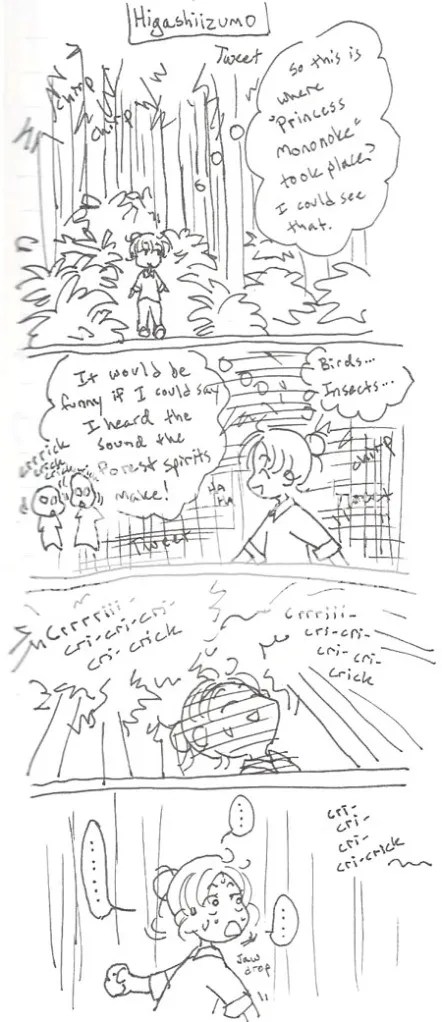
I kid you not, that is exactly how it happened! I heard the Kodama (tree spirits)! If you have not seen this movie, this is all you need to know:

This would make a great story, expect that I remembered it wrong. Hayao Miyazaki’s movie “Princess Mononoke” didn’t take place in Higashi-Izumo. It took place in Oku-Izumo!

I was really excited about the unidentified sounds and certainly appreciated the five-minute walk through the forest near Yomotsuhirasaka for it, but I thought about it more later and what I remember of the Studio Ghibli film. The geography wouldn’t make sense with the time period, so I checked–sure enough, I was wrong! Oku-Izumo makes more sense, giving the iron production history there. I feel a little disappointed, but whose to say forest spirits wouldn’t spread out to the surrounding areas?


I see a lot of piles of rocks like this in forests around here, and they always remind me of Lafcadio Hearn‘s essay about another Shimane sight, “In The Cave of the Children’s Ghosts”:

From the sea the ribbed floor of the cavern slopes high through deepening shadows hack to the black mouth of a farther grotto; and all that slope is covered with hundreds and thousands of forms like shattered haka. But as the eyes grow accustomed to the gloaming it becomes manifest that these were never haka; they are only little towers of stone and pebbles deftly piled up by long and patient labour.

‘Shinda kodomo no shigoto,’ my kurumaya murmurs with a compassionate smile; ‘all this is the work of the dead children.’

(Buri note: Haka = grave(stone), Kurumaya = driver)

Given the circumstances, these rocks made me think more of Kodama!

…but maybe the nearby neighborhood puppies lived here instead?

Thus ended my charming visit to the gateway to the underworld. Given it’s ties to Yomi, the story of Izanagi and Izanami is rather dark and places associated can be on the somber side, but other Kojiki stories that took place in the San’in region tended to have happier endings. Now that we have this tragedy out of the way, look forward to more love stories and heroism ahead.

The road to hell is lined with good intentions, they say. Good intentions and flowers.

Following Part 1 of the trip to Higashi-Izumo, I took a short hike from Iya Shrine to Yomotsuhirasaka, otherwise known as the entrance to Yomi. There was no chance of getting lost, what with all the signs pointing to the underworld of filth and death (though that being said, there are two ways to get there–I took the spookier route on the way back to civilization).


Once you leave the main road and go up a steeper neighborhood road, Higashi-Izumo gets even more quaint. Who would expect the entrance to Yomi to be among such charming farming villas? Strangely quiet farming villas, but charming none the less.

Then I found Yomi, up the hill and at the end of the forest, next to an eeriely silent pond. There were two or three large orange and white koi swimming very slowly, but the surface of the water was never disturbed. Hmmm. Did Izanami keep pet fish?


And then I entered. Well, not Yomi itself, but the area that seals it.

There is a carved stone to state what the area is, and next to that is a regular-looking tree with an obscure label. It’s none other than the peach tree Izanagi took peaches from to throw at his pursuers from Yomi! Though the time I visited was not the season for peaches, it was looking fairly lively among the deathly atmosphere.


There is series of boulders after that, but I’m willing to bet it was the tallest one that Izanagi used to seal the entrance.

Suspiciously enough, you can walk all the way around this boulders–though Yomi is thought of a cave, these don’t lead to any apparent cave above ground! Was Izanagi’s aim that terrible? Well, I guess he deserves a little credit for moving it in the first place, and we can’t criticize a job half-way done. That entranced is used later on in the Kojiki anyway, so maybe it was Oonamuji’s mother who moved it out of its original place–oops, that’s a spoiler!

I choose the largest boulder based on the surroundings. Similar to how torii signify a separation between the mundane world and the pure space of a shrine, those trees seem a little suspicious. This is, however, just my own opinion and desire to find ways to tie up plot holes.

My spookiest experience of the day came right after I left Yomotsuhirasaka.

Having finished re-telling the story of Izanagi and Izanami, introducing some places associated with them should now make more sense. Some of places have not only been listed in the Kojiki and Nihonshoki, but have also been listed in the Izumo Fudoki. The Fudoki was like Japan’s first encyclopedia, written 713-733, and today the Izumo Fudoki is the only one remaining nearly fully intact. That means most of these places are really old and have fairly reputable roots, though it is worth noting the Shinto scholars’ impact in the Edo era (1603-1868) on cementing these places’ claims to Kojiki fame.

Manai Shrine (in red) is a shrine to Izanagi, Iya Shrine (blue) and Kamosu Shrine (purple) are both Izanami shrines, Izanami’s grave on Mt. Hiba (green) and final resting place of her soul on the restricted grounds of Kannoyama (yellow) are both relatively close by, but Yomotsuhirasaka (orange) in the Higashi-Izumo part of Matsue was what I was most interested in visiting.

Simply put, I live near the entrance to the underworld.

I started my Higashi-Izumo daytrip at Iya Station, where there is a friendly little place to kill time while waiting for the train, full of tourist information and ice cream and chatting old ladies and books–lots and lots of old books! This is the NPO known as Higashi-Izumo Machi no Eki: Metora, run by a kind lady happy to make your visit to hell–I mean, Higashi-Izumo–pleasant and well-informed. She named the place after a local kabuki actor from the Meiji era, Oonishi Seitarou, whose stage name was Metora (“Lady Tiger”).


The neighborhood is old and quiet, and definitely feels like a small town (which used to be a distinct municipality from Matsue, until a merger in 2011). It was a pleasant walk with a little Jizo shrine, flowers, and fish to discover–which I found so pleasant that I almost didn’t notice Iya Shrine when I passed by!


Iya Shrine, as stated before, is an Izanami shrine.

That being said, it’s not the most decadent shrine–even is the main building in which she is enshrined is hidden behind a bunch of trees, and the parts that you can walk right up to are very sparsely decorated.

Not that I am complaining–the atmosphere was very other-worldly, as Shinto shrines are set apart to be. Notice the mirror? In Shintoism, mirrors are frequently used instead of idols. Go ahead and take a minute to ponder that. Unlike shrines in more metropolitan areas, the torii here looked and felt old–just like the stone gaurdians at the entrance with their faces worn off by time. The gohei were also noticably unkempt.


Perhaps that atmosphere is appropriate, seeing as it can be considered a shrine of the dead–which I also find highly interesting, considering death is such a taboo impurity in Shinto shrines. Speaking of impurity, let’s take a trip to the entrance to Yomi in the next entry!

This makes me wish I lived a little closer to Oda!

Yes, that is a pure white crow with blue eyes (not an albino). Read more about the sightings by clicking here.

The map, for reference:

Design a site like this with WordPress.com
Get started