
April 5, 2014
Representing the San’in region on the World Stage!
Posted by Buri-chan under Buri-chan Anecdotes | Tags: kimono |[14] Comments
April 2, 2014
Curse-carrying dolls, floating away…
Posted by Buri-chan under Local Anecdotes | Tags: dolls, festivals, holidays, Japanese calendar, kids, shinto, tottori |Leave a Comment

Click for source
Happy Hina Matsuri, otherwise known as Dolls’ Day or Girls’ Day! At this time, families with young daughters decorate with elaborate dolls and eat delicate delicacies.
“But wait!” some of you may say. “Hina Matsuri is March 3! It’s April 2, so you’re a month late.”
To which I say, “No, I’m not! I live in the San’in region!”
Recall this lengthy explanation of why the modern Japanese calender, in an attempt to synchronize with the West and retain tradition, is more than a little complicated and maybe a touch crazy. For our purposes here, suffice to say the Gregorian calender tends to be roughly a month off the old Japanese agricultural calendar, and so holidays that mark the changing of seasons or events in nature may be celebrated weeks before these seasonal changes. Something that marks the beginning of spring feels even less festive when you’re in a colder area, so some areas–such as the Tohoku region and the San’in region–choose to celebrate the holiday according to the old calendar as opposed to the Gregorian calendar.
While today may be April 2 according to the calendar in broad use, it is 3/3 according to the old one, and Hina Matsuri as it is traditionally celebrated is going on today.
What do I mean by “traditional”? That depends on how far back you want to look, though there is “traditional” merit in how it is celebrated in any given time period. While the “traditional” mental image of the celebration may call to mind a multi-layered display of Heian courtiers and their accessories, there are of course modern families who find this a pain for the price and go with cuter, smaller renditions to enjoy the festivities. In the smaller towns where the houses are bigger, however, you’re somewhat more likely to encounter people with room in their homes for the full sets. Some friends of mine in Yasugi have three daughters, and they’ve had three complete sets on display throughout March and through now.


Part of the fun of observing the dolls is seeing all their unique expressions. Which doll has what pose and expression is generally determined by its position in the set, but it was fun to compare them between the three sets.
Or if you’re too lazy or cheap to get a set of dolls to display, or even if you don’t have any daughters to celebrate, anyone can easily enjoy the dainty atmosphere decked out in visions of peach blossoms, red, white, and green sweets, and luxurious kimonos and decorations.

I didn’t plan on celebrating Hina Matsuri, but that was a delicious shortcake.
The doll set as we know it today didn’t really become a tradition until Japan was westernizing, though. The practice of making wishes for a girl’s bright future by making use of dolls goes back even further.
In fact, it didn’t even have to be for girls. We have records from the Heian era about a millenium ago that men as well used dolls in a special bina-asobi ritual. Dolls were not so much to be a toy as to represent the form of a human (hence, they are called ningyo today, a different pronunciation of the characters 人形 for hitogata as they used to be called, which literally mean “human form”). Representing human form gives them the ability to take human curses in our place. That’s great and keeps us from getting sick and all, but you can’t just keep that cesspool of bad luck with you. After taking the fall for us, the dolls must be banished so that the curses stay far away.
This is where we get Nagashi-bina, the ritual floating of dolls down the stream or out into the ocean. This grand sending-off is the more direct origin of Hina Matsuri as we know it today, though you could go back hundreds of years even before the Heian era to see some of the earliest uses of dolls for spiritual purposes in Japan, and you’d have to back centuries and centuries further in Chinese history to see where they may have even gotten that idea, what with burying dolls with deceased rulers as opposed to burying live people with them. Given the milleniums of dolls having the bad luck of taking away our bad luck, it makes the notion of a doll hanging around for amusement purposes something ponder-worthy.
In late February leading up through March 3, it’s easy to find doll displays either in museums, public gathering spaces, or personal homes, but what about this darker side of doll use?
The display dolls we now consider traditional come back into the mix here. There is a thought that old, damaged dolls should be allowed to retire, as by that time they have acquired a soul of their own and grown tired from their duties in providing good luck to little girls. Thus, they are usually entrusted to a shrine as opposed to haphazardly thrown out, and while some have taken on unique new lives in artistic displays, there are some shrines that simply store hundreds of these elaborate dolls. If this sort of thing interests you, might be able to visit these kinds of shrines around Kyoto and Wakayama to see the store houses in March, or if that’s not your thing you should beware of these rooms of soulless(?) eyes staring back at you!
You don’t usually find these dolls floating down the river, though… well, nowadays, you typically don’t find any dolls floating down the river. Tokyo makes a good show of it with sending paper dolls down a pink slide to the water, though.
However, then you have Mochigase, a district of Tottori City that has maintained a local practice with its roots in the Edo period. Paper dolls are arranged with sweets and other decorations on a woven straw basket, then sent down the Sendai River (not to be confused with a city in Miyagi Prefecture). This river runs through Tottori City on the way to the Sea of Japan, and runs right by the location of the Nagashibina-no-Yakata, a museum dedicated to the practice of Nagashi-bina and other types of Japanese dolls from different locales and time periods. Mochigase’s doll rituals frequently take place at the banks of the river around here, and it is one of the biggest events of its kind maintained throughout Japan. Smaller cities in Tottori also have their own traditional styles of handmade dolls and similar Nagashi-bina events as well. Unfortunately, I can’t be in Tottori today, so I’ve hunted around for some resources and borrowed from photos instead (click for the sources and more galleries!).

Click for source–there is a whole gallery of semi-official cuteness-in-kimono waiting for you.
FYI, that is the doll museum in the background.

Click for source–Ojisan Jake has a couple of entries about the content of the museum, so I highly recommend check his blog out. These are the sorts of dolls being set afloat down the Sendai River.
I may not be there in person today, but that can’t stop me from enjoying some dainty (and more traditional) Hina Matsuri snacks here.


March 30, 2014
Izumo Soba: More buckwheat for your buck
Posted by Buri-chan under Historical Anecdotes, Local Anecdotes | Tags: food, Fumai, ice cream, Izumo, Matsue, unnan |[4] Comments
Soba is a typical noodle dish that may come to mind when you think of Japanese cuisine. Served hot or cold to suit the weather, you dip the thin buckwheat noodles in dashi sauce as you slurp.
Or at least, that’s how I used to think about soba. Having gotten so used to Izumo Soba, I now find regular soba rather bland in comparison. Where’s the deep color? Where’s the aroma? Where’s the nutty taste and firm texture? Why bother making a mess with dipping when I can just stir the sauce in and eat it as is?

Regular soba is made with flour from the tiny unhulled buckwheat seeds, which makes for a rather uniform (and typically factory-prepared) consistency, but Izumo Soba is made using the entire seed, hull and all. This not only makes for more texture and taste, but also more nutrition.

A big close up on ting buckwheat hull (thanks, Wiki.)
Furthermore, Izumo Soba is still typically handmade (you can see photos of the process here on the Haneya restaurant homepage), and these makes for variations in each restuarant’s brand. Some people are very fierce in defending their favorites, and seeing as I’ve only tried a handful of the different Izumo Soba restaurants swarming around Izumo Taisha and Matsue Castle. Provided you don’t have a buckwheat allergy, eating Izumo Soba is pretty much essential when visiting the region, and the place I take people usually depends on where we happen to be standing around lunchtime or what kind of scenery we want, or wherever we can squeeze into the establishment on especially busy days!
Another difference you may have noticed in the above photo is how Izumo Soba is served. While you might usually picture soba served on a bamboo mat, this is charming, but it doesn’t make it very easy to take noodles with you on the go. The bentou-box approach has become pretty standard for Izumo Soba, especially when served in Warigo Soba style (I have yet to even hear of an Izumo Soba restuarant that doesn’t offer Warigo Soba). In this form, it is stacked in three little boxes and an extra box on top with the toppings.
The toppings are mostly similar to what you’d expect in other soba servings–strips of dried seaweed, chopped green onions, maybe some katsuo flakes. However, instead of wasabi, Izumo Soba is usually served with momiji-oroshi. Literally translated, this grainy red topping is “grated maple leaves” but it is really a mixture of grated daikon radish and spicy red pepper. However, the toppings are not limited to this–I’ve also have Izumo Soba served with raw quail egg or sticky grated yam. Part of the fun of Warigo Soba is that you can try out different ratios and combinations of flavors in each dish. You add dashi (the sauce) on top and stir it all together before you start slurping, but you can add the leftover dashi to the the next dish for a strong flavor since it’s already soaked up some of the flavors in the first dish.

On that note, here is a handy video explaining how to eat Warigo style Izumo Soba like a pro!
Notice that drinking the water the soba was boiled in is an option. It’s known for how healthy it is, and has a smooth, light texture and flavor. One of the other popular ways to eat Izumo Soba is in the original water it was boiled in, with some flavor added to make it a nice broth. You can add additional toppings to this from there, and some establishments are known for their own touch on this, such as how Yakumo-an adds duck meat.
Way back in the Edo period when there were very clear distinctions between what different classes of people ate in the caste society, soba was considered commoner food (bare in mind that sushi started this way, too!). Despite how many members of the samurai class turned their nose up at such simple fare, one of the Izumo domain feudal lords was known for his love of good soba. While Matsudaira Harusato (better known by his tea name “Fumai”) is commonly associated with promoting tea culture (still very noticable today), he is also known for sneaking out of his quarters at night go dine at the cheap soba joints!
Nakamura Chaho credits him with the following words:
I drink tea, look for good tools, eat soba,
Garden, watch the nature’s beauty, and
Without other desire, laugh loudly.
I don’t know about Lord Fumai, but I usually desire dessert even after a satisfying soba meal.
It seems that weird ice cream flavors around Japan making use of the local speciality products (or at least making use of the creativity of the locals) has been a big topic around the internet lately, which I did not notice until I had people asking me if I’ve tried any weird ice cream flavors. Well, yes, but it’s not as I go looking for them. It’s more so that you can find them anywhere and my friends and I think, “gee, that’s interesting” and give it a shot. I wouldn’t say they were especially weird (but perhaps after living in Japan for a while my definition of weird has shifted), but I do have a favorite among them.
You can probably guess that I’m leading up to soba-flavored ice cream.

I tried this at a new Michi-no-Eki (a fancy style of road stations or rest stops throughout Japan, many of which are sights in and of themselves) in Unnan, located south of Izumo and Matsue (together with Okuizumo and Yasugi, these five cities/towns make up what is commonly know as the “Izumo region”). This Michi-no-Eki is called Tatara-ichibanchi and has a special focus on introducing local mythology (especially the Yamata-no-Orochi 8-headed giant serpent, which resided in Unnan), with the help of Shimane’s volunteer tourism ambassador, the scowling Yoshida-kun (whose day job happens to be attempting to take over the world). (Recall that Yoshida-kun and company have also volunteered their villianous services in telling Lafcadio Hearn‘s “Kwaidan” ghost stories.)

One of the gastronomical options at this rest stop is the Izumo Soba restaurant, Murage, and they offer this ice cream on their menu. In addition to the buckwheat seeds on top that provide a little crunch, their add components of the soba to the ice cream itself, and it’s a light, refreshing flavor. Unlike other flavor adventures which were more for the experience than for partaking of the treat again, this I would be happy to eat again just to enjoy it!
Izumo Soba is much the same way. It’s not only something I eat with people visiting, but it’s something I pick up at grocery store and use in my daily life, too. It’s not only for the experience as described–it’s simply really good soba.
March 27, 2014
The First World Slipper Table Tennis Competition
Posted by Buri-chan under Buri-chan Anecdotes, Local Anecdotes | Tags: CIRiously, onsen, sports, Tamatsukuri |Leave a Comment

Let’s take a trip to a ryokan in our imaginations. What do you see there? Many people might start with the charming atmosphere of the street leading up to the hotel, the owner and workers politely greeting you in kimono and then showing you to your room where you can get changed into your yukata, a comfy cotton kimono you can relax in. Your shoes are left at the entrance, and you will have slippers to use throughout the halls. A dip in the onsen might look relaxing or you might be picturing antics from numerous anime scenes, and afterward, while your body is still warmed up by the hot mineral water bath, you can chill out and drink some milk from a little glass bottle. The ryokan of course has a first-class, multi-course Japanese style meal with a focus on fresh, local products, but after dinner you’re not quite ready to curl up in your fluffy futon and go to sleep.
No, now is the time to challenge your friends to table tennis!
This classical ryokan activity is something everyone is familiar with, but I can’t say I’ve seen any of these tables set up at the ryokan I’ve been to. That said, the Tamatsukuri Onsen area is pretty much everything else you’d look for in an onsen resort area, so they got the idea to invigorate this ryokan-style sport. Just holding a big table tennis match wouldn’t do–to make it more ryokan-like, they replaced all the paddles with hotel slippers, and offered a free stay in Tamatsukuri as the top prize.

Since it’s not likely any other place on Earth is holding the same sort of competition, it automatically became the first world slipper table tennis competition. So as to represent the rest of the world, a couple fellow CIRs and I entered the competition in the mixed-gender doubles match (there were also girls-only and guys-only doubles categories). A big thank-you to them for sharing the photos!
Representing China with Liu, XiaoMan looked just as cool and as competitive as ever.

I, however, must apologize to the United States and by extension to the entire western hemisphere for having been such an embarrassing table tennis representative.

I teamed up with Kim, who was representing South Korea. We had a perfect losing record, but it was still fun!

While other people were talking about how hard it was to hold a slipper instead of a paddle, I found it didn’t make much difference for me. Perhaps I did a little better with a slipper than with a normal paddle. You could hold them anyway you want, so while some people gripped them, others just put their hands inside like a mitten. I thought they were helpful for catching runaway balls.
While I was busy chasing balls I completely missed or sending my opponents chasing after balls that were clearly out, there were many more serious competitors attacking for the bragging rights and for the big prizes. Everyone was awarded a consolation prize for of local dried seafood, as there was also free crab miso soup and rice balls (because the local crab and rice is delicious, of course) for all of the participants. Still, at events like this, you can usually expect to see at least a few people dressing up or otherwise making a show out of it with muscle shirts or, in keeping with the retro-ryokan theme, some kimono.

Since we all lost in the preliminary rounds we went out for lunch instead of sticking around, but I heard later that in the finals that afternoon, each of the participants were given yukata to wear!

Like so.
There was a lot of exposure for the event, though I’m glad I didn’t have my picture in the paper this time because I was wearing my “I am concentrating super hard and do not look like I’m having any fun at all” face even though I really was enjoying it once I got the hang of it. There was also a TV crew there for whatever question-and-answer TV show this was. I had to chase balls around the camera crew sometimes.

It seems the first world competition was a success, and everyone–including people who couldn’t make it this time–is talking about their plans for next year, everything from when to practice and who to team with, and coming up with snappy team names. Maybe with a little more practice I could be a better representative next year, but anyone is welcome to come try their hand at it next March!

March 23, 2014
Rain on the Black Castle
Posted by Buri-chan under Local Anecdotes | Tags: flowers, Koizumi Yakumo, matsue castle, plants, water, weather |[4] Comments
This has been an odd winter in the San’in region, which is typically known for the amount of snow it gets compared to sunnier parts of the country. I was told by many people to expect a very cold winter this year. However, while Tokyo had been experiencing heavy downfalls, we had usually been experiencing rain as opposed to snow.

As striking as Matsue Castle appears on a sunny day, there is a sense of it looming over the city on such dreary January days as this, and I can’t help but be reminded of how Lafcadio Hearn described it:
…solid as when first built long centuries ago, a vast and sinister shape, all iron-grey, rising against the sky from a cyclopean foundation of stone. Fantastically grim the thing is, and grotesquely complex in detail; looking somewhat like a huge pagoda, of which the second, third, and fourth stories have been squeezed down and telescoped into one another by their own weight. Crested at its summit, like a feudal helmet, with two colossal fishes of bronze lifting their curved bodies skyward from either angle of the roof, and bristling with horned gables and gargoyled eaves and tilted puzzles of tiled roofing at every story, the creation is a veritable architectural dragon, made up of magnificent monstrosities—a dragon, moreover, full of eyes set at all conceivable angles, above below, and on every side. From under the black scowl of the loftiest eaves, looking east and south, the whole city can be seen at a single glance, as in the vision of a soaring hawk; and from the northern angle the view plunges down three hundred feet to the castle road, where walking figures of men appear no larger than flies.
(“The Chief City of the Province of the Gods”, from Lafcadio Hearn’s “Glimpses of Unfamiliar Japan,” 1894.)
Matsue Castle is sometimes nicknamed “the Black Castle”, given that it wasn’t covered in flame resistant white paint like many other surviving original castles of Japan were. It’s managed to survive both rain and lightning despite the lack of this finishing touch. The castle isn’t the only black sight that only seems blacker on a dark, wet day. The area is also lined with many black pines, many of which (not pictured here) are very old have grown into large, unique shapes that necessitate supporting the trees with wooden pillars as they loom over the sidewalks and canals.

Rain or no rain, Sunday means tourists, and I frequently see at least a few of them climbing of the stairs from the Otemae (main) entrance at the southeast end of the castle hill. This is the most photogenic approach to the castle, for sure, with its neatly shaped rock walls and lookout towers. As a reminder, this is the area where they’re planning on rebuilding a historically accurate main gate, and the 5,000,000 yen reward for usable historical photos and materials until March 31, 2014 (so a final push, please help us promote that.)

In May, those bare branches will bloom in to unusual, furry-looking nanjamonja fringe.
While I like visitors to be able to see the castle in all its sunny glory, I live here and see the 400-year-old tower on a daily basis, and frequently take walks around the castle hill even in winter, so I’ve seen its many faces in many different kinds of weather. While sunny days are splendid, it has more mysterious character in the rain.

Matsue Shrine, on the approach to the castle tower
One of the places I find the most character is in the castle’s stone wall. While you can enjoy the alluring, smoothly cut and fitted styles when approaching from the south, I usually like to leave the castle from the north gate–that is, the back gate. This leads to the forest area that the Horio clan decided to leave primarily to nature to protect. Here, the fitted stone walls in which the rocks were mostly left in their natural shapes, melt away into the hills and trees. Eerily quiet as this other world on the back of a tourist location may be on a sunny summer day, the rain highlights the textures of the features that have stood quietly back there for four hundred years of history.

Somebody else thought to wander around my favorite spot. Go find your own, dude, this quiet corner is mine!


If the name is any indication, they used to wash horses in this pond. Now you’ll usually find aquatic birds instead, especially in winter when many of them migrate here. If anyone is, I’m sure they’re enjoying such ducky weather.

Given the choice, though, I’ll typically take sunshine and flowers. Speaking of, March at Matsue Castle means the camellia exhibition, the fragrance of the plum garden, and the start of the spring festival to celebrate the cherry blossoms!

Click for source

Click for picture source!
Technically, the entire Mt. Kameda encircled by the canal is Matsue Castle, though usually people picture the castle tower. I stroll around the castle a lot, though where I go depends on what's blooming (camellia and plum blossoms are my favorites, though you can find cherry blossoms and autumn leaves all over the main areas), or if there is an event going on, or what the weather in general is. During Suitoro (the lantern festival in Sept/Oct) there are hundreds and hundreds of lanterns all over the main castle areas and walkways, as well as around the canals, I didn't even bother trying to indicate a sight that is everywhere. The Inari shrine would probably be Lafcadio Hearn's suggested spot, so I included it.
March 20, 2014
Kimono Practice for the World Competition
Posted by Buri-chan under Buri-chan Anecdotes | Tags: clothing, cultural training, kimono |[7] Comments

With this likely being my last kimono competition, I changed things up with a slightly new style again–yet again of my own creation, now that I’m getting the hang of how this works. While I had already mixed things up a bit by doing a bunko style bow to try to stick out among a lot of the participants doing fukura-suzume style, I wanted to make sure I’ll really stand out on the NHK stage in April.
“Sensei,” I said, “I want more black!”
We discussed the prospects in a way that sounded like a teen arguing with their grandmother about wearing so much black. “More black!” and “Yes, I understand you like that, but…!” Her hesitance was less about how much many more cheerful colors there are to wear instead, and more about how you don’t typically show very much of the reverse side of the obi (belt) unless it’s a somber occasion, whereas the swinging-sleeves furisode style kimono is for very festive occasions. By the way, that fukura-suzume? It’s as festive as you can get, even if it’s comparatively easy to construct. However, getting to the world competition means I have a little more room to take a risk, and seeing as the proper side of my obi is rather light-colored, I want to make sure it will make more of an impact. Plus, the reverse side has a butterfly pattern I like, though that’s all for my own personal satisfaction.
As we experimented during one of the regular lesson times, we asked the opinions of other practitioners present, and as much as fun as Kimono-sensei was having with it, she still wasn’t sure how far it would be okay to stray from commonly accepted ways of doing things. She called another Kimono-sensei for a second opinion, who said, “Sure! Sounds innovative! Go for it!”
So we’re going for it.


Green circles: Ideally, these points should poke over my shoulders just a little so they are visible from the front view–but they should be as even as possible.
Pink circle: Showing this much black as an accent is unusual, which is why I’m hoping it will catch the judges’ attention. The folds should be obvious and provide an interesting texture, so that it would show I’m not just able to innovate, but I’m able to innovate well. If you can’t see the folds, it will just look weird and halfway done.
Yellow circle: As much as possible, these two sides should be even. I pulled part of it a little too low–oops!
Blue line: The line where both side of my obi meet each other will be a crucial point the judges are looking at on a bunko style obi. They should create a smooth line along the bottom, there should be a clear diagonal line where they meet, and the plastic piece of my biyou-sugata tool I use to but it on shouldn’t be visible. This is very hard to get right! Many people choose to do a fukura-suzume style because this part is completely covered up, so you don’t have to worry it.
I’m very pleased with the style we came up with, which I have since experimented more on so as to be able to do it faster (it usually takes me about 2 minutes and 30 seconds, give or take).
What I’m not pleased with is everything that still goes wrong when I’m practicing, like how my collar always falls forward as I’m leaning over to fold the obi.

Or how the velcro on some of my tools tends to stick to the wrong tools.

Or how the snaps on the biyou-sugata sometimes come undone.

Practicing takes a lot of time out of my schedule since the prep and clean-up take so long (though the part I’d do on stage typically takes me 8~9.5 minutes). I’m trying to enjoy it rather than let the frustration get to me, because as much as I would have dreamed about ten years ago (or even five, or three years ago!), I never thought I’d wear a furisode, much less any kimono quite so often. After I give my borrowed materials back to Kimono-sensei in spring, I may not have such an opportunity again. I owe it to my teenage and college and grad student self to make the very most of this.
Tiring though this sort of practice can be, sometimes all it takes is a peek at the hair accessories to get me excited for this experience again. As much as I can complain about nihongami (and that I’ll have to sleep with it partially sculpted the night before), it’s not worth complaining because I’m really looking forward seeing the ensemble all put together. Perhaps some of the reason I get a little burnt out with it is because I’m always practicing in fully festive furisode but with normal hair, so it lacks the full punch it should have. Trying it out with a dangling hair accessory was exactly the inspiration I needed! It’s sort of large, so I hope I’ll be assigned a hair dresser that won’t hold back on sculpting the look. I want to have as much fun with the furisode aesthetic as I can, pushing the boundaries of hanayaka (florid showiness) without crossing into “weird” territory, especially since I will once again be surrounded by many other people’s unique and gorgeous ensembles.

And, yeah, winning a world competition would be pretty cool too. I’ll keep doing my best with these last weeks of practice.

With any luck, the cherry blossoms will be in bloom on the day of the contest.
March 17, 2014
Irish Festival in Matsue 2014
Posted by Buri-chan under Local Anecdotes | Tags: community, dance, holidays, ireland, mascots, Matsue, performers |[8] Comments

Happy St. Patricks Day! Seeing as it’s a day for everyone to be a little Irish, there are a handful of spots in Japan that take advantage of the chance for revelry, but Matsue maintains a special soft spot for Ireland given the influence of writer Lafcadio Hearn, who was half-Irish. This was one of the biggest, sunniest Irish Festivals yet, though it sounds the Shamrock was even more lively! The Shamrock is the pub that takes over the vault of Karakoro Art Studio for this Saturday and Sunday–yes, of course there is Guinness, as well as a number of though Irish drinks, foods, and desserts using Irish recipes (and by that I mean many of them make sure of Irish alcohol in the cooking). This time I only took part in the parade and some Ceili dancing after the performances following the parade, so I’ll have to take that on good faith. Here are some snapshots of the Irish spirit in Matsue, several of which were taken by XiaoMan, seeing I was preoccupied with walking and waving and dancing and my humble camera has its limits. Thanks, XiaoMan!
Seeing as Matsue is called the City of Water, the events on Sunday the 9th started with a water parade.

This year the parade kicked off from Matsue Castle, where everyone first gathered to ogle at each other’s green ensembles. For many people, celebrating Ireland means a chance get creative with green costumes, and for many performing groups, that also means having taking advantage of having an audience already gathered. A couple of school marching bands are always present, some Yosakoi dancing groups shot their spirit, and even some kids get to show off their respective skills (though its anyone’s guess who has more fun with it, they or their parents).


After some opening greetings, including from our honored visiting Irish diplomats, the Matsue Castle Rifle Troop let off a salute, which was immediately followed by a couple of doves. There weren’t any in the parade, but we had lots of canine spectators decked out in green, too.

Making our way out of Matsue Castle, we passed by the city’s founder, Horio Yoshiharu, who seemed to give his blessing over the parade. I can’t help but find it funny that the Matsue Musha Gyoretsu Warrior Parade coming up in early April finishes up the parade at Matsue Castle instead, but since it’s done to recreated the procession into Matsue that makes sense. Sadly, I will be busy with a kimono contest that weekend and can’t attend this time–bummer! Also, I might add that the bagpiper played through the entire parade, which was pretty impressive, though he sure was out of breath by the end! Kudos to him for a good show.


What’s a modern day event in Japan without mascot characters present? By the way, the man in green (because that’s real specific) is Lafcadio Hearn’s great-grandson.


Yes indeed, those musicians are part of a traditional Irish music group. They perform both nights at the pub. Of course the Irish Festival is about more than just being green! That said, though we do wrap up the day with Ceili dancing, we don’t have much of a dedicated Irish step dance group out here.
But we did have hula dancers.

And a group dancing Michael’s Jacksons “Beat It,” including a group of bystanders who jumped in without warning to join them.
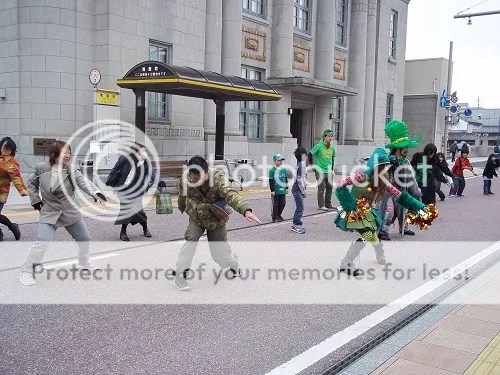
The final event (before everyone everyone packs up and heads inside for the pub for another six hours) was, as mentioned, the Ceili dancing, which the hula dancers graciously practiced in advance and lead us in. I think I picked it up a lot faster this year than I did last year!

To wrap this up, here’s one more photo of the rifle troop because they’re cool and they had a performance at the end of the parade as well. They practiced military drills according to how they would have been done in the Edo era, and by law, they only use antiques. I’m not sure how likely Lafcadio Hearn would have been to see this back in the Meiji era, but it’s a common sight around Matsue today, but they don’t usually have shamrock decorations on their attire.

I still have the step dance music stuck in my head. If you’ll excuse me, I think I need to go attempt some Ceili dancing all by myself.
March 14, 2014
Obousan Cafe: Chillin’ with the monks
Posted by Buri-chan under Local Anecdotes | Tags: Buddhism, Matsue |Leave a Comment

Chatty monks!
In my hometown, there was a cafe I only visited once but it left a deep impression because it is, as I understand, run by Orthodox monks. It provided a cozy meeting space and a library of books so as to contemplate wisdom with a freshly caffeinated mind. Not usually the kind of place you’d expect to run into monks, but at least in the US, if you’re interested you can usually find some way to chat with a religiously ordained person.
In Japan, however, many people are curious about Buddhism but do not feel they can just wander into a temple and start asking questions. Would they be bothering the monks with their curiosity? Would just a quick try at zazen meditation be okay instead of making a big commitment to it? Which sect of Buddhism would you even know to go to? What are the differences in what they believe in each temple? Typically these practical unknowns may keep people from going out of their way to find out, and they’ll just assume that funerals may be their only chances to see Buddhism in action. That’s where the emphasis is placed, right?
Not necessarily.
Across the country, it’s somewhat rare to have a chance just to chill out and casually talk with a Buddhist monk (which in some sects makes no differentiation between male and female) or drill them with low-level or high level questions about anything from their daily routine to what happens after we die. It’s even more rare to gather monks from different sects together in the same place for this kind of discussion.
Though the Izumo part of the San’in region places a lot of cultural emphasis on the Shinto side of things (and there are historical reasons for that), we still have our share of Buddhist temples and they still take over on spiritual sides of life experience that Shinto doesn’t typically cover. Recently, Matsue has started hosting Obousan Cafe, or “Monk Cafe.”
For now, it’s still being held in the Kiharu Cafe space in the Matsue History Museum, on Saturday nights when the museum is closed for the day and all has gone quiet on the surrounding historic streets that teem with tourists during the day. On the night I attended, many of the participants were from outside of Matsue. Before we started I made small talk with a few girls from Tottori, and at my discussion table later on there was even someone visiting from Yokohama who came to take part. We were joined by four monks who were happy to have the chance to meet with us.
The evening started at 8:00pm with some zazen (seated Zen meditation). I’ve seen some Buddhist texts in English translations and have made no sense of sutras as I’ve heard recited in Japanese, but there was no such detailed instruction of scripture. Instead, the monk from Housenji Temple instructed us in the Soutou Sect way of zazen: simply do it.

You start by bowing towards your sitting place, then towards the monk guiding you in meditation.

Learning the correct posture.
Usually, this very simple (and therefore difficult) form of meditation is done facing a wall, but instead we had the night view of the low-lit Izumo style Japanese garden I’ve always enjoyed seeing during the day from the cafe. With your glance towards the floor in front of you, however, you’re not supposed to get distracted by it. With no instruction on what to meditate on but simply instructed to breath so as to calm our hearts, the monk rang a chime to signal the start of meditation, and the room went silent.

…
……..
……………
When’s the last time you sat still in 15 minutes of silence?
Yeah, that’s what I thought. While I can’t say my mind was completely still (ha! far from it!), it was probably closer than I usually get in my day-to-day busy life. However, probably in large part due to my martial arts and tea ceremony practice, 15 minutes wasn’t too difficult for me to handle–I know that in the past it definitely would have made me more antsy. After the monk rang the chime again, we turned around to face him for a brief break. He acknowledged very calmly that it may have felt short to some people, but may have felt excruciating to those whose feet fell asleep (again, tea ceremony practice kicked in and I was okay!). Although discipline and regular zazen practice would allow people to be much more effective at calming their minds, there was no striving to “get better at it” or anything like that–once again, our goal was just to do it.
The second period of meditation only lasted 10 minutes in the interest of time constraints. I was feeling very calm, but a bit sleepy. Had I have closed my eyes I probably would nodded off! This is not the style of zazen in which the head priest whacks your shoulder with a paddle to rescue you from drowsiness.
Quietness felt like a special experience and even as I was thinking I can totally do this at home!, the monk leading us practically read my mind: “You might think you could do this at home, but it turns out to be much more difficult that you would think. You would need a lot of willpower, so it’s easier to train yourself in the right setting.”
Yeah… he’s probably right. Also, if you ask, it seems monks can very easily get you in touch with their zazen groups. I think having other people around also helped me stay focused–accountability, you know?
After this, the staff quickly arranged the tables and an array of local wagashi. Then the monks joined us at our different table groups and began serving us tea while introducing themselves, speaking in hushed tones and unhurried paces, though obviously excited to have a listening audience. I barely had a chance to think of some questions of my own since the Japanese participants in my group had already prepared a number of them and the monks were happy to elaborate at length, and I was content to simply listen for a while.

There were very interesting questions like, “are there ghosts, or do souls reincarnate right away? If that’s the case, then why do we celebrate O-bon or visit our family graves?” The details in the answers to such questions as this may differ from sect to sect and I don’t feel qualified to provide answers here seeing as I wasn’t taking notes, but the first monk I spoke with from Jiunji Temple of the Nichiren Sect, made sure to emphasize that it’s very much so for the sake of living people observing these customs as it would be for the spirits.
One thing he said that really stuck out to me was about the prayer beads. At least in Nichiren, the left hand represents the present world we live in and sin in, and the right hand represents the unseen world. The prayer beads are kept on the left hand as a seal on all the evils of the world, and when you put your palms together in prayer, this is signifying a meeting of the two worlds. Whether you keep the beads in your left hand while doing so or slip them over both hands varies by sect. The design of the beads also varies, and he pointed out that the long cords on his beads are used for handling objects that should not be handled directly.

Halfway through the talk session the monks rotated, though participants were free to move around to talk with whichever monk they wanted to. I finished the evening speaking with a higher-ranked male monk and lower ranked female monk from Junkouji Temple, which is of the Joudoshin Sect. (To organize these different sects in your head and learn more of the history, please see the flow-chart on this article by Mami on Tokugu.) We talked a bit about their prayer beads, too. While some are build differently for different genders based on the size of their hands and how they would customarily handle them, many other details are just according to personal preference. The higher-ranked monk simply liked his wooden beads, and the lower-ranked monk chose amber beads because they aren’t so cold to handle in winter.

I hadn’t asked much of anything yet, but for lack of any pressing theological questions, I asked what got them interested in the religious life. The lower-ranked monk was very excited to answer this question and tell her personal story of discussing the breadth of Buddhism as a lifestyle through asking questions during a few funerals in her family. As she prattled on passionately, she caught herself when she saw the upper-class monk smiling patiently.
“I’m sorry! I just got so excited to finally be able to answer something! I’ve gone on too long, why don’t you speak?”
“No, no, go right ahead!”
“Haha, I’m embarrassed to be overstepping my sempai!”
As she continued on her soap box, she started preaching along the same lines are the Nichiren monk. “People usually think Buddhism only has to do with death, funerals, and the after-life,” they had said. “Actually, the teachings are more for how you should live your life, as it will affect your after-life! I wish more people took the time to learn more about it in their daily lives, rather than wait until someone dies before they visit a temple or talk to a monk. That’s why I’m so glad to see everyone here asking questions–we’re happy to teach.”

There are tentative plans to continue another round of the meditation and talk sessions, and if possible they’d like to hold it in a temple to have more people take part, provided they can still have monks of different sects attend (there will probably be more info on the homepage or Facebook page). As it develops, the staff is very interested in how to work around the language barrier to welcome more foreign visitors so they can have a low-pressure experience like this with minimal time commitment. While discussion is definitely easier if you can follow the ebbs and flows of it in Japanese, I don’t think the zazen would be a problem for anyone. After all, you can learn the correct postures just be being observant even if you don’t understand the words being used, and after that, it’s not even about words–it’s just about being.
…being quiet, anyway.
March 11, 2014
Musical Evacuation Training
Posted by Buri-chan under Local Anecdotes | Tags: community |[12] Comments
So there we were enjoying the performance from the Shimane Prefectural Police Band when the lights started flashing and we heard a loud rumbling sound. Everyone ducked throughout the rows of the theater, covering their heads, waiting like that as we listened to announcements from the staff. “Please stay as you are as we await instructions,” a woman’s voice said, and we behind her we overheard another staff member calmly confirm information over the phone. It was relayed to us in an orderly fashion, stating the magnitude of the earthquake and whether or not there was a tsunami warning. Moments later, as instructed, we walked out of the theater and outside to the evacuation zone, and watched as the firefighters entered the building to assess the situation, and later wheel a victim out on a stretcher.
This was not a real disaster. Rather, it was one of many disaster preparedness drills and training sessions done throughout Japan, throughout the year. Of course, this time of year has everyone especially aware of earthquake and tsunami safety.

Shimanekko‘s here to assure you everything’s okay, but check out these public service announcements anyway, nya!
I have experienced only one real earthquake here in the San’in region, and an app on my phone (like most people have) woke me up and alerted me far enough in advance that I had plenty of time to prepare for the incoming jolt that was about a level 3 or 4 on the Japanese scale–it was only one big jolt, as the epicenter was pretty far away. I didn’t have much to prepare at that moment, though–I wasn’t sleeping where anything but the ceiling could fall on me, and should it have proven more serious, my emergency kit was ready and I knew where my nearest evacuation centers would be. Furthermore, I had a pretty good idea what to expect if I needed to stay in one of those centers for a while, or what some of the risks following a large earthquake would be. In the seconds before the earthquake struck I wasn’t terribly worried, since I’ve had so many opportunities to prepare and make a mental plan for what to do.
EDIT (March 14, 2014): Within 72 hours of posting this entry, I experienced my second earthquake in this region, which went much like the first–woken up by an early alarm system with plenty of spare time to prepare, and this time the level 3 tremor carried on a little longer. Still doing fine!
I can’t stress enough, in any place around the world with any potential list of disasters, how crucial it is to be prepared and to practice how to respond. I hope all of you reading this have emergency kits and known and practice what to do, so I’ll spare you the lecture (but if you feel guilty because you don’t, please do yourself and your community a favor by finding out).
One of the things I appreciate about living in Japan is how much training they offer the general public, and I pity anyone who hasn’t gotten to ride an earthquake simulator! When you know you’re not in any real danger, it can be a lot of fun. Likewise, attending an overnight evacuation training program, or attending a concert knowing that there will be a drill are both good ways to enjoy yourself a bit while keeping fresh on emergency responses.
Granted, when I first heard about the concert, I mistakenly thought it would be a concert of songs about how to protect yourself and make an orderly evacuation, like the kind of thing I think I remember hearing once or twice when I was a kid. Instead, the band was in marching band uniform and had a wide array of instruments to do covers of everything from Disney medleys to medleys of 1970’s artists I’ve never heard of. They incorporated dancers and baton twirlers, too. The evacuation was much earlier in the concert than I expected, but that meant we got to relax for the remainder of it. Having a captive audience, however, the conductor did take that opportunity to make a public service announcement about bank fraud, and the closing number included some friendly reminders about traffic safety. The conductor even joined in with pom-poms at the very end for this one!

The Matsue Young Warrior Troupe pledges to protect the elderly from traffic accidents.
After that, my group went on to a short lecture about general earthquake safety and preparedness, which, unlike the other presentations I’ve seen on this topic, included video from experiments done following the Kobe earthquake to illustration what happens in a magnitude 7 (Japanese scale) earthquake with unsecured furniture. Even with dummies the results were not pretty, and even though I am satisfied with my current level of earthquake prep it made me consider where I might be a little lazy with it.

A reminder of daily items that turn dangerous in an earthquake.

Some items you should consider for your getaway bag.

This handbook is one of only many resources the prefecture has in place for foreign residents, and I imagine most prefectures have their own versions. The most recent new thing I’ve heard about is a phone bank system you can register for to receive and leave messages about your wellbeing following a disaster, and I think the system is multilingual.

Interpreters and emergency volunteers also keep up on their training and the community finds ways to help each other out, but you are your biggest and most immediate help in an emergency.
Finally, we wrapped up with some emergency food, which is specially produced to last for a long time and be prepared very simply. I’ve had various types, but this was my first time to try emergency oden, a dish of different vitamin and protein-filled Japanese style food items in a clear broth. It stays good for five years, and is prepared simply by sitting in boiling water for five minutes. I’ve never made oden myself, but I’ll make you a bet it tasted better than any attempt I could make.

I anticipate a moment of silence again at work today at 2:46pm.
I hope that all of you, dear readers, will acknowledge the third anniversary of the 2011 Tohoku earthquake and tsunami by practicing what to do in an emergency and making sure the items in your emergency kit are up to date.
March 8, 2014
Kunibiki: Pulling the legend on today
Posted by Buri-chan under Historical Anecdotes, Local Anecdotes, Mythology | Tags: en-musubi, ichibata, Izumo Fudoki, kunibiki, shimane, Yatsuka |[3] Comments
In the previous entry, we addressed the historical origins of the Kunibiki (land-pulling) legend. Now to take a look at why it’s hard to come to the San’in region and not learn a little about this legend.
First of all, there is art like this everywhere:

Click for source
More curiously, this painting at Yakumotatsu Fudoki-no-Oka has a number of people/gods pulling the land. Ah, don’t mind me pretending to be Susano-o here. I have a weakness for dress-up and you can do that for free in the museum lobby. We’ll bring up Fudoki-no-Oka again in a few paragraphs.

There is art both inside the Ichibata Railway between Matsue Shinjiko Onsen and Izumo Taisha and along the stations, including one I saw on the ceiling of one of the little local trains with Yatsuka saying his catchphrase, “Kuni, ko! Kuni, ko!” This is literally “land/country, come!”

Yumeminato Tower in Sakaiminato, on the tip of the island/peninsula one of Yatsuka’s ropes turned into, provides a view of the mythologically added-on land, and labels for everything you’d be looking at from the observation deck. Unfortunately, I visited just as it started raining that afternoon, and right after getting one shot you couldn’t see very far. Thankfully there is plenty to do inside the tower, my personal favorite spot being dedicated to the history of early contact with not only Korea, but others throughout the Asian continent. It’s too bad I didn’t take anyone to dress up with me in so many ethnic costumes that day!
Click for source

On a good day, you should be able to see 360 degrees worth of sea and land.
While the story of Kunibiki is not included in the Kojiki, Yatsuka’s is listed among godly genealogy there (though this, like many elements of the Kojiki, if up to interpretation). Just as much a kami as any of the other eight million gods that populate Japan, he is enshrined at Nagahama Shrine along the coast of coast of Izumo, at the western end of the peninsula. Although sacred ropes are common in Shinto practice throughout Japan, this god’s use of ropes makes them a common theme at this shrine on their good luck charms. You know what else ropes can be used for? En-Musubi. Just one more way in which the San’in region finds ways to bind your fate.

Click for source

Click for source

Click for source
Also in Izumo City, there is a Kunibiki Marathon, the 33rd of which was held last month.
Over here in modern-day central Matsue, the very word “Kunibiki” is a common part of life. Kunibiki-doro is a major street leading north from JR Matsue Station, and Kunibiki Bridge is the easternmost of a series of four bridges that link the northern city center to the southern city center over the Ohashi River. Does singer/song-writer Mai Hoshimura ring any bells for anyone? Her song “Kunibiki Ohashi” is named after this very bridge! The music video also makes generous use of footage from the Ichibata Railway and other scenes of Matsue:
Furthermore, Kunibiki Messe is Shimane’s largest full-scale convention and exhibition center, located just across the Kunibiki Bridge from Matsue Station.

Click for source (and other nifty photos of a nifty building)
But this legend has had influence on naming conventions long before that. Way back when this legend was being recorded in the Izumo-no-Kuni-Fudoki, and for a few centuries surrounded that, the governmental affairs of the region were handled from a district in what is now southern Matsue. This district was known as… Ou!
Yes, that “Ou” which Yatsuka shouted when he declared his work a job well done. Not only does the interpretation of the utterance vary slightly, but the spelling varies as well, and is further complicated by how it was written then and how it was written later on and how it’s even written differently now.
Are you ready for some language nerdiness now? His shout, whatever it expressed, was recorded with the characters 意恵 for the sounds as opposed to their meanings. Phonetically, they were later expressed as おゑ, which may look strange to the hiragana-inclined readers among you. This is because we no longer use the character ゑ (ye) in Japanese syllabary. It’s usually replaced by え (e, like eh) now, which is why the lucky god (and San’in native) Ebisu is usually called えびす, but depending on what beer you’re drinking you might still see ゑびす from time to time. However, in this case, “Oye” (oh-yeh, not oi!) was not usually transcribed as “Oe” but as “Ou” (like oh, not oo) or… “Iu”?
Now we need to get back to the use of characters used for pronunciation, though when it comes to place names, you’ll find the general rules of standard pronunciation for Chinese characters mashed around to fit the Japanese language are not always followed. For our purposes here, it’s not worth trying to make sense of. Let’s just accept that although Yatsuka may have shouted 意恵, the area named after his shout was recorded as 意宇. Although in some place names it would still be read “Ou” in keeping with the desired pronunciation cast upon these unsuspecting characters stripped of their meaning in favor of phonetics, the more common sense reading for them is “iu” (ee-oo).
Still following? Good! Because you find both “Ou” and “Iu” throughout the region. While the district of Ou has been parsed out and reorganized into other little neighborhoods that retain many names passed down from the Izumo-no-Kuni-Fudoki, when the area is called “Ou” you’re usually referring to the ancient government center and its ruins and the historic shrines found throughout that area. The aforementioned Fudoki-no-Oka is the best place to go to learn about this, though so far I haven’t visited the indoor exhibits because I was running out of time the day I have visited (having spent too much time that day at the neighboring shrines and folklore village, Izumo Kanbe-no-Sato). On the eastern stretches of good old Ou, there is the Iu River flowing down from Lake Nakaumi.

But what of that forest, made from Yatsuka’s rake?
Well, it’s not so much of a forest anymore as it is a grove of trees, but…

Click for source
This is the main spot everyone is referring to as Ou-no-Mori (“The Forest of Ou”, written with an old character for forest: 意宇の杜), and has a few different kinds of trees. However, perhaps this is isn’t the only spot left over from the rake-forest.

Click for source
Because the legend involves various look-out spots and geographical features throughout the region, you’ll find the word “Kunibiki” everywhere from Mt. Daisen to Mt. Sanbe. Now just think of how smart and cultured you’re going to look when you visit the region with your friends and tell them the myth behind the word they keep seeing? What with all the historical, geographical, and linguistic tidbits packed into these two entries, you can also look like a know-it-all and drive everyone crazy. Have fun!

 San'in Monogatari