This is a post a hike to Iwami Ginzan, the UNESCO World Heritage Silver Mines. Truth be told, we were already there–the silver mines stretch throughout the area and were in active use and points of contention between the warring Mori and Amago clans and otherwise, and they were so influential on the economy of the region that 16th century missionaries made sure to note it in their reports and it was included in early Western maps of Japan. At their peak, they accounted for 1/3 of the world’s silver production.


Recall Kotogahama and the Nima Sand Museum.

Sounds very cool, expect that most of the tunnels are out of sight what you can see is better seen in person, and seeing as photography is prohibited in the highly informative museum, I’m left primarily with photos from the hike. It was November, the leaves were changing, and the weather was perfect. Although most of the forest looked green, the red/orange/yellow trees stood out against the backdrop–trees or rocks–and looked especially bright in the sunlight.


There were a few restaurants offering locals the usual cafe items and local specialties, as well a few gift shops I haven’t run into elsewhere. For instance, a silver shop full of jewelry and other items, as well as a little shop specializing in fragrance pouches–priding itself on being the one place in all of Japan that sells metal-scented potpourri pouches.

Of course, this being the inaka, there was lots of inaka character to be found, from persimmons floating in the streams to… well… tanuki.

I’ll introduce my favorite of the little places in the next entry.

Continued from Part 10


Recall how the White Hare served as matchmaker for these two.


This son would wind up being named after “a fork in a tree,” Ki-no-mata-no-kami.

For as long as this story was, there are surprisingly few places to introduce associated with it–but places exist nearby nonetheless! After all, Shinto shrines can be associated with very surprising things.

I’m planning on some more short stories, especially with material from the Izumo Fudoki, to intersperse with the following Kojiki stories. Okuninushi will continue to be a main character–after all, being the lord of the land has a way of propelling one into main character status in many legends.

Learn about the sites associated with this legend!
Akaiwa Shrine, Shimizui, and Ishinomiya Shrine
Oiwami Shrine, Tono Shrine, and Mii Shrine
Yunokawa Onsen
And good old Yomotsu Hirasaka, the entrance to Yomi

Or start reading the next story!
The short story of a lovestruck (and stuck) Crocasharkagator
(Or you can continue following Okuninushi’s adventures)

Or see the Kojiki a.t.b.b. masterlist!
The Kojiki Myths in Manga Form

Many people across Japan are familiar with the basics of the tennyo (heavenly maiden) legend, and there are a lot of fun ways to read into it, and compare or combine it with the legend of the star-crossed lovers–including another heavenly maiden–who meet on Tanabata. Although commercially celebrated on July 7, the celestial activity it actually celebrates was on August 2 this year. Next year (2015), it will be on August 20.

This particular version of a well-known legend takes place in Kurayoshi, Tottori Prefecture. The kids of Kurayoshi still keep the associated drum and flute traditional alive, as you can see on their blog.
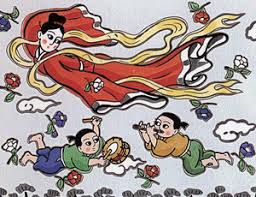
Click for source

A very, very long time ago, in the land of Hoki, a young woodcutter was going about his usual work when he discovered something hanging on a boulder which he had never seen before. It was a beautiful, pure white and transparent folded cloth. Something like this must belong to a heavenly maiden, he thought, and then took the garment home.

That evening, as he was eating dinner, there was a knock at the door. There, he found a frantic but very beautiful maiden. “I cannot return home. Please allow me to stay,” she said sorrowfully.

“Not to worry, come on in.”

The maiden went on to explain, “I am a heavenly maiden. The gods sent me on an errand to the land of Izumo, and on the way back I stopped to bathe. I lost my heavenly robes,” her voice began to waver as she succumbed to tears, “Now I can never return to the heavens.”

Upon hearing this, the young woodcutter decided to hide the robes and never tell her that he stole them.

The heavenly maiden remained at his house, and at some point she became his bride. She gave birth to two sons, and when they grew older, she taught them to play the drums and flute*, and the sounds reminded her of her time in the heavens.

The years passed, and one summer night her sons went out to the mountain to gather bamboo for Tanabata decorations. In light of the holiday, she decided to prepare a feast, and starting pulling out all of the dishes she would need from the cupboard. While searching for some misplaced dishes, she discovered a dark corner of the cupboard where there was a wrapped package.

Finding it curious, she opened it and was shocked. “Why, it’s my heavenly robes!”

Nostalgic over seeing her garment again, she immediately put it on, and her body became light and fluttered off the ground, lightly rising toward the sky.

Her sons returned from gathered bamboo and noticed her up above them. “Ma!” they shouted. “Where are you going? Ma!!”

They called and called, but her form grew further and further away and then disappeared from sight, and she never returned to them.

Since then, it has been said that you can hear the sound of drums and flutes coming from the mountain. This is the voice of the two children calling out to their mother in the heavens. At some point, they started calling the mountain Utsubukiyama* because of this. How pitiful! Even today, you can sometimes hear the sounds of the drums and flutes riding on the wind.

Click for source

*The name “Utsubukiyama” can be broken down as follows:
The verb for beating a drum is 打つ (utsu)
The verb for blowing a flute is 吹き (fuki)
The word for mountain is 山 (yama)
Utsubukiyama: 打吹山

The title is a bit of a mouthful, but the festival itself is quite refreshing–especially considering the free use of onsen facilities although the Matsue Shinjiko Onsen area on the northeast banks of Lake Shinji! The line of ryokan and other facilities all have views facing the lake along the boardwalk.


The onsen are only open for a few hours in the middle of the day, but the festival really picks up in the evening. The purpose of the festival is to give thanks for having the springs in the first place. There is a statue of Jizo, the merciful Buddha often thought of as a patron of children. This is the Oyukake Jizo whereas “oyukake” means that you pour hot water on it, and thus your wishes are granted.

Oyukake Jizo on a sunny day


Oyukake Jizo on a rainy festival night

In addition to the usual street of food and game stalls (as well as toy sales and free sake tastings and what not), there were stage events set up near the line to offer incense and pour water on the Oyukake Jizo. It started raining partway through, but no one seems to mind–umbrellas or not, the crowds didn’t decrease at all.


This festival began in 1974, and it has since become a classic sign of late summer around this onsen area. Besides games and food stalls and stage events and people in yukata everywhere, one of the main draws is cooling off by the lake and watching the fireworks.

The early people waiting for fireworks while the lake is still quiet… I didn’t attempt to take any photos of fireworks this year, but you could always see my Suigosai entry from last year.

Now as for fireworks, I’m afraid they can’t compare to the display put on during Suigosai, the focal point of the summer. This event was supposed to be held August 9~10, but due to a typhoon, it has been postponed until August 30. Usually they fire 3000 fireworks over the course of half an hour on the first night and 6000 fireworks over the course of an hour the following night, but due to this schedule adjustment, they’ll be firing all 9000 of them from 8pm until 9pm!

Everyone, if you can make it to Matsue this weekend, try to find a spot early before everything fills up with people!

And don’t forget, the best Suigosai viewing spots are also around the Matsue Shinjiko Onsen area, and the Ichibata Railway will even be allowing people to view it from a special train car. Well, they’re probably best only next to the view from Matsue Castle, but people had to win a raffle of sorts to get acess to the tower at that hour. Anyway, before or after the fireworks, there is a free foot onsen outside the Ichibata Railway station and the Shijimi Clam Center. The one outside the station has a second Oyukake Jizo to pour hot water on.


Although I have the opportunity to admire and savor them on a near weekly basis in my tea ceremony lessons and normal rounds around town, I’ve had the pleasure of handcrafting wagashi (traditional Japanese confectioneries) a couple times here in Matsue, a city famous for this craft since the Edo era (we’ve got Lord Fumai to thank for that, of course). These classrooms are not hard to get in on–Aoto-sensei, from Saiundo, teaches a class regularly at Karakoro Art Studio. This is one of the most popular classes offered there on a near-daily basis. The themes of the sweets change every month to match the seasons, but you can usually expert to learn to make two sweets with two basic techniques (and receive a third prepared by the masters). There is a short video of the classroom experience here.

Although you wouldn’t typically make them there yourself, one of my other favorite places to watch the craft in action is at Kissa Kiharu, the cafe inside the Matsue History Museum. Itami-sensei is legendary!

He’s making a fig themed wagashi in this video, as figs are big around here. I’m having trouble finding pictures that do justice to his Izumo Nankin (a local variety of goldfish). My humble wagashi cannot compare, oh sob! I just have to drown my artistic inadequacies in more sweets, though this is a comparatively healthy way to indulge.

Not a handcrafted Matsue wagashi, but a Matsue craft based on a handcrafted wagashi

Not a handcrafted Matsue wagashi, but a Matsue craft based on a handcrafted wagashi. That said, this is the first wagashi I ever crafted, with more photos of the process and results here.


sakura2

With the exception of the middle one, all of these were crafted and consumed by Yours Truly.

While walking home one day, I noticed a big white moth lying on the pavement. I think moths are pretty, so I stopped to observe it. Almost immediately, it started running towards my shoe and hopped on.

My shoe is not a flower, little friend!

I can’t imagine what the people in the cars driving by must have thought of the American stopping to take a picture of her shoe. I tried to shake it off, but it wouldn’t budge, so I tried to burshed it off with my hand, and then it started crawling on my hand. With much coaxing, I got it to hang on to a willow branch instead. Though I wouldn’t take it home with me or anything, it was fun to get a good look at it.

I notice a lot of different white moths the region, and instead of having a destination, many of them just seem to hang in the air. There is nothing like coming across a grove of sunlit blue hydrangea in the forest and seeing the air flicker with white moths. The frustrating thing is that it’s the kind of exchanting moment that isn’t captured very well by photography!

Uh… no, not sure how the car got there… following the exchanted moths, maybe?

Other times they are more blended in the surroundings, and only in enjoying those surroundings do you notice them. For example, this white moth, as well as a slightly smaller one in a different shape, were both chilling out on this flight of sunspotted shrine steps.


Other times they’re much more noticeable among their surroundings.

Am I strange for enjoying the moths so much? There are also plenty of butterflies of different colors and sizes, and many of the big black ones remind me of lace. I also enjoy spotting lizards–and once even a little frog!–on the steps up to my apartment and around the outside walls. To try to tie this entry together a bit instead of just posting every animal encouter that lasted long enough get a photo, I have just a couple more white animal favorites from here in Matsue.

This isn’t the only migratory swan I’ve seen–Lake Shinji is a favorite spot for them, and sometimes you see crowds of them (though I was never close enough to get a picture). I haven’t seen them much around the shores with more human activity, though, so it was a surprise one day while I was eating lunch by the northeast boardwalk and it calmly and silently paddled by, against the waves.

This other encounter was while walking through Kyomise, a charming little shopping district in Matsue south of the castle.

I had never noticed cats in that store before, but then again, the doors are usually open–perhaps they only prowl when the shop is closed!

Continued from Part 9

Yes, this setting should look familiar.


Continued in Part 11

Thanks to a shared connection through writer Lafcadio Hearn, water cities Matsue and New Orleans began a Friendship City Relationship in March, 1994. To celebrate the 20th anniversary, a delegation and ceremony was held here in Matsue last October, followed by Little Mardi Gras in Matsue, which is what it sounds like. This event–with a special focus on including children in the local community–takes place in October, so you can get your Mardi Gras fix in Japan between Carnival seasons.

I am busy right now with a group from Matsue on an exchange program in New Orleans thanks to the Japan Society of New Orleans and a TOMODACHI Exchange grant from the TOMODACHI Initiative. Click here and here to see the play-by-play on that exchange on Facebook, and in the meantime on this blog, enjoy a few photos from last year’s Little Mardi Gras in Matsue!


The school bands and bands throughout the community, in addition to their impressive performance in the parade, also played at Karakoro Square, Karakoro Art Studio, and a little further north towards the Shimance Civic Center. The music lingered through the streets hours after the parade had ended.

Regular entries will resume shortly!

Thanks to a shared connection through writer Lafcadio Hearn, water cities Matsue and New Orleans began a Friendship City Relationship in March, 1994. To celebrate the 20th anniversary, a delegation and ceremony was held here in Matsue last October, followed by Little Mardi Gras in Matsue, which is what it sounds like. This event–with a special focus on including children in the local community–takes place in October, so you can get your Mardi Gras fix in Japan between Carnival seasons.

I am busy right now with a group from Matsue on an exchange program in New Orleans thanks to the Japan Society of New Orleans and a TOMODACHI Exchange grant from the TOMODACHI Initiative. Click here and here to see the play-by-play on that exchange on Facebook, and in the meantime on this blog, enjoy a few photos from last year’s Little Mardi Gras in Matsue!

Music has no borders, but jazz has a special way of bringing people together across across linguistic borders. With no advance preparation togther, Sasha’s band and the Khacha Band were able to seemlessly start performing New Orleans’ classic together as if they had always performed together.

Thanks to a shared connection through writer Lafcadio Hearn, water cities Matsue and New Orleans began a Friendship City Relationship in March, 1994. To celebrate the 20th anniversary, a delegation and ceremony was held here in Matsue last October, followed by Little Mardi Gras in Matsue, which is what it sounds like. This event–with a special focus on including children in the local community–takes place in October, so you can get your Mardi Gras fix in Japan between Carnival seasons.

I am busy right now with a group from Matsue on an exchange program in New Orleans thanks to the Japan Society of New Orleans and a TOMODACHI Exchange grant from the TOMODACHI Initiative. Click here and here to see the play-by-play on that exchange on Facebook, and in the meantime on this blog, enjoy a few photos from last year’s Little Mardi Gras in Matsue!

In celebration of the 20th Anniversary of the Friendship City ties, Sasha Masakowski and her quartet visited to perform at the anniversary ceremony and for Little Mardi Gras in Matsue.

Design a site like this with WordPress.com
Get started