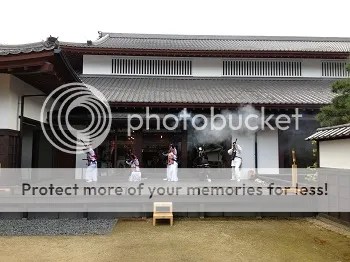
Note the Yamabushi (mountain warrior) with deer horns, as well as the gender balance.

A perfectly nice Sunday in Matsue, and not unusually, there are warriors walking about the castle area. Also, stopping into Kiharu in the history museum for some tea and wagashi is just as pleasant as usual.

Around this time in spring, purple is in season. In addition to irises along the castle moats throughout the city, western Japan is also covered in blooming wisteria. I had always imagined them only being vines covering archways in gardens, but I’ve been pleasantly surprised to see they grow as tall as cottonwoods in the wild.


You might be surprised to have your tea and inspired confection experience interrupted by the sounds of gunfire. Gunfire in Japan!? Nothing to take cover from, it’s just the Teppo-dan, Matsue’s rifle group that practices rifle use according to how it was practiced in the Edo era. They perform demonstrations at special events throughout the year, but you can also catch them for free at the history museum courtyard.

Seeing as this is was simply one part of martial arts training for the samurai class, the group is armed with not only rifles (gunpowder only), but also swords. Sessions begin with a little sword practice.


After that, they move into displaying a few different gunfire formations.


This formation is called “Chidori-uchi”, which could be interpreted as either being arranged like a plover in flight, or shooting plovers. Either way, it seems fitting for Matsue since Matsue Castle is nicknamed Chidori-jo (Plover Castle) for it’s wing-like shachihoko (decorative fish) at the top of the roof, the largest in Japan.

The length of the performances may be weather dependant, but they typically perform at 10:00am and 2:00pm on the third Sunday of every month. According to one of the group members, this may also be one of the only places in Japan with all-female groups putting on displays sometimes, too. They practice elsewhere outside of the city center, and if anyone who lives here is interested enough, I’m sure they’d be excited to bring on beginners.




Continued from Part 7


I see what you referenced there, Susano-o.


The link is here, for good measure.


Like the story of Izanagi and Izanami little romp in Yomi, you can visit many places associated with this legend in real life.

Learn about the sites associated with this legend!
Water: How the Hii River inspired the beast
Sake: The potent brew that defeated it
Shrines: For happily ever after

Or start reading the next story!
The White (or hairless?) Hare of Inaba
(But you can also skip ahead to Susano-o’s next appearance)

Or see the Kojiki a.t.b.b. masterlist!
The Kojiki Myths in Manga Form

Another flower post as promised!

Yuushien is one of the most famous gardens in the San’in region (though the most famous would have to be the one at the Adachi Museum of Art located in nearby Yasugi). It is a Japanese-style garden for all seasons; a quiet space to listen to the sounds of the waterfalls, observe the seasonal trees and flowers, feed the fish, and collect your thoughts. That is, unless you go during Golden Week.


It’s not by simple coincidence that iris (aka “sweet flag”) season lines up with Golden Week. Read more on Fumiyaen‘s insightful blog.

Yuushien is located on Daikonshima (otherwise known as the Yatsuka district of Matsue), a island on Nakaumi, a brackish lake between Shimane and Tottori. It used to be a town of its own, and there is a unique dialect spoken only on that island with some influence from the surrounding Mihonoseki Peninsula, Sakaiminato, and general Izumo dialect. It was formed from volcanic rock and you can explore underground lava trails, and those familiar with Japanese cuisine will probably notice that it literally means “giant radish island” (大根島). While I’m sure they probably grow somewhere around there, the island is not actually known for daikon radishes.

Rather, the island was recorded in the 8th century Chronicles of Ancient Izumo as “octopus island” (’takoshima’ たこ島)(though this probably had more to do with someone bringing an octopus to the island than there actually being octopus in Nakaumi–squid are more popular around here!). It was given somewhat similar sounding kanji at some point (‘takushima’ 太根島), which gradually morphed into some similar kanji based on an alternate pronunciation of the aforementioned kanji (‘taikushima’ 大根島), and this was eventually misread as the pronunciation that is currently used today (‘daikonshima’ 大根島).

On of the other theories about the name origin is that it had some ties to what the island of volcanic soil is known for: ginseng! This was traded with Korea and other places back in the Edo era when Izumo province was in financial straits, and is still prized today (and easy to get your hands on).

But this post is not about ginseng, it is about flowers. The other thing Daikonshima is famous for is its peonies (‘botan’, ). The prefectural flower of Shimane, thousands upon thousands of them bloom all over the island, and they are highly prized by peony lovers all around the world. Yuushien is but a central location to see some 180 varieties in a single place, including many varieties that were cultivated on the island. There are always some kind of variety blooming on Yuushien, even in winter when the blooms are protected from the snow by little straw huts. For a few days during Golden Week, however, the pond is filled with over 30,000 blossoms. That’s only a fraction of all the blossoms within the garden at that time, much less within the entire island! As soon as you step into the garden, you might even notice the fragrance before the actual sight. Kudos to anyone who knows what I mean when I say I half-expected to meet Liu Mengmei! Peonies originally came to Japan from China, they just thrived and developed extremely well on this island. As it turns out, there is a Chinese style garden elsewhere on Daikonshima.


Besides vendors selling their own cultivated peonies all over the island during the Peony Festival, there is also an exhibition during this particular period of time, and you can use your garden admission ticket to vote for your favorite cleverly titled variety on display (by the way, foreign visitors get half-off admission to the garden all year round for only 300 yen).

“Old Mountain Lady”, but I wonder which one?

Without further ado, how about we just move on to a sampling of pictures?

Striped varieties were originally cultivated on Daikonshima.


Peonies are huge. Many blossoms seemed to be about the size of my head.


Yellow varieties are not as common, but there were plenty to be seen anyway.


Just the normal trek to work…

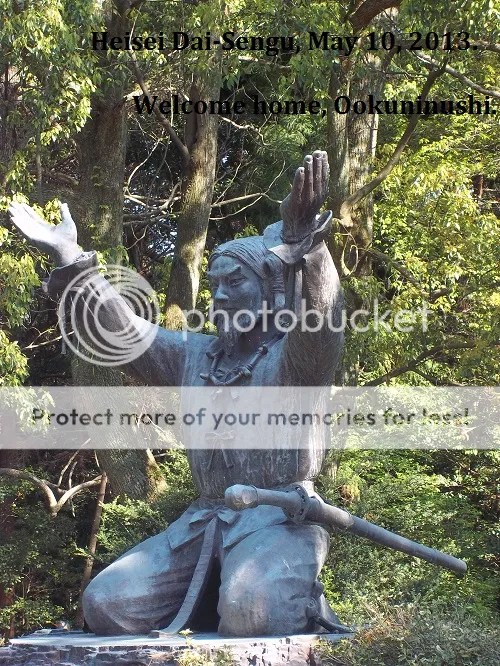
Izumo Taisha, the 2nd most important Shinto Shrine in Japan, undergoes Sengu–a complete reconstruction–every sixty years. What with Shinto’s emphasis on purity, the thought is to refresh the whole shrine after every complete cycle, primarily focusing this renewal on the honden, or primary hall of the shrine where the deity resides. The deity in this case is Ookuninushi–a key figure in the Kojiki who I haven’t started writing about quite yet!–and the honden in question is a national treasure of Japan. Like Kamosu Shrine (also a national treasure), it’s a primary example of taisha-tsukuri style shrine architecture.

Imposing as the shrine might already be today, traditionally it is thought to be even more imposing–about 48 meters imposing–in its previous incarnations. There wasn’t actually much evidence for this until 3-meter-wide pillars were discovered in 2000, and since then they’ve been displayed in the nearby Shimane Museum of Ancient Izumo, along with models of what the shrine might used to have looked like until its downsizing in the Kamakura era and the previous posts used at the top of the shrine before this round of reconstruction.


There was a lot more wood in that previous version than just these posts, so since reconstruction started in 2008, they’ve been using little pieces of the wood in their o-mamori (good luck charms or emulets). Parts of the old wood are still on display next to where you can purchase these charms.

In addition to being the home of one of the most prominent kami of the kojiki legends, Izumo Taisha is also the spot where all the kami congregate for their annual meeting in the 10th month of the old agricultural calendar. While this is known in the rest of Japan as Kannazuki (the month without gods), in the Izumo region is is called Kamiarizuki (the month with gods). Read a little more about that here.

Hotels fit for the gods!

And what are they all discussing at this meeting? En-musubi! Despite it’s significance in wider Shinto application, Izumo Taisha is a shrine just like any other. In addition to shrine activities like drawing your omikuji fortune slip, you can also purchase an ema, a board with illustrations usually unique to each shrine, on which you would write your petition and leave it hanging at the shrine. Because of Izumo Taisha’s reputation for love, matchmaking, and happy marriages, many of them have petitions like “that I get married within three years and attain happiness” or “that I meet an amazing girl and live happily ever after with her,” or “that I may–no, that I will definitely–start attracting men’s attention!!” I’ve also seen some hung by couples thanking the gods for answering previous matchmaking requests, or ones hung side by side from couples declaring their love for each other and how they want to be the best spouses ever.

While Izumo Taisha is a major spot for almost any visitor to the San’in region, you might that retains a rather quiet atmosphere when it’s in the off season, even though it has a tent with semi-regular Kagura and Kabuki performances. On my first visit there, I could to see everything as an easy place, from the pine tree walkway to the building surrounding the honden to the kagura-den, the traditional performance hall for Kagura dance. This building has the largest shimenawa (sacred rope) of any shrine in Japan. The straw itself already weighs five tons, but it gets even heavily with everyone tossing coins in the rope for good luck–technically you’re not supposed to do this, but tradition is hard to stop!


Then came Golden Week–the on-season for tourism everywhere in Japan. This year it took place one week before the Sengu ceremony, so technically Ookuninushi does not yet inhabit the fresh, new honden! None the less, many people were lined up to make their offerings in front of it, anyway.


There’s the honden! Good to see construction is finally done!


I can only imagine how packed its going to be tonight when they move Ookuninushi back in! While theoretically anyone could walk up and attend, the only people who will actually be able to see anything have been invited or made their reservations well in advance. That said, the celebration of the Sengu’s completion will go on for the next few weeks a very, very long list of performances, most notably Kagura dances from Izumo, Iwami, the Oki islands, and beyond, and guest performers of a range of other traditional, folk, and modern Japanese performing arts. Pretty much all but one or two of these performances is free and open to the public, so if you happen to be in Izumo sometime between now and June 8, chances are there will be something going on in the covered stage area next to the pine walkway. More information here.

True cherry blossoms season–when the air is filled with thousands and thousands of soft white petals–may be considered over, but other varieties kept on blooming for weeks thereafter. Here is another handful, though still a mere sample of the wide varieties just planted here around Matsue–and probably the last ones I’ll be posting about for this year! After all, I’m so late with this final post that we’ve run clear into other flower seasons (new flowers coming soon, I promise). These ones are all from Suetsugu Park, like the last bunch I introduced.

“Surugadai-nioi”


“Ichihara Tora-no-O” (Ichihara Tiger’s Tail)


“Itokukuri”, similar to the Fukurokuju below.


“Fukurokuju”, named after the Lucky God of Happiness, Wealth and Long Life (see below).


“Gyoikou” or “Gioiko”, the most unique variety I’ve seen. They are a pale green, and their pink stripes appear as they mature. They have some fragrance, too!

This is a similar story from Chizu, Yazu County, in Tottori Prefecture.

A long time ago, there was an old man and an old lady who struggled through a very meager life. Seeing as they could hardly even feed themselves, the old man tried picking flowers to sell, but no matter how many he picked, no one would buy them. At the end of the day, he’d always go to the Chizu bridge. There, he’d say, “I offer these to Otohime, the Princess of the Dragon Palace under the sea” and then ceremoniously chuck the flowers into the river before going home.

Every day it was the same thing. He told his wife, “Hey, Old Lady, I’m goin’ out to try to sell flowers again,” and when he couldn’t sell any, he’d drop them in the river, saying, “I offer these to Otohime, the Princess of the Dragon Palace under the sea.” It looked like they would float on forever, but one day they flowers sunk instead. Upon returning home, he told his wife, “I haven’t been able t’ sell a single flower. Aw, well, I guess I’ll just keep offerin’ ’em to the Princess of the Dragon Palace.”

Suddenly, there was a knock at the door. A beautiful, young girl with eyes full of sympathy had come to pay a visit, holding the flowers. “Today, the lovely flowers you tried to send to the Dragon Palace wound up at my doorstep instead. I’d like to thank you very much for them. I told the Dragon King about you, and he said to bring you along to pay a visit to the Dragon Palace. Would you like me to take you?”

“Me? Go t’ the Dragon Palace? Well, I guess I’m not doin’ anything else,” he replied, and agreed to go along. She brought him to the ocean’s edge, where a giant turtle was waiting. She instructed him to ride on the turtle’s back, and the turtle told him to close his eyes. Just as soon as he did so, they had arrived at the Dragon Palace.

Upon entering the palace, he saw feasts prepared in every room, and he was treated to the finest of hospitality. The old man was quite enjoying himself, when the young girl whispered to him, “When Miss Otohime asks what she should give you, you should reply, ‘I don’t want anything, just a little boy with a runny nose will do.'”

Almost immediately afterward, Otohime said, “Now, what shall I bestoy on you as a parting gift?”

It seems the old man did indeed reply, “Ahh, I don’t really want anything, just a lil’ boy with a runny nose will do.”

“Very well,” replied Otohime. “That is what I shall give you.”

And that she did. He was a filthy little ragamuffin with a horrid runny nose, but the old man brought him home anyway. When they said to him, “Hey, Runny-Nose Boy, we got no more rice,” the boy made infinite amounts of rice appear. “How ’bout sake? Got any sake?” they’d ask, and he’d give them sake. Whatever they asked him for, he provided. When they said, “We want money!” the floor was covered in piles of gold coins.

Little by little, their lot in life improved and they lived quite comfortably. Their little old hut of a home could no longer suit them, so they told the boy they wanted a fancy dwelling place. Once that appeared, they even had use for servants, which the boy with the runny nose also provided. This was how they spent their days.

While this was all well and good, wherever the increasingly selfish old couple went, the boy with the runny nose was right at their side, and his presence was downright irritating. “What are people gonna think of us if we always have that nasty little brat around?” asked the old lady. They tried asking him to hold his runny nose shut, or at least to wipe his face, but it was no use.

At last, they said, “Just go away somewhere!”

“Alright, I’ll go away somewhere,” the boy with the runny nose replied, and he left.

Everything they had received from the boy rapidly disappeared–the rice, the sake, the money, even their fancy house turned back into an old hut.

It suited them perfectly.

Twice a year, Japan does a nationwide traffic safety campaign. As part of the campaign in Matsue, the police bring in guests to help pass out information pamphlets and reminders to motorists. Maybe we aren’t as exciting as the Susanoo Magic basketball team that was brought in before, but we at least turn a few heads (Mikopi-kun helped with that).


We were told afterward that it was a very lucky day–the weather held out and the wind died down long enough for everything to do the roadside campaign, and there wasn’t a single traffic accident reported the whole day.

May this entry serve as a reminder to everyone, both in and outside of Japan: Obey traffic laws, don’t drive too fast, and always remember to buckle your safety belt!!

Continued from Part 6


Recall that Susano-o was banished for picking on his older sister, the sun goddess.
Continued in Part 8 (the conclusion!)

Cettia diphone, the Japanese Bush Warbler (or Japanese nightingale), known here as 鶯 uguisu).

While they are typically associated with the coming of spring and have many poetic names to that effect*, I first noticed these little birds while I was taking a winter walk around Matsue Castle and saw a few of them playing in the bare, snow-laden bushes. At the time, they weren’t making their signature “Hō-hoke-kyo” chirp**, but I did enjoy their twinkling voices. Cute as they were, they were a little too fast for me to take a picture of.

Now that it’s spring, however, I’ve been asked a few times: “Have you heard the uguisu yet? They sing hō-hoke-kyo.”

Yes, and I’ve seen them plenty, too!

Here’s what Lafcadio Hearn had to say about them in his essay, “In a Japanese Garden“:

Wild uguisu also frequently sweeten my summer with their song, and sometimes come very near the house, being attracted, apparently, by the chant of my caged pet. The uguisu is very common in this province. It haunts all the woods and the sacred groves in the neighborhood of the city, and I never made a journey in Izumo during the warm season without hearing its note from some shadowy place. But there are uguisu and uguisu. There are uguisu to be had for one or two yen, but the finely trained, cage-bred singer may command not less than a hundred.

It was at a little village temple that I first heard one curious belief about this delicate creature. In Japan, the coffin in which a corpse is borne to burial is totally unlike an Occidental coffin. It is a surprisingly small square box, wherein the dead is placed in a sitting posture. How any adult corpse can be put into so small a space may well be an enigma to foreigners. In cases of pronounced rigor mortis the work of getting the body into the coffin is difficult even for the professional dōshin-bozu. But the devout followers of Nichiren claim that after death their bodies will remain perfectly flexible; and the dead body of an uguisu, they affirm, likewise never stiffens, for this little bird is of their faith, and passes its life in singing praises unto the Sutra of the Lotus of the Good Law.**

With this in mind, I played the call of the uguisu to my friend’s parakeet. Now that got it chirping!

*Poetic names:
harudori or harutsugedori: “spring Bird” or “spring-announcing Bird”
hanamidori: “flower-viewing bird”
utayomidori or kyoyomidori: “poem-reading bird” or “sutra-reading bird”**
Might also be referred to as a sasako bird in poetry.

**Hō-hoke-kyo is an abbreviated name for the Lotus Sutra.

Seiza, the proper style of sitting on the floor, can be done in a few ways–one is the rather common sense approach to just support your rear in the nest of your feet, but this leads to cutting off your circulation rather quickly. Another approach I hear a lot from martial arts practitioners is to keep your rear slightly elevated off your feet, but this leads to pain in the knees–which is why when I have to get out of seiza I’m usually told “rest your knees” instead of “let some blood back into your feet.” For people who really have bad knees (or who are not held to the same standards as Japanese people), the third option is to get a little stool to fit between your legs and rest on.

I’ve been looking for ways to improve my seiza posture and endurance, but the greatest reassurance I’ve found is that circulation should improve with practice, and it doesn’t seem anyone has ever had their toes fall off due to this posture. I practice seiza while reading or studying kanji so as to keep my mind off the burn, but when I think I’ve been doing it for half an hour, it’s only been eight minutes. Furthermore, it’s one thing to practice this while I’m at home on my carpet, but it seems my feet go cold twice as fast when I’m on the tatami mats in the tea classroom. Perhaps it’s just that my sense of time is altered there?

If I’m going to practice the tea ceremony, I’m just going to have to deal with it and get better! Does anyone else have any seiza training tips you’d like to share?

Design a site like this with WordPress.com
Get started