August 22, 2013
The Kojiki a.t.b.b. – The Hairless Hare of Inaba – Part 1
Posted by Buri-chan under Mythology | Tags: animals, hare, Inaba, kojiki, nihonshoki, Oki |Leave a Comment


August 19, 2013
Matsudaira Fumai Comic
Posted by Buri-chan under Historical Anecdotes, Local Anecdotes | Tags: Fumai, tea |Leave a Comment
This is not my comic, nor my translation–Tenmen gets full credit for that (and please check out her blog, Tea in Translation–it’s a great resource! ). Nevertheless, it features good old Lord Fumai and some of the history of the Izumo domain, of which Matsue was the capital. Fumai’s love of tea (and its tools) still reigns strong in this region.

 Matsudaira Fumai was a famous tea master of the Edo period and lord of Matsue. You can get an idea of his love for tea from this comic. Remember, it is read from right to left.
He Didn’t Show It….
Asahi Tanba: Lord, the treasury is completely empty.
Matsudaira Fumai: Hmmm… How to restore the funds of the country…?
MF: I recommend raising the land tax, complete austerity, and promoting new industies.
AT: Yes, my lord.
AT: Lord, the treasury is full!
MF: Well done. Since we have the money, maybe I’ll buy that tea bowl I’ve been wanting.
AT: The treasure is empty….
MF: Hehe.
August 16, 2013
Chilling Summers
Posted by Buri-chan under Famous Persons, Ghost Stories, Local Anecdotes | Tags: Frogman, ghost tour, Koizumi Yakumo, Matsue, matsue castle, youkai |1 Comment

In Japan, summer is considered the perfect time to indulge in some spooky stories or visit haunted houses. This rationale behind this is that when you encounter something creepy, it sends chills down your spine and makes your shiver, thereby being an effective way to beat the heat. There is a rich culture of creepiness all throughout the islands, but the San’in region–particularly on either side of lake Nakaumi, right in the middle of the region–actively retains this culture throughout the year.
While Sakaiminato may be a youkai-researcher’s heaven and Matsue’s ghost tours and lectures with Prof. Bon Koizumi (Lafcadio Hearn’s great-grandson) draw visitors from all over Japan, I haven’t been writing as much as the haunts here as I thought I would. I think its because I feel inadequate. Mizuki Shigeru and Lafcadio Hearn are the experts and have already poured their energy into recording these tales, and it feels as though my own writing on the topic wouldn’t compare!
One of the more recent writers to join the story-telling scene is “Frogman”, the creator of a flash animation called “Taka no Tsume” (Eagle Talon). For what I’ve seen of it, it’s a rag-tag group set on conquering the world for the sake of world peace… I think. It goes so fast that English subtitles probably wouldn’t help, especially with many references that might need explaining, so I don’t foresee this getting very popular abroad. That said, it’s the kind of thing that people recognize all over Japan right now.

Frogman is originally from Tokyo, but is in love with Shimane and has lent the fame of his nationally famous characters to the prefecture’s public relations. In a region rich with folklore and stories, he uses “Yoshida-kun” to tell those stories in his slapstick style of seemingly severely caffeinated humor in a very limited span of time. There is even a line of souvenir t-shirts out here in the San’in region, one with Kitaro and an outline of Tottori, and the other with Yoshida-kun and an outline of Shimane. Respectively, they say, “Tottori: It’s to the right of Shimane” and “Shimane: It’s to the left of Tottori.” I find this hilarious, but I live here.
The most recent Frogman–Shimane project is now debuting at the Matsue History Museum–3 minute (or in one case, 1-minute!) retellings of the haunting stories Lafcadio Hearn wrote about!

Salutations: “I had always thought that animating Lafcadio Hearn’s ‘Kwaidan’ would become my life’s work. To think that it would take shape in such a wonderful place as this…!! I am really, truly grateful. I hope you all will enjoy getting scared!” – Frogman, 2013.7.27
This is just one part of the summer Kwaidan festivities going on this summer. Besides overnight ghost story activities for kids, there are also ghost tour scavenger hunt activities that I’ve seen kids on summer vacation walking around with guides for.

The syrup-buying woman

The human-eating turtle
The history museum also has a small haunted house set up themed around Hearn’s writings. What better way to cool off than to visit Yuki-Onna? Take a lantern, listen to the startled screams of people going ahead of you, and then watch your step as you enter the darkness. From the outside, you can hear the amused giggles of the people running the exhibit.

And then you can chill at the museum cafe, Kiharu, with both a cold drink and spooky stories.

Rokuro-kubi
Speaking of Hearn’s “Kwaidan,” perhaps you’re already familiar with the 1964 film of the same title. In case not, here are links to a few of the most famous stories (these are also ones the Eagle Talon team did their own retellings of) on Project Gutenberg, in Hearn’s own words:
Yuki-Onna (The Snow Woman)
Rokuro-kubi (The Long-necked People)
Mimi-nashi Hoichi (No-ears Hoichi)

Hoichi is pretty popular here. This is a statue by Lake Shinji, and I’ve seen a number of costumes and retellings of this story.
While there is hardly any need for me to make my own renditions of the tales, I do find that while I’m showing people around Matsue I frequently say things like, “this is the bridge where this one ghost hates this one song and this one samurai sang it and then…” or “this is the cemetary where…” or “this is the temple where…” as I’m pointing out the sights. I suppose we dohave a lot of ghost stories, don’t we? Seeing as this is the final day of O-bon, I’ll just post this piece of Hearn’s “Glimpses of Unfamiliar Japan” to explain why there is no official Bon-odori (O-bon dance) in Matsue proper, though most places usually have a local style of it.
The grim castle has its legend.
It is related that, in accordance with some primitive and barbarous
custom, precisely like that of which so terrible a souvenir has been
preserved for us in the most pathetic of Servian ballads, ‘The
Foundation of Skadra,’ a maiden of Matsue was interred alive under the
walls of the castle at the time of its erection, as a sacrifice to some
forgotten gods. Her name has never been recorded; nothing concerning her
is remembered except that she was beautiful and very fond of dancing.Now after the castle had been built, it is said that a law had to be
passed forbidding that any girl should dance in the streets of Matsue.
For whenever any maiden danced the hill Oshiroyama would shudder, and
the great castle quiver from basement to summit.
August 13, 2013
Tanabata, O-bon, and the Delight of Delayed Holidays
Posted by Buri-chan under Local Anecdotes | Tags: holidays, Japanese calendar, obon, summer, tanabata, weather |[3] Comments

Today is officially Tanabata, the one night of the year when the seperated lovers, herdsman Hikoboshi and weaver Orihime, are allowed to meet! These two are otherwise known at the stars Altair and Vega, which are typically seperated by the Milky Way.
“But wait!” those of you familiar with this holiday might say. “That holiday is July 7th! The seventh day of the seventh month!”
Yes and no. It depends on which calendar you’re going by, and for that matter, which part of Japan you reside in.
Japan has a crazy number of calendars they function by. Anyone who has ever filled out any kind of official form in Japan may have run into confusion over whether to write their birthdate according to the Western calendar or according to the Japanese year-keeping system, which changes according to the reign of the emperor (we’re in Heisei Year 25 right now). What’s more, there is an even older year-keeping system which dates back to the founding of Japan and is only used to record dates in very limited circumstances.
When it comes to yearly calendars, there has long since been influence from China and the lunisolar calendar a good portion of the Asian continent was functioning according to (or calendars similar to it). Many traditional holidays were also imported, or at least held on certain days according to the former Japanese calendar. While we’re mentioning calendars and almanacs, there are even ones that cycle more frequently than the days of the week do, and are only used now for determining things like auspicious wedding dates.
When Japan westernized, they adopted the Gregorian calendar with much more vigor than many of their Asian neighbors did. While the lunar new year is still celebrated at the start of the lunar new year in other countries, in Japan, all New Years festivities are timed according to the Gregorian January 1st. That means that while China will still be in the Year of the Snake until January 31st, 2014, Japan will start the Year of the Horse a month ahead of time. I’m born in January, so this causes some confusion when I tell people what year of the zodiac I was born in.
This means that holidays celebrating seasonal changes have also been changed so that they are too early for the season they are celebrating. Hence, Japan instituted the optional tsuki-okure (“month delay”) system. This means that although a holiday may be nationally recognized according to its date on the Gregorian calendar, different regions of Japan may choose to celebrate it one month after that date.
I bring this up because the San’in region practices tsuki-okure. Like the Touhoku region the weather is a bit cooler, so holidays that commemorate warmer and warmer weather are celebrated in appropriately warmer weather. Hence, Doll Day (usually March 3) is April 3, and Children’s Day (usually May 5) is June 5. Instead of delaying the festivities until those dates, what typically happens is that they start celebrating on the dates according the Gregorian calender (since everyone else is already doing it) and just keep the decorations out a month longer. If you are on a trip to Japan and missed the doll displays or carp banners, now you know where to go.
Back to Tanabata, yes, that would technically put it at August 7th, which still doesn’t quite match up with the old lunisolar calendar. The one-month delay is just meant to get a little closer to the original date. That said, Tanabata festivals typically aren’t held on any preappointed day; instead, individual shrines (and companies or whatever other entity) will choose a date that is convenient. Theoretically, though the starry lovers only meet for one night, you could say the Tanabata season goes on for over a month.
The basic way to celebrate Tanabata in Japan is to write a wish on a tanzaku (strip of paper) and hang it on a decorated sprig of bamboo. You find this in shrines, in shopping malls, or any other public gathering space. Towards the end of the season, they look a little heavy with everyone’s wishes.


It just so happens that on July 7th, we held the closing ceremony for the 23rd Japan-America Grassroots Summit 2013 in Shimane. As far I saw, it seems the summit was a great success, with at least 80 Americans visiting places all over Shimane for homestay and cultural exchange experiences (just a side note, this is a great way for Americans of any age, occupation, or language ability to visit Japan (or host guests with they go to different parts of the states–you’re next, San Diego and Tijuana!)). As part of the ceremony, we had the Americans take part in this 1200-year-old tradition.


As for what the locals have been writing…


Speaking of summer holidays and tsuki-okure, this is right around when a lot of the country celebrates O-bon (think Day of the Dead, only its three days). The timing varies, but several areas choose to line up this holiday a little more closely with its lunisolar date, usually roughly August 15. (The area around Tokyo seems to have a distaste for tsuki-okure, though, so theirs is around July 15. However, the holiday atmosphere still lasts through August because everyone is gone visiting their hometown then!)
To mark the deceased spirits’ return to their world after a brief visit with their living relatives, it is common to float lanterns down a river or the like, toro-nagashi. In Matsue, this year’s toro-nagashi will be on August 16, at the Ohashi River which bisects the north and south sides of the city.


It’s both a little late to be posting these pictures from last year, and a little early to be posting them now–today marks the first day of O-bon here, so the spirits have only just arrived.
August 11, 2013
Lights on the Lake Shinji Boardwalk
Posted by Buri-chan under Buri-chan Anecdotes, Local Anecdotes | Tags: festivals, fireworks, lake shinji, Matsue, nature, summer |Leave a Comment

I live and work around the northeast bank of Lake Shinji, right by where it feeds into the Ohashi River (which then continues into Nakaumi by cutting through the middle of Matsue). Here’s a bit of trivia: way, way back when, Lake Shinji wasn’t a lake at all, but part of the Hii River! The ancient Izumo flatlands have quite a history of (and culture based around) flooding out there on the west side of the peninsula. Thankfully I haven’t heard of any recent floods!


The boardwalk around that area is a popular spot for joggers, or picnickers like me and my coworkers. Though it’s usually a quiet place to sit (or stretch) and listen to the waves, watch the Shijimi clam fishers at work, or observe the wildlife, last weekend every bit of dry land was covered with people and food stalls. Major roads were blocked off to make way for foot traffic, and only the luckiest few were able to squeeze their way into a lakeside seat (or be lucky enough to have friends who grabbed a spot, as was my case–getting to said friends amoung the crowd was the hard part).
What was the big draw? Matsue’s Suigosai! Otherwise known as the “let’s set off 9000 fireworks over Lake Shinji” festival.
To be more precise, they set off 3000 fireworks for half an hour on Saturday night, and then 6000 fireworks for a full hour display on Sunday night. Fireworks are nothing new to me and I can’t say I’m an enthusiast or anything, but it was probably the best display I’ve ever been to. Besides being so close and watching the reflections on the surface of the lake and the remaining sparks disappear into the water, it was fun being in such a densely packed crowd and listening to the children shout out the shapes that appeared in the sky: “Heart! Smiley face! Watermelon! Umbrella! Circle!!”
At one point, the fireworks seemed to spill off the boat and the sky momentarily went dark. “Was that a dud?” everyone started asking their neighbors, until we noticed softly twinkling lights of various colors floating on the lake. Nice touch!
Seeing as I only had my phone to take pictures with, I’m not aiming to impress anyone with firework photos, and these don’t show the usual height of the fireworks, just the ones close to the water surface. Photos can’t do justice to being there in person at bustling and loud events, after all (cheap excuses, sure–but I was enjoying myself in the moment!).


That said, on less crowded summer nights, the board walk is a perfect setting for lighting small fireworks and playing with handheld sparklers (just hopefully not in as much wind as we did them in).

We were trying to spell “Matsue”… don’t mind my backwards ‘e’.
Fireworks are nice and all, but when it comes down to it, I prefer starlight. Being at sea level with so much moisture in the air, it surprises me how many stars I’m able to see here. The night we all went to light fireworks, a couple of us were lucky enough to notice a shooting star, too.

August 8, 2013
A Kabuki Pilgrimage: Izumo-no-Okuni’s Grave
Posted by Buri-chan under Famous Persons, Local Anecdotes | Tags: Inasanohama, izumo taisha, Izumo-no-Okuni, theater |[2] Comments
Though no one is quite sure when she died, the final resting place of Izumo-no-Okuni is a very easy side trip from Izumo Taisha. In fact, Izumo no Okuni’s Road leads straight from the exit of the shrine down to Inasa-no-hama Beach where all the gods of Japan enter from on their way to the shrine for their meeting every year.


On a typical visit to Izumo Taisha, you’d end up exiting from this street:

This is a good place to get souvenirs and sample local specialties. Don’t skip by too fast!
At the intersection, you’ll turn right, and head down this street:

On your left, you’ll come across the entrance to the cemetary. After that, you’re on your way to pay your respects to the founder of kabuki theater.


After one final look back up the street, you can continue down the road just a little more to get to the beach.



August 6, 2013
Bio: Izumo-no-Okuni
Posted by Buri-chan under Famous Persons | Tags: izumo taisha, Izumo-no-Okuni, kabuki, miko, theater |Leave a Comment
If you’re familiar with theater styles of the world, perhaps you are familiar with kabuki. If you’re familiar with kabuki, perhaps you’re already familiar with its founder, Izumo-no-Okuni (1571~??). Not only is she the mother of Japan’s first form of pop-culture drama, but she lead a fairly dramatic life herself.

A brief survey of popular culture in Japan reveals that although folk culture did exist and change throughout the ages, it was the high culture of the elites that defined the tastes of the ages. In the Warring States period when samurai had to mentally and spiritually prepare themselves for death at any moment, the ritualistic Noh plays were the height of theater. No one could really expect the common riffraff to appreciate such a refined art, though. Not that commoners’ opinions were worth much to begin with.
In that day and age, it was common for shrines and temples around the country to send priests, nuns, monks, and shrine maidens to the capital to solicit donations. With religious dance being the heart of performance culture at the time, a beautiful shrine maiden–the daughter of a local blacksmith–was chosen to leave her duties at Izumo Taisha to solicit donations in Kyoto.
It was supposed to be a brief trip, but for whatever reason, she decided to ignore the call to return home. Rebellious and pleased with the large crowds her dances drew, perhaps? Or maybe by that time she had already met her lover and emotional, creative, and financial partner, Ujisato Sanzaburo? (Please read Lafcadio Hearn’s account of her story if you want a more romantic retelling.)

Whatever the case, she shirked her shrine duties (though continued to send money, it seems) and remained in Kyoto, performing in the dry riverbeds and recruiting women–often social outcasts–to perform with her. Graceful though her religious dances were known to be, she introduced very flamboyant, exaggerated, and provocative dances to the populous, and she grew famous throughout the country. She was especially well known for her performance in male roles.
Her humorous and dramatic performances were both loved and loathed by common people and those of high status alike. Part of what makes Kabuki interesting as a form of theater is that it started as a low-class form of entertainment for the masses, and during the Edo period it was the common peoples’ tastes than had the most influence on the artistic movements of the era. This was the start of Japanese consumer culture! What’s more, it was frowned upon for the dignified warrior class to engage in these popular forms of entertainment, but they frequently became regular patrons of kabuki anyway.

She was so famous and her troupe had such an influence on the tastes of the masses that soon brothels wouldn’t hire just any pretty women–they had to be talented in outlandish singing, dancing, and acting, too! Following Izumo-no-Okuni’s retirement and disappearance from the public eye, the newly established Tokugawa government would no longer tolerate this crazed form of mass entertainment corroding public morals. Women putting themselves on such gaudy display was too scandalous! Thus, women were banned from the stage. Kabuki theater was already so well-established by that point that it didn’t disappear, it merely replaced the womens’ roles with young boys (similar to what Shakespeare was working with). That was also problematic in a moral sense, so eventually the stage was limited to grown men as actors specializing in specific characters types. Contrary–or quite similar to–Okuni’s popularity in her male roles, the onnagata (female role) performers are often among the most famous and most popular actors. (Remember good old Metora-san?)
Today, kabuki is considered a high form of art that is thought to require some amount of sophistication to appreciate (400 years ago, who would have expected that?), and quite some sum of money to view live. I still have yet to see more than video clips of it, but exposure to kabuki (and its founding story) a number of years ago was, in a sense, the first I had ever heard of the Izumo region. How much longer Izumo-no-Okuni lived after retiring is a mystery, but it seems she returned home to her old neighborhood. It may surprise people just how easy it is to pay their respects to her on a typical visit to the shrine, which I’ll explain in my next entry.

August 3, 2013
Kiyomizu Temple of the (further) west
Posted by Buri-chan under Local Anecdotes | Tags: architecture, Buddhism, food, Kiyomizu Temple, luck, shinto, wagashi, yasugi |Leave a Comment

I’ll bet you read the title and thought this would be about Kiyomizu-dera of Kyoto. Surprise! There’s more than one temple of pure water–this one is about a couple hundred years older, and affiliated with the Tendai sect of Buddhism rather than the Kitahosso sect like the one in Kyoto. This one in the San’in region (of course), specifically Yasugi City, Shimane Prefecture, on the border of Tottori Prefecture.

Like a great number of old temples and towns across of Japan, over the course of its history it has gone through many fires and reconstructions. The temple itself is 1400 years old, but the oldest surviving building is its main hall, Konpondo, which was reconstructed in 1393 and renovated in 1992, both times funded by the faithful. After it was tied up in (or burned up in) the battles between the Mori and Amago clans in the warring states era, the Horio clan of Matsue saw to the reconstruction of many of the other buildings.

One of the major things that has earned this temple so many faithful followers is its reputation for yakubarai, or “expelling evil.” Like many other cultures around the world, Japanese culture has notions of supernatural luck and influences, and there are times you are more prone to bad influences than others. In particular, there are certain unlucky ages called yakudoshi when you are especially susceptible. Shrines and temples that specialize in this often have a large sign posted about what ages people need to watch out for.

“How is your destiny at 25 years old?”
Deeply religious people entering these years have the option of paying about ¥5000 (roughly $50 USD) to undergo a purification ritual. I’m not very familiar with these rituals, but I’ve seen some of them advertised as only taking about 15 minutes. I also don’t have any knowledge of how many people have these rituals performed. Others may simply be more cautious than usual during those ages.
While both Shinto shrines and Buddhist temples offer yakubarai rituals and protective charms and talismans, they seem to differ on which years are lucky and which ones are not. The first time I saw one of these boards at a Shinto shrine, I was entering the unlucky part of my luck cycle (luck tends to build and then plummet and start over). A handful of years later, and now according to this temple, I am once again entering a bad luck period. Maybe I should time my visits so I only visit places that say I’m having good luck?
There are other reasons for visiting any given shrine or temple, though. Many have reputations as nature-viewing spots (Kiyomizu-dera is known for its cherry blossoms as well as its autumn leaves), and others provide a retreat from the hustle and bustle of daily life. We went as just another part of enjoying a hot summer day.

Hot and humid those Japanese summers are, it’s cooler in the forests and up the mountains.
On the short hike up (or down) from the parking lots, there are a handful of inns where visitors stay during the heights of cherry blossom or maple leaf seasons, as well as restuarants providing Buddhist-style vegetarian cuisine.

Besides Konpondo, one of the other famous buildings in the treasure tower, a the 3-story pagoda–the only one of its kind in the San’in region. While many pagodas in Japan are just for viewing from the outside, this is one of the few you can climb up from the inside.

Leave your shoes outside, and climb on up! It was a narrow space and hard to say whether you climb stairs or ladders.


I thought it was fun, but it was even more fun to go with someone who was afraid of heights.
Around the center pillar and on each level, there were a number of little treasures.

I also really liked seeing the complex woodwork. Lacking the mind of an architect, I don’t understand how it works, but it looks neat.

And, of course, there was a stunning view. Can you spot the tip of Lake Nakaumi?

Being named after the pure water the mountain is known for, there are a number of uses for that pure water. Hence, the temple is also known for its youkan, a traditional confection described here in more detail.

We took home some gelato made with said youkan.


It was the kind of summer temple visit that was refreshing in more ways than one.
July 31, 2013
A brief history of the Japanese language to make excuses for my errors
Posted by Buri-chan under Buri-chan Anecdotes | Tags: CIRiously, japanese language, katakana |[8] Comments
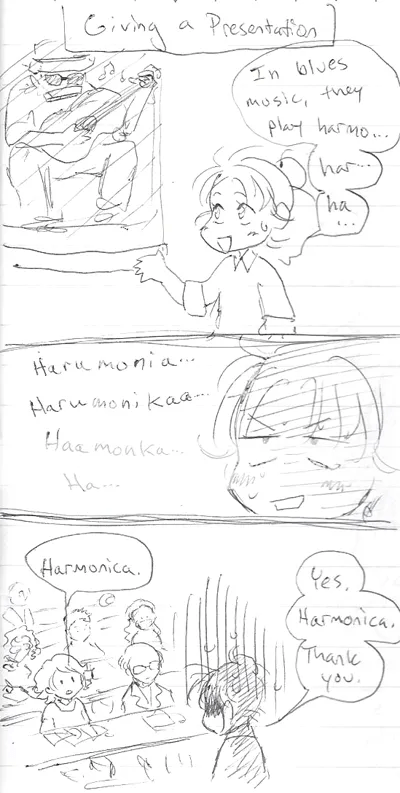
To some extent, learning Japanese is like learning at least six different languages.
It was originally a home-grown spoken language (though I have heard theories that it was influenced by Turkish–wrap your brain around that for a moment). Early on in Japanese history (as we understand “Japan” as a country, not just an occupied group of islands), it imported written characters called “kanji” (漢字) from Chinese, a very developed and literary society. These characters carry both pronunciation and basic meaning, and when you put them together with other characters, you can express more complex ideas. They fit the Chinese language beautifully, even though the sounds or even shapes associated with them have changed throughout the history of their use. They do not, however, fit Japanese quite as perfectly.
The spoken Japanese language adapted this written language by throwing the characters around, mashing them together, smashing them a few times, and then pulling the tangled mess apart. What they wound up with was a reasonably reliable method of recording written language, a large number of loan words from Chinese, and some fragments of kanji that wound up being devoid of meaning and would only represent phonetic sounds: hiragana (ひらがな) and katakana (カタカナ).
When Japan was primarily in contact with countries now considered China and countries now considered Korea, this linguistically served them fairly well. Then the Portuguese missionaries and Dutch traders came in with entirely foreign ideas and items that had no existing words to describe them. Furthermore, when Japan chose to start Westernizing, they sent students out to developed countries in the West, and they came back from English-speaking and German-speaking countries and then some with even more ideas to express. These words of Western origin were adopted into Japan by way of katakana syllabary.
As contact with foreign nations increased, so did the percentage of the Japanese language that was based on loanwords. However, like trying to get a written language like kanji to fit the spoken Japanese language, it took smashing and stretching these words a bit. For instance, my name, Brittany, is written as ブリタニー, and said Buritani (Boo-ree-tah-nee). Whether or not this is recognizable to people who don’t speak Japanese (or at least who don’t speak Katakana-English!) is anyone’s guess.
Hence, in order to speak Japanese with any fluency, you sometimes have to relearn English (and other languages) in a different way.
There are a few words that trip me up sometimes. For the record, “harmonica” is “haaah-moh-nee-kah”(ハーモニカ). Another word that trips me up because it’s so hard to recognize out of context is Connecticut (“koh-neh-tee-kaTTOH”, コネティカット). If we’re talking about US states or geography it’s easy, but when someone asks me in an open question-answer setting, “Do you know about Connecticut?” I risk looking like I know nothing about my home country’s geography when I have to ask what it is. Yes, I bring this up because it’s happened–twice.
Imagine how much sillier I look when I say, “Makudonarudo (マクドナルド)? No, I don’t think we have that in the US.”
Disclaimer: This is from the perspective of a native American English speaker whom has been actively speaking and studying Asian languages and cultures and histories for most of the past decade, especially those of Japan and China. I do not formally study linguistics, therefore this is not presented from the point of view of the study of linguistics. Yes, there is a difference.
July 28, 2013
A sweet fix
Posted by Buri-chan under Buri-chan Anecdotes | Tags: en-musubi, food, wagashi, weather |[2] Comments
One Saturday morning, I was eating an apple. A good, healthy choice, right? Well, then my post-braces retainer along the back of my teeth broke off. Thanks, apple.
A big non-sarcastic thanks to my dentists, though. They were able to get me in that afternoon to fix it and give me a brief cleaning. As happy as I am with their service, I was a little grouchy about having to spend my Saturday at the dentist. I was wearing in new shoes, and they hurt. As I was taking the neighborhood streets back home, it started to rain, and I was without an umbrella.
But, what was this? A little tiny shop decorated with flowers? Selling wagashi (Japanese confectioneries)? Yes, please!

Was this an act of enishizuku, perhaps? A little ironic to go straight to a sweets shop on the way home from a dental cleaning. I have no excuse–I’m really, really not keeping up on that New Year’s resolution to cut down on sweets. They just keep jumping out from every corner around here, I don’t even have to go looking for them! I’ve identified the places where I’m most likely to encounter the temptation to buy Western sweets, though I still occasionally find myself seated with a slice of some fancy concoction in front of me and wondering how I got there.

Not that I was going to say no once it was in front of me.
But the wagashi! They’re everywhere here, everywhere!! There are the major shops with long histories that provide the signature wagashi of Matsue (which, along with Kyoto and Kanazawa, is known as one of the major wagashi-producing cities of Japan), and there are little shops like this scattered throughout town. This is Isshunan, and while there isn’t much space inside for more than one person to shop at a time, there is quite a bit to look at.


Since I entered, I felt I couldn’t leave empty handed. I got a small, simple manju, but that wasn’t all I walked out with. The shop owner, a very cheerful, grandmotherly lady, insisted I borrow an umbrella.
Which meant, therefore, that I would have to make another trip there to return the umbrella. Oh, darn! (I’m being sarcastic here.)
I couldn’t just go home empty handed then either, could I? On the day I returned the borrowed umbrella, I got these “Matsue Picture Scrolls.” I could have gotten one, but whether I’m gluttonous or generous, I don’t know. I got a whole package to share with my neighbors (really, I did share!).

Inside these lightly sweet pancake-like scrolls is semi-crushed azuki.

One of the nice things about wagashi, besides the variety of shapes, flavors, and sweetness levels, is that they are typically free of artifical perservatives and are typically lower in sugar and fat than their western equivalents.
Therefore, I don’t feel as guilty about consuming them multiple times a week.

 San'in Monogatari