One evening at naginata practice, we did an exercise in which one person would hold a shinai (a bamboo sword used for kendo) and the other would strike it with their naginata to work on their accuracy. This is also something you can practice with both people holding naginata, but since we have many short people with limited reach, the shorter shinai was a little easier. Some of the girls were giggling and imitating kendo strikes and intrigued by how flimsy the shinai seemed to be in comparison to our beloved naginata.

As a few of us learned later that night, the shinai is worthy of some respect for the damage it can do.

After our usual practice session, those of us with armor and time stayed later to get some sparring practice in with A-sensei, who happens to be Nihon-ichi (number one in Japan), now three years running! She is awesome. The fact that I get to practice with her is also pretty awesome, although I’m still a sparring beginner. Even the elementary school girls have to take it easy on me, but they are really hardcore and tough to begin with (and I can’t stress enough how cool they all are!).

As we were packing up our armor and only a few of us were left, A-sensei asked to borrow some shin guards–not for her, but for someone else suiting up in armor across the dojo. This man was usually around at that time practicing iaido, the art of drawing a katana and overall looking pretty cool and samurai-like, but apparently he was also a kendo practitioner. While I don’t know who prompted it, he was suiting up for a duel with A-sensei.

I’ve seen her duel at naginata matches, but not so much during our practices, during which she is providing instruction while sparring instead of going at it with her full strength. Furthermore, I had never seen a duel between a kendo-ka and a naginata-ka, only duels against the same weapon. The remaining students and teachers and I were of course very excited to watch this match.

Unfortunately, you’ll have to make do with my sloppier than usual sketches I made after returning home late that night, as I didn’t even have my phone on hand to snap pictures–not that they would have done justice to seeing it in person anyway! They were both attacking aggressively, using strikes that are only used by experienced practitioners for their increased chance of injury, such as throat strikes. While the rest of the iaido class and the judo class on the other side of the dojo of the Shimane Prefecture Martial Arts Hall calmly continued their classes as usual, we watched and listened as they traded shouts and strikes.

For all I could tell, it looked like A-sensei was winning, as she was getting more accurate strikes in without them getting blocked. However, something very unexpected happened:

The naginata she was using snapped in half!!

I don’t mean the part where the bamboo blade is attached to the (usually) oak portion, as that is meant to be easily replaced as it gets beaten up during fierce matches. I mean the oak itself! I didn’t see exactly how it happened, but it was a clean, diagonal break down the middle.

A-sensei, cool as ever, shrugged it off, saying that it looked like it was going to break soon anyway. I have no idea how much experience she might have with pushing weapons to their limits, but nonetheless my other teachers were very surprised to see it happen. She had a spare ready and the match continued, with another classy break later for the kendo-ka to readjust his mask. A-sensei’s performance implied she wasn’t shaken at all by the broken naginata, but it made the rest of us even more fired up.

Men! Kote! Sune! The strikes picked up speed, but A-sensei was making most of them!

Her opponent was not quite as fast, but still got a number of powerful strikes in. After the match, we saw that she didn’t escape a couple of light injuries.

At last, they stepped away from each other and bowed, indicating the formal end of the match. It was A-sensei’s win!!

As the kendo-ka removed his mask, he was sweaty and smiling, shaking his head and commenting on how hard it was to match her speed. She was smiling and sweaty as well, as they thanked each other for such an invigorating duel.

You could say that, although they were both very skilled, A-sensei turned out to be the better opponent. However, as my younger classmates were celebrating her victory, one of the teachers remarked, “Of course, the naginata has better reach, after all.” No need to pick on katana and shinai users, as both have their merits, but I do wish naginata could be even half as popular as kendo. With more practitioners, we’d see even more skilled naginata-ka like A-sensei. For now it’s just a pleasure to train with her, but seeing as the other competing adults I’ve seen in the region have trained just as much, I don’t think my odds would be very good in a real match quite yet!

His famous progeny Matsudaira “Fumai” Harusato comes up in this blog a lot, but the first of the Izumo Province Matsudaira clan was Matsudaira Naomasa (1601~1666) who was probably the Matsue feudal lord most known for his valor.

He was the grandson of Tokugawa Ieyasu, founder and first shogun of the Tokugawa Shogunate (otherwise known as the Edo period). Though he was born only two years before this period officially started, things weren’t entirely pacified right away, so he had martial experience from an early age. At the tender age of 14 in 1615, he led troops in the Battle of Osaka, which was one of the final big battles to bring in the new era. Sanada Yukimura happened to be fighting on the losing side of this battle, but nonetheless was classy enough to show his admiration for his youthful enemy. He won a lot of recognition from people on his own side as well, and had a career in a handful of fiefs around Japan before being given the Matsue Domain starting in 1638 (seeing as the previous clans had no heirs). The Matsudaira clan would rule uninterrupted for the remainder of Matsue’s feudal history, until 1871 when the whole governing system was abolished.

Naomasa was a dedicated follower of the harvest god (but commonly known as the fox god) Inari, and founded the Jozan Inari Shrine, still found on the northern end of the Matsue Castle grounds today. Lafcadio Hearn was rather fond of this foxy shrine and described its founding thus:

When Naomasu, the grandson of Iyeyasu, first came to Matsue to rule the province, there entered into his presence a beautiful boy, who said: ‘I came hither from the home of your august father in Echizen, to protect you from all harm. But I have no dwelling-place, and am staying therefore at the Buddhist temple of Fu-mon-in. Now if you will make for me a dwelling within the castle grounds, I will protect from fire the buildings there and the houses of the city, and your other residence likewise which is in the capital. For I am Inari Shinyemon.’ With these words he vanished from sight. Therefore Naomasu dedicated to him the great temple which still stands in the castle grounds, surrounded by one thousand foxes of stone.

(“The Chief City of the Province of the Gods”, from Lafcadio Hearn’s “Glimpses of Unfamiliar Japan,” 1894.)

Naomasa also started the Horan-enya ritual, one of the three great boat festivals of Japan. It’s like holy kabuki on boats.

Click for source and small a gallery of Horan-enya photos.

Well, it started as a ritual to save them from a famine, and it evolved over the years after a fishing boat dashed to the rescue of a boat carrying Inari that was getting jostled in the wind and waves of the Ohashi River in the middle of Matsue. It’s only done every 10 years now, and the next one should be in 2019.

Naomasa also founded Gessho-ji Temple, which he named after his mother. All of the Matsudaira feudal lords of Matsue are buried here, and it is also famous for its hydrangea and for a giant stone turtle that used to roam around at night and terrorize people. That’s a ghost story for another time.

Naomasa’s final resting place, surrounded by bright blue hydrangea in the rainy season.

Finally, most visitors to Matsue recognize Naomasa by the equestrian statue of him that stands in front of the Shimane prefecture government office, facing towards the castle (the statue used to be directly in front of the castle, and there is a miniature version of the statue inside). While I haven’t exactly gone looking for them, I can’t say I’ve seen any other statues of 14-year-old samurai, so it’s pretty cool.

Click for gallery source and other historical postcards of Matsue. This one is from 1927.

It’s Golden Week so people have time to travel, which means every pocket of Japan is flooded with visitors right now. Even better, this period of consecutive public holidays coincides with extremely pleasant, picnic-perfect weather.

I can’t stress enough what a great time it is to see peonies at Yuushien Garden while thousands and thousands and thousands more are on display than usual, but as we know, peonies tend to be show-offs, and there are plenty of other seasonal flowers to enjoy at this time.

One of my favorites I hadn’t seen much before moving here was fuji (wisteria, witten as 藤, not 富士 like Mt. Fuji!), and from the highway you can see large purple trees towering out among the forests, and one of my favorite seasonal sweets from Kiharu, a charming cafe inside the Matsue History Museum, is an original wagashi with a delicate fuji motif.

That photo is from the wisteria at Yuushien among all the peonies, but one of the most pleasant and easily accessed (and free!) places to view them is Matsue English Garden, which is what it sounds like: A garden in Matsue designed and maintained in English style, with varying heights and shapes and botanic selections around the meandersome garden paths. Located right outside one of the closest railway stations to Matsue Shinjiko Onsen station (the easternmost on the Ichibata Railway that leads to Izumo Taisha), you can walk right in and go straight to wandering the garden, or there are like displays and exhibitions or fairs going on within the glass-walled hallways surrounding the garden.

englishgarden

On a sunny day, light floods all of the enclosures, including the hot house or the stage area which is home to a couple of giant ficus trees I’m very fond of and some other unusual plants I still am not sure of the identity of. While I haven’t eaten at the restaurant there (but enjoyed ice cream or home cooked treats from food fairs), I imagine it is also well lit as it provides a view of Lake Shinji, which the garden is on the northern banks of.

But the upclose view of Lake Shinji is free, too. There is a grassy green lawn to stretch out or run around on at the southernment most point of the garden, overlooking the lake, or you could take a stroll down to the boardwalk. We held the closing ceremony and reception of the 23rd Japan-America Grassroots Summit 2013 in Shimane in this back area last July, and it proved to be the perfect space to accomodate so many mingling visitors and performances. It’s no wonder people plan weddings there.


But, you know, I live right by Lake Shinji too and have no shortage of good views of it. There is something in bloom all year around (most notably a wide variety of seasonal roses!), so I was there to see plants and English garden design!


And of course, early May means wisteria, which are best viewed from within the tunnels they hang from when arranged in gardens, observing the speckled sunlight and the purple hues in varying rays and shadows.


Miss Artemis from Otaku Lounge is a good model as always!

Those of you with access to them, go out and enjoy some wisteria. After all, in Hanakotoba (Flower Language), they mean “Welcome!” However, be careful! They also mean intoxication, including being intoxicated with love.

Speaking of those of you with access, the furry nanjyamonjya trees at Matsue Castle will be blooming soon!

Continued from Part 1


If only these two were around for Izanami.


…to be continued.

This. Is. HANAMI!!

While I went all over the place last year to spots like Tamatsukuri Onsen, Kisuki, and Senju-in Temple, I didn’t spend much time at the O-shiro Castle Festival that marks the start of spring, complete with a temporary Edo-style open-air a tea house (one more than usual in the area) serving matcha and sakura-mochi on every clear day. I do so love the scent of sakura-mochi. The castle was worth visiting almost every day for a while, though the best time I went was at noon when the flowers were in full bloom.

Sure, yes, the flowers were great… but I think I might have done more baby viewing that afternoon. Where had all these babies suddenly come from!? Little faces peeking out of carriers while (slightly) older siblings are helped to teeter down the stairs, or babies out for a day with grandma and grandpa, or babies so small you hardly notice their tiny limbs poking out of their carriers. Dads carrying strollers up the stairs while moms huff and puff and follow more slowly, carrying in the baby while walking in heels. Babies barely mobile squirming on the picnic blankets, and for every baby, a smartphone to snap pictures of said baby and their first Hanami (flowering viewing).

I’m pretty sure the babies weren’t all planned for cherry blossom season, but given important beginnings are planned around cherry blossom season, I wouldn’t be too surprised if some were. I think my surprise may just be a combination of not seeing so many young families all congregated in one place so often, and of everyone finding it too cold until that point to bother braving the weather with their tiny bundles. That may apply to more than just babies–everyone dressed up a little more than usual, either breaking in new outfits purchased for spring, or finally breaking out some old favorites again. Haha, take that, winter! Be gone!!

It wasn’t only people with babies at Matsue Castle this particular lunch hour–it was as if everyone was there! The young couples were obvious–holding hands and dressed most fashionably, though a little shriek of surprise caught my attention when one young woman tripped in her high heels. Thankfully her boyfriend already had her hand to keep her from tumbling too far down the steps, and they shared a laugh as she stood back up.

These two, however, made a more graceful couple–at least on a shorter set of stairs.

The old couples were also picnicking and strolling together, more still and quiet than the young families who had brought puppies and baseballs gloves. They took their time, and at one point I overheard an old man ask his wife what in the world she was doing stopping to pick up a fallen blossom, as the two seemed to have differing opinions on the aesthetics of the blossom and its natural place.

That’s a Lafcadio Hearn marker–his students used to have their physical education class here.

The kids are enjoying their short spring break between school years, so there were picnic groups made up entirely of elementary school boys, as well as a few family-run yatai (food stalls) where the kids were helping out as well. A little more so than adults, kids tend to scream like they’re having fun when they are freaking out about the shaved ice machine going haywire.

It is only the students who are on break, as working society is busily taking little more than lunch breaks in the new fiscal year. Thankfully there is cultural reinforcement at this time of year to at least take a midday breather to appreciate the cherry blossoms. One such worker was perhaps slightly older than middle age, but had an appreciation of beauty that was apparent on his face. As he came up the old uneven steps he was already glancing upwards at the blossoms, and he slowed his pace as he approached, smiling with what looked to be a sign of approval. Good job, blossoms. A trio of young recruits were looking a little less than used to their formal black suits, but they still giggled like school girls as they made their way through the grounds. A fourth picked up her pace and to join them, and the others gawked at how fast she had gotten an ice cream cone from one of the yatai.

I didn’t plan on getting anything from the yatai, but it had been a while since I last had a crepe…

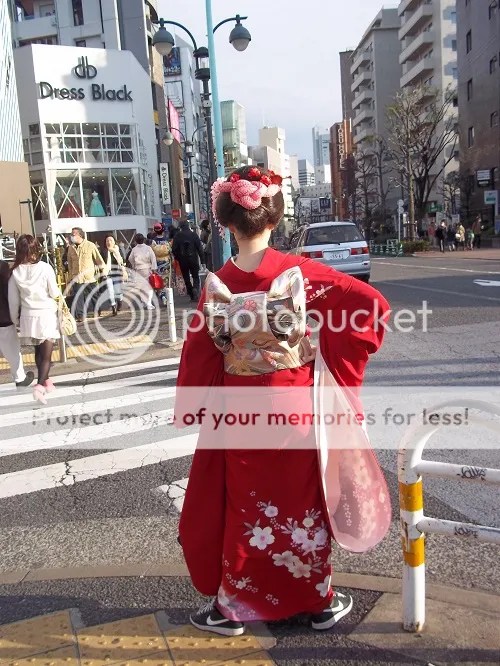
Despite how dressed up everyone is, I only noticed one person in kimono, which feels a little less than usual for big events around the castle. She had dressed it up casually and left her hair down, but seemed increasingly warm and tired in it as she looped here and there among the cherry trees. Perhaps her friends hadn’t arrived?

Perhaps what was oddly lacking was serious photographers–sure, everyone was snapping photos on their smartphones, but the big, clunky cameras that so many retirees frequently tote around the castle didn’t seem as present as usual. That’s perhaps because Hanami is best done with the people you love, and best enjoyed in the moment.

I was short on moments, however, and had to get back to work at city hall–though it just so happened that I ran into Mayor Matsuura on my way back, as he was on his way in. Enjoy your midday break, Mayor!

This was just the scene on a sunny Thursday afternoon, and the blossoms throughout the castle keep were lit up until 9pm. On the weekends during the castle festival, there were also Kagura, Dojou-sukui, and musical performances, as well as free samurai dress-up. Speaking of samurai dress-up, this year’s Musha Gyoretsu Warrior Parade had sunny weather for their march to the castle! I was in Tokyo for the kimono contest at the time, but maybe this sort of luck with carry through next year, too! As long as I don’t have anything else to do I’d love to take part again, but it’s so hard to choose what sort of role I’d want. Performing with a naginata was great and all seeing as it is my weapon of choice, but there are so many other props that look fun to try out, be it long and detailed wigs, or bows and arrows… ah! My inner samurai-wannabe is at odds with my inner Yamato-Nadeshiko-wannabe. That’s why being one of the lady warriors was such an obvious choice last time.

Alas, looks like I am getting carried away with the aesthetic thoughts the cherry blossoms arouse–but just when you looks again, they’ve all disappeared.


March 27:

I noticed yesterday that the buds of the cherry trees on my way home are now visibly pink. Took a walk around the castle this morning to see how they’re progressing, and they look ready to burst open at any moment. The forecast for the somei-yoshino, the representative breed of cherry blossom, is that they’ll bloom in Matsue starting March 30. I already saw an early blooming mountain variety in Yasugi on March 15, next to a plum blossom tree in full bloom. There are still some hearty plum blossoms in bloom in town today, but they’re on their last breaths. In these final days of blooming they give off the strongest fragrance, but their petals are already dotting the grass, moss, and sidewalks.

Though cherry blossoms are known for their sentimental scattering, no flowers fall quite as dramatically as the camellia. Like the plum blossoms, they’ve mostly enjoyed their glory for this year, and the bright green, post-early-spring-rain around the Matsue Castle grounds is dotted with trees surrounded by fallen blossoms. They don’t scattered their bright magenta petals like the similar sazanka flowers do, instead they fall with a pottori sound. The sight and sound of a fallen camellia pulls more of my heartstrings than any amount of scattering cherry blossoms can. The stone steps on the western slope of the castle hill are green with moss, fresh grass, and lush new leaves, but they are also decorated with bright fallen camellia heads.

I can’t say I enjoyed them in silence, however, because birds of all sizes are varieties are chattering in large numbers this morning. It’s a wonder how some old trees don’t fall over with that many blue herons sitting at the top branches.

Up by the castle tower, the cherry blossoms take center stage, and while they are almost ready for their spotlight, they are only that–almost.

March 28:

23 degrees this morning, and it felt amazing! The sun poked through, and the dew on the grass was very noticeable.
Some of the somei-yoshino cherry blossoms are starting to peak through their covers.

However, some cold weather varieties are already in full bloom, like the large white oshimazakura at Suetsugu Park. Not only is it full of blossoms, but it has young leaves and fragrance.

Across the street from this tree, several people were lined up in suits outside of the main entrance of city hall, applauded from someone I couldn’t see making their exit. It’s almost the end of the Japanese fiscal year and many people are about to retire or be transferred somewhere completely different. This is a sending-off for some such person, but I don’t know whom.

March 29:

The cats are prowling in the neighborhood–looks like everyone is shaking off winter laziness. A lot of cherry blossoms here have already opened and it’s warm enough to need to open a window. My poor kimono practice partner has a terrible case of allergies and has been doing her best not to sneeze on the silk.

March 30:

The rain was loud all night, but it’s just a light rain this morning. Today at Matsue Castle–where the 3/30 forecast seems fairly accurate–I heard an uguisu–that semi-officially means it’s spring! A stark contrast from the continual rubbery honking of the herons up at the tree tops, but everyone morning has been filled with the sounds and songs of quite a variety of birds. I’ve woken up most mornings lately to sunshine and a chirping chorus.

While we’ve had ducks and other aquatic birds hanging out in mass numbers in our waterways all winter, today the ducks in the castle moat are looking more frisky than usual. I wonder how soon we’ll see turtles families again?

March 31:

Ah-ha, so this is the bird that’s been doing all the screeching! There were a few of them by the southwest turrets of the castle today building nests, sticking their faces in flowers, and happily screeching.

The blue crested herons are still just as busy. Today most of them were heading towards the nests carrying branches; quite industrious on this sunny day. Many have already been sitting in nests for a few days, frequently visited by their partners who they pestered for branches and food, likely.

At work, we’ve had many people coming to say their formal good-byes, and we had a sending off at our own entrance today.

April 1:

Foggy weather this morning, but it soon cleared up into perfect flower-viewing weather, especially considering most of the blossoms are open now. The somei-yoshino are pillowy and white, but I am more attracted to the pink varieties, like this cherry tree planted in honor of the Sister City relationship between Matsue and Onomichi.

Not all the camellia are down for the count. This large pink variety right outside my office is a late-bloomer.

April 2:

The cranes were arguing about something this morning. Despite nesting in such close proximity, which multiple nests at one treetop, they can still be a little territorial.
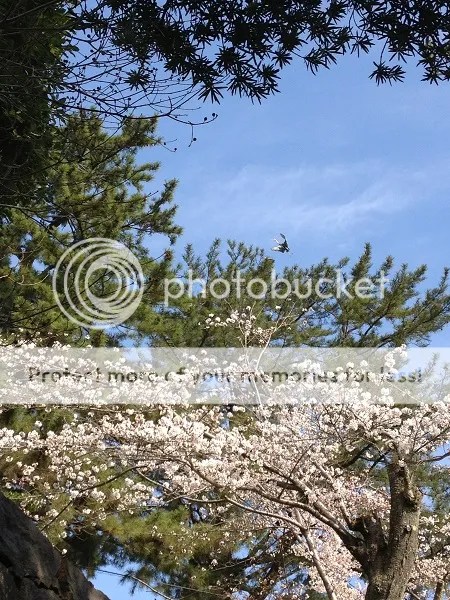
I finally remembered my sunglasses–it feels like I haven’t touched them in ages (though I’m perhaps one of the few people here who uses them without trying to make a fashion statement). In any case, the sunshine feels great.

The bring green grass and clover patches are making their return in the park, but they’re already dotted with scattered cherry blossoms. I wonder how much longer until their dramatic exit? It’s forecast to rain tomorrow…

The good-byes have switched to self-introductions as seasoned workers and young recruits are taking their new posts. It’s also the season for welcome dinners instead of just good-bye parties, and I came across a long train of excited new young employees, split into a few groups as the traffic light separated them on the way to hotels with ballrooms large enough to host them all. Thankfully my division-only party was small enough to talk with everyone and still hear yourself as you scoot along the tatami floors, pour drinks, and get to know each other better.

April 3:

Still sunny this morning!

And not only that, but the somei-yoshino all throughout town–and especially at the castle–have burst into full bloom. A couple unexpected detours in the afternoon led me to some quieter spots around town, such as Cherry Road, which is lined with cherry trees and overlooks the Sea of Japan. Another less famous spot, however, had low-hanging branches that almost looked heavy with fluffy white blossoms, and the shaded grass around the trees was a home for wild flowers that looked down the hill on some cultivated, deep green bushes. The sunlight glittered down upon the whole scene. That was well and good, but then the wind came and the blossoms began scattering–and that, dear Readers, was the mysterious cherry blossom viewing in Japan as I had always pictured it.

April 4:

I woke up to thunder, howling wind, and water crashing around my roof and walls.

Well. The cherry blossoms were nice while they lasted.

April 9:

Hold on–those blossoms are still hanging on! It seems conditions here were perfect for more flower viewing while I was anxious about tornado warnings out in Tokyo.

April 10:

One of the Go-mei (seasonal names for your tea scoop in the tea ceremony) for April is 花吹雪 (hanafubuki, “flower blizzard”). Even the light wind today is making that apparent, as cherry blossom petals don’t need much force to carry them away.

April 11:

The somei-yoshino had looked fluffy and white from far away, but they’re starting to look like deep shades of orange highlighted with spots of blossoms now. The fresh young leaves start with this rustic color, but they’ll turn green by summer and blend in with all the other trees.

Some later varieties are all fluffy yet heavy-looking with yae style blossoms–layers of petals all piled together rather than the iconic five-petaled blossom.

April 13:

On my usual Sunday morning route cutting between the Shimane Prefecture Office and Chidori Bridge–the little getaway route the feudal lord would have used to escape from his residence to Matsue Castle in case of an attack which never happened–I committed the sin of ignoring my surroundings and checking my phone. While consumed in the virtual world held in my hand, a fluttering cherry blossom flicked me in the ear, turning my attention to the last buds clinging to the branches, as well as though among the grass, water, or air that had given up the struggle. The blossom that hit me seemed to say, “I’m still here–look at me now!”

Cherry blossoms are perhaps less known for their grace as they are for their ethereal evanescence–you have to make it a point to view them, because they disappear so soon.

Following the blossoms in the trees, however, “cherry blossom grass” (sakurasou–technically Japanese primrose) tends to stick around for a while. I’m a big fan of brightly colored coverage like this, be it some variety of sakurasou or baby blue rurisou (nemophila), and some areas in Japan are famous for planting entire hilly areas in colors other than green. The wild collection of green plants covering the ground together also have their own rustic appeal, such as the excitement of finding yomogi (Japanese mugwort) which can be ground up and added to rice cakes to makes them green and give them a spring-like aroma. However, if you are more attune to food than to seasons, you might grind up the little leaves in your hand and have the smell remind you of mochi instead of the other way around.


April 15:

Although the bigger cherry blossom tend to hold on longer, the little walkway behind my office is now lined with big white blossoms, though the tree still looks plenty covered as well. It’s very, very sunny today, but the wind is still a little cold. Big waves on Lake Shinji today. We might be getting cloudier weather tomorrow.

April 21:

The turtles are back in all sizes again–I spied some twenty turtles out for a swim or sun bath in the castle moat. Although the hill Matsue Castle sits on is called Jozan (Castle Mountain) now, it used to be called Kamedazan (Turtle Mountain).

14420-turtles

My spring fever had been wearing off until I was interpreting for a group of educators from Thailand, and when we brought them up to Mt. Makuragi for a view of Lake Nakaumi, they were all much more excited by the somei-yoshino cherry tree that was still mostly in full bloom. What luck to see cherry blossoms while in Japan, though true cherry blossom season is mostly over. There are many other varieties in mostly full bloom now, including fluffy pink blossoms that bunch together like pockets of pillows, and green tinted blossoms that at a close view have stripes of pink, but from a distance they trick you–“Ha! You only thought I was leaves, but I’ll bet you’ve never seen leaves in such a soft green tint!”

The group continued to ooh and ahh at all the flowers, very different from the tropical varieties they are accustomed to, and it seem it’s already too hot for many of them. The flower beds throughout the city planted by community volunteers are at their most cheerful right now, and the peonies at Yuushien Garden are just now beginning to wake up. While there are always enough peonies to make a visit just for them, most of the garden seems green compared to my first memories there from May of last year, but the buds are big and ready to take over the garden in an array of bright colors.

We took a brief visit to Izumo Taisha as well–this being my 11th visit there, so perhaps I am somewhat jaded to grandeur of the shrine. However, upon arrival, there was a garden of pink-tinted cherry blossoms that stood out against the familiar green mountains of Izumo, and all of a sudden Izumo Taisha felt new and exciting to me again.

Spring has a way of doing that.

It has been said that in Japan, people dress for the calendar date instead of the weather. I’m inclined to agree.

When traveling or living in another culture, it’s always worth taking note of how your wardrobe compares to the level of modesty and neatness of those around you so as to be respectful. When preparing to live in Japan, one piece of advice I heard here and there is that people will not tell you directly if you’re showing too much skin, but instead will ask if you’re cold as an indirect way of saying “cover up! That’s not appropriate!” In my experience, I’ve been asked this a few times when wearing short sleeves, but I think the surprise is less about it being immodest and more about how no one else is doing it–at least not on that particular date. This is very different from the culture in which I grew up, in which dressing in layers for the sake of being able to add and remove layers so as to adjust to changing temperatures indoors or outdoors is commonplace and considered practical. In many places around the world, however, practicality is not of prime importance when it comes to fashion choices (especially if kimono are any indication of that).

Furthermore, when it comes to the calendar date, it’s not just clothing that adjusts to fit the theme. In the tea ceremony as well, there are a lot of tools used seasonally, or you switch between summer and winter tools at specific times of year. They don’t match up exactly, however–it’s more chic in Japanese aesthetics to use a motif of some occurence in nature that hasn’t quite started yet. For instance, wearing a kimono or using a tea cup with cherry blossoms in full bloom is a way of saying “look what’s coming soon!” but if you were to use them in full bloom, it would feel a little like you’re trying to upstage nature. Furthermore, using them just after the event would just make you look like you’re behind in the season. Keep in mind that these are general ideas, not hard and fast rules, and there is a lot of flexibility allowed in appropriateness. However, in part due to the tendency to use motifs a little in advance, and in part due to the one-month speed-up of the old holidays with the new calendar, you find some seasonal changes being made long before it would make practical sense to do them. This especially drives me a little crazy towards the later parts of summer and winter, when the tools have already changed before the weather has, which means we’re using tools for hot weather when it’s still chilly outside or using tools for cold weather when it’s still hot and humid!

But alas, practical sense and aesthetic sense are not always in agreement, though it’s especially nice to appreciate both senses when they align on the right calendar dates.

Be on the look-out for some spring-themed entries coming up, full of snapshots… however fashionably late they are.


Recall how that happened.


Continued in Part 2

Nine study-filled years after my first experience wearing kimono, and about 19 months after getting wrapped up in these kimono dressing contests, I participated in the 2014 World Kimono Competition on April 7 at the NHK Hall in the heart of Tokyo. While I’ll probably still wearing more subdued kimono for tea ceremonies and what not, I went into this know that it would likely be my last time wearing such a furisode, the florid style of kimono worn by young single ladies to beckon attention and generally flaunt all the flashiness that kimono can embody. Such a kimono demands an equally exuberant hair style, such as the traditionally bulky-shaped Nihongami (日本髪 “Japanese hair”). I expect this to probably be the last time I sport true Nihongami, too.

While I had very early morning appointments at beauty parlors for the regional competitions in Kochi and Hiroshima, for this competition I instead was assigned a hair stylist and makeup artist to come to my hotel room the night before and morning after. I was a little nervous about not being able to get any sleep with my hair styled like that or that it would all be ruined by the time I woke up, seeing as I do not have the discipline to sleep perfectly still on a wooden block pillow like women in the Edo period used to do. Once I saw how tiny my hotel room–even tinier than I’m used to in Japan–I was a little concerned about how much room the hair stylist would have enough room to work.

I was also concerned about how experienced the hair stylist might or might now be with Nihongami. To be on the safe side, Kimono-sensei gave me a magazine cover to show to the stylist for reference. When the smiling older gentleman came in with his young assistant, I showed him the cover, and he laughed, saying, “I was the one who did this!”

He had been working this competition for years and worked magic despite the tiny workspace, and when I told him my teacher left cloths to wrap the style in a turban as I slept, he replied confidently, “I can fix anything! It’ll hold anyway. But even if it doesn’t, I can fix anything!”

He put in the accessories temporarily to show me and Kimono-sensei, which we were pleased to see in the shape he created, but in addition to the pins holding the style in place, he left in the kanoko (spongy red cloths with a dappled pattern) and the kushi (decorative comb at the top). I wasn’t so worried about the kanoko, but wasn’t the kushi, you know, breakable? I expressed my concern, but laughed it off: “It won’t fall out, don’t worry. I can fix anything!!”

Well, okay! This is the style I slept in…

“I am TOTALLY going to sleep just fine like this!”

…and that’s pretty much how it looked when I woke up, too!! There were only minimal fixes before he finished working his magic. He arrived after my make-up appointment but had assured me the night before that if I didn’t get a good make-up artist, he could fix that, too. On top of all this confidence, he made sure to remind me several times to enjoy myself.

While we’re still on the topic of Nihongami, I’ll go on a tangent here to say that it takes a lot of time and effort to successfully deconstruct this hairstyle so after the contest I simply took out the decorations, changed into Western style clothes. I thought it was too strange to wear Nihongami without any decorations, so my very good friend who came to watch went out and picked out a big bow to stick in it. As we were heading out to dinner, I got my picture taken for a magazine!

Don’t worry, I was smiling for the magazine shot.

The hassle of removing all the pins and handfuls of fluff later made me really, really glad I just walked around in that style for a while instead of trying to fix it before going out.

That is not a mirror behind me. That is my real hair sticking out beside my head.

Okay, that’s enough about hair. You’re all still reading because you want to see pictures of kimono, right? So here are some superfluous photos from before and after the actual competition. I got there at 9am for the rehearsal (and most of us got a little tripped up with the floor of the stage at the NHK Hall started moving), and the actual opening ceremony was at 11am, the international participant category was after 1pm, and the awards ceremony was close to 4pm. That gives you little spurts to slip out of backstage to snap photos, scarf your bento lunch as gracefully as possible, practice or make necessary adjustments, or just chill out and talk with the other participants. By “chill” I mean we all got progressively less and less graceful backstage as we lounged on tatami and waited for the awards ceremony.


Like in the regional competitions, there were three categories for women (casual, formal tomesode, and flashy furisode), and due to the larger participation in these categories, each region may send seven representatives to the world competition as opposed to the three sent in other categories. Other categories were for men, children (boys and girls together–and a western girl joined them in this category), schools (in which a team of three dresses each other), and the international participant category. There were 18 of us this year, but it seems that if they have trouble gathering enough representatives there is always the possibility of being thrown in with the Japanese men and women’s categories. Seeing as there were 12 or so in the regional competitions, 18 was more than plenty. We had mostly women in furisode, but also women dressed casually, and a handful of men. In addition to representing our respective regions of Japan, we represented China, Taiwan, the United States, New Zealand, Vietnam, Canada, Brazil, and Thailand.

A fellow CIR friend of mine was there, as was the girl who won 1st place in the regional competition in Hiroshima–the one in the beautiful deep purple kimono. We sat together and chatted backstage, but besides the men in another room, I talked at least a little to everyone. While in the regional competition everyone is a little surprised how they got themselves into this, in the world competition everyone already has some experience. You still hear all the lauding praise for each other’s style and talent, and everyone still remains rather humble about their own abilities. Truth be told, though, I was feeling a bit more competitive than before.

However, grace before competitiveness! Poise before aggression! And above all else, smile, smile, smile, smile–gracefully!

I was mostly satisfied with how I did on stage, both in terms of skill and speed in putting on the kimono and in embodying the Japanese spirit of aesthetics. I think everyone did really well, and it felt like it went really fast.

At last the award ceremony came, and like the opening ceremony, we had (a large portion of) all the participants in all the categories all fitted on staged together.

No, we did not have representative from each of those countries, but it still adds the “world” competition flair. Granted, as far as I know these contests are only held in Japan.

The dramatic drumrolls and music played for the announcements of 3rd place, then 2nd place, then 1st place of the school and children’s categories, as well as for the reading and presentation of their awards. In the same fashion came the announcement of the international category.

So… yeah… no, I didn’t place among the top 3. I really wanted to write that you would be reading the blog of a world champion, but technically I was in a 15-way tie for 4th place. All three winners were in furisode, with 1st place from New Zealand and 2nd and 3rd from China, including the girl in the deep purple kimono in second place. Once again, she was incredibly fast, despite saying she hadn’t practiced much. That’s just a touch vexing after all the evenings and weekends I poured in practice, but I’m happy for her and the others girls anyway. It just so happens they’re the three I talked with most backstage, and the girl from New Zealand had family visiting and watching in the audience, too. So good for them, and good for the rest of us for getting that far and making it a close match.

The winners among the men were announced, followed by the women. They had actually already been on staged for announcements beforehand, as they choose the top seven women from each category to narrow down who would stand on stage for the final announcement. The other representative from Matsue, who had won first place in the casual category at the regional competition made it into the top seven, but that put here in a five-way tie for 2nd place, seeing as they count that a little differently. There is a 1st place announced in each of the 3 women’s categories, then a special winner in each category for being the most outstanding, and then there is a Queen chosen from among the furisode participants to rule over the entire kingdom of kimono practitioners present on stage.


The Queen was very choked up while giving her acceptance speech.

I came a long way and learned a lot doing this, and though I cannot boast of world championship, I can boast of the unusual skill of self-dressing–without a mirror–in the top layer of a furisode with anyone one of three different styles of obi, all within roughly 8 minutes. Perhaps it’s not the most useful of skills, but I can apply the same basics to dressing myself in more commonly used kimono, and that’s what I set out to learn in the first place, having book-studied kimono for years before that.

Still, though there must be non-winners in any competition, there is the sting of not having something concrete to show for one’s efforts. What was I lacking, I can’t help but wonder, and that makes me not want to look very carefully at the photos as all I’ll see was my errors. Everyone did very well, so perhaps it just came down to the little details and the little impressions people made in their stage presence. Perhaps I really lack the spirit of Japanese aesthetics after all!

I gave grace and poise a good shot. I gave grace and poise a really, really good shot. Maybe I’m just not as suited for grace and poise as I hoped to be.

The rest of my to-do list in Tokyo was a little exhausting, but I felt very refreshed flying home to the little Yonago airport with Kitaro and his ghastly friends welcoming me back. On the shuttle back to Matsue, I got to see a grand view of Mt. Daisen and the late afternoon sunlight reflecting off of Lake Nakaumi. On my walk back home through town, I got to catch one of Lake Shinji’s famous sunset scenes. All seemed right with the world again.

…and then I got to work the following morning, where Araki-san, the cheerful-as-ever old man known his bouncy folk-dance performances around the world, was practically waiting for me. He had a big present, and proudly unwrapped it for me, revealing a snapshot taken from my first Dojou-sukui lesson/performance about a year ago. I’m not sure what photo contest it was, but it seems it won some kind of prize. He continued to go on and on about how I have natural genius for the famously silly folk dance, and how I should continue performing (this is a common technique of sweet old people trying to twist your arm into doing more performances at busy JR stations or for mass media exposure).

I had to back out of the TV appearance he was trying to get me into, but he kept insisting how good my silly expressions and bouncy footwork are, and look! My expressions were so good that I even won a contest!

…crushing irony. Such crushing irony.

Design a site like this with WordPress.com
Get started