Mascots are a very normal part of daily life in Japan. Each prefecture has their own mascot (and they compete for the best mascot prize every year), companies and organizations will have their own mascots, cities will have their own mascots, even certain aspects of cities will have their own mascots–as is the case with Peony-chan, who represents Matsue’s… well… peonies. Their reputation may already proceed them, though. According to the Japan Times on 11/20/12, “Sales of peonies from Matsue, Shimane Prefecture, are booming in Vladivostok after hitting the market in Russia’s Far East in 2009, virtually selling out every year because of their variety of colors and longevity.” The day Peony-chan came to visit, she was preparing for a trip to Taiwan.

Matsue peonies are especially well known on Daikonshima, where they can be seen all year round–though I’ve heard early May is the best time to see them. That’s when I’m planning on going! The other flower that represents Matsue is the tsubaki (camellia), which I’m looking forward to seeing around the castle in winter.

<

While this is the only mascot of this size to pay a visit to my office, I don't see Peony-chan in my daily life as often as I see, say, Appare-kun, the PR champion of Matsue Castle!

Unlike most mascots he’s human(esque) and has a more varied set of expressions than just “happy” and “super happy”, but like most mascots, he can be made into any kind of product, especially edible ones.

I haven’t run into him in person yet, but I have seen his bride Shijimi-hime, based on a Shijimi clam (a specialty product of the area. Most of the Shijimi clams consumed in Japan come from Lake Shinji). This kind of encounter is also completely normal.

There is no mascot I see as often as Shimanekko.

Get it? Shimane (prefecture) as a neko (cat)? And notice the visual reference to Izumo Taisha, with the roof architecture and the shimenawa rope? You noticed that all, right? Of course you did.

Even if you didn’t, you can’t visit Shimane without noticing Shimanekko. Besides Shimanekko on the face of products from pencils to hand towels to cookies to bouncy castles in every place from rest stops to places of legend to your neighborhood convience store, there is also a Shimanekko dance.

Shimanekko and Appare-kun are so popular that they even get drilled with questions about whether or not they are friends and star in commercials for candy companies.

Furthermore, have you heard of the Yura-Chara Grand Prix? I didn’t until very recently either, but apparently many thousands of people did, and they voted for their favorite mascot characters. Out of over 860 entries in 2012, Shimanekko took 6th place! Good job being cute, Shimanekko!

Continued from Part 5

6-1
6-2
6-3
6-4
6-5
6-6
6-7

Here ends Izanagi and Izanami’s tragic love story, though the siblings have plenty of battles ahead of them.

Learn about the sites associated with this legend!
Iya Shrine
Yomotsu Hirasaka (the gates to Yomi)
Kamosu Shrine
Manai Shrine

Or start reading the next story!
Start reading Susano-o’s story and how he fought the Yamata-no-Orochi.

Or see the Kojiki a.t.b.b. masterlist!
The Kojiki Myths in Manga Form

Today I went out to Mihonoseki, the peninsula that makes up the northeast tip of Matsue, most known for the highly important Miho Shrine, and for its lighthouse.

Can you find the red 'you are here' marker?
The primary point of my activity today

To the south you can see Nakaumi…
Hey look, it's Daisen!

…and to the north you can see the Sea of Japan.
Not to mention the Oki Islands, though they aren't in this picture.

It’s a fairly rural area, with a very laid back way of seafood-rich life.
There were still more in the water, too
Wish you were here, Dad!
Literally, the bridge to the floating island
You want to drive around in this ancient shrine? Sure, why not! I'll help you up there!
I'm still not a big fan of azuki (red bean) manjuu, but I found out today that I do enjoy kuri (chestnut) manjuu!

While waiting for the festivities to start, I peaked into the tourism center to see what was for sale there (besides dried squid and dried seaweed and all kinds of dried fish).
It looks wide from this angle, but the upper floors are actually very narrow
The dried squid beckons you!

That was when the old ladies seated in the back who spoke in a thick Izumo dialect addressed me: “Welcome. Come sit down for a cup of tea.”

If there’s one thing I’ve learned, it’s that you don’t refuse when old ladies offer to have you sit down, especially if you have the time to kill. They served me dried squid first and showed me how to tear off the pieces a little bit at a time. It was not my first time having dried squid (I certainly got my fill a month ago while interpreting for a squid-drying workshop!), but one of the other things I’ve learned is to just shut up and pretend it’s my first time hearing something when people want to teach me something, no matter how much I may think I know about it.

After that they gave me some of the kuri-manjuu I had seen on sale in stalls outside leading to the shrine (that I was nearly tempted into buying myself!), and some sencha prepared in a Chinese style tea set–warmed up ahead of time, gong-fu-cha style.

The conversation was light and the location was highly informal, but according to my book-knowledge but yet unpracticed tea philosophy, it was essentially a tea ceremony. I was invited to eat a couple morsels before taking part in the tea my host had chosen and served her favored cups, and we appreciated each other’s company in the fleeting moments it took to consume them.

Though the squid sort of changes the mood... or sets it?

It was light conversation. What country are you from? Have you always lived in Mihonoseki? Is this your first time here? How old are you? Were you a teacher at Mihonoseki elementary school? Has this festival always been like this? Do you have a boyfriend? Hmm, even old ladies can sound like high school girls sometimes. High school girls with thick dialects.

In the spirit of being a guest, I asked questions about the tea cups, and then they decided they should prepare Japanese style matcha in a proper wide cup. Guess who got her afternoon dose of caffeine?

Over the course of our little tea party, they called out to acquaintances walking into the shop, or acquaintances walking into the shop called out to them. They were invited to tea with us, and each time someone new showed up to talk about the make up the girls put on him for the festivities or about the year end party they’re planning, the old ladies introduced me, my job, my country, my age, and that I’m going to find a boyfriend (you can guess whose idea that was).

Soon after the festivities started and the party ended. Even outside where everyone was crowding around with giant cameras that put my point-and-shoot to shame, acquaintances who had briefly passed through the tourist center made sure to point out the best spots to me.

And just what had I gone there to see in the first place?

This was ceremonious, really.

I’ll explain this December 3rd festival properly another time. There is a lot more of the Kojiki to retell first!

In Matsue (and the Izumo region in general), anything can be given an En-Musubi (縁結び) label.

To break it down, “en” (縁) is our ties to one another–something like fate. The verb “musu(bu)” (結) means to mind or entwine things together. Therefore, a translation for “En-Musubi” can range from “fated encounters” to “match-making.” While it can include any kind of ties we might have with any person, it is especially associated with finding your soulmate, and there are famous En-Musubi spots all around the region. As it is used in many forms, you’ll probably see the phrase get used a lot here, and yes, there are reasons for why the region is so wrapped up in this: En-musubi is what all the gods get together to discuss while they are having their meeting at Izumo Taisha during Kamiarizuki!

Seeing as we’re all a little tangled in all this En out here, even the rain in Matsue is full of it. That’s why it’s called “Enishizuku” (drops of En):

Since it reaches everyone at the same time, touches everything from nature to man-made structures, we are all bound together by the drops of water… Well, that’s a charming way to think about it, I guess. Even my laundry gets to soak up a bunch of En.

In my experience all of Japan gets a lot of rain, but it seems Matsue is particularly well known for having a lot of rain, and the rain at Lake Shinji has been a poetic topic for many visiting writers. It’s not quite like a typhoon when we get storms here, and while Lake Shinji isn’t as violent as the sea, it certainly puts on a show when the wind picks up. Every thirty years or so Matsue gets a flooding problem, but the worst I’ve seen has been the parking lot in front of my apartment–seeing as that part of town was a marsh back in the Edo era.

Matsue has recently started a public umbrella-sharing program. Since a lot of buildings have places to leave your umbrella when you enter, inevitably a lot of them are forgotten if it looks clear again when you leave (I’ve done this a few times. I really miss one of those umbrellas…!). Participating locations put those forgotten umbrellas in specially marked umbrella stands, and anyone who needs them can take them. I haven’t needed to yet, but I’m sure it will come in handy someday!

Well, whether the weather is cold or whether the weather is hot, we’ll weather the weather whether we like it or not. While rain is not my personal cup of tea, I do enjoy all the moats and rivers and lake views around town. That’s why it’s sometimes called the Venice of Japan–but more commonly called the Mizu-no-Miyako: The City of Water.

…and En-musubi.

Sunday, November 25, 2012 was the regional contest kimono dressing contest for the Chuugoku and Shikoku regions (covering nine prefectures). This year it was hosted in Kochi City, with the winners earning the right to go on to the competition in Tokyo in April.

Though only two of us were entering from Matsue this year, we went with a group of eight–three Senseis busy working, and three drivers and photographers to cheer us on. On Saturday we got to do a little sight seeing in Kochi (I wonder what Sakamoto Ryouma would think if he saw how much merchandise there is in his name?), but Sunday we handed ourselves over to be vessals of the Japanese spirit, purveyors of tradition, and models of proper kimono behavior (ha!).

Sunday started with an early appointment at the beauty parlor to have our hair done. We weren’t even the first people there!


90 minutes and some terrible amount of damage to the ozone layer later, my “Nihongami” (Japanese hairstyle) was finished. I got a lot of stares and comments on the walk back to the hotel, where I ate my breakfast and then did my stage makeup and got myself dressed to go. For the first time, my 16 pieces of kimono underwear stayed in place for not only a couple hours worth of wear, but the whole nine hours I was dressed in them. That is a huge relief! There were so many practices with the entire shape was ruined because some layer of my undergarments had slipped out of place.

You might notice that the collar is attached to nothing but itself and the sleeves seem a little bare. For this level of competition that much was fine, but in other levels an additional full-length layer–complete with full length sleeves–is necessary. A few of my fellow foreign participants were using those anyway.

It was right about then that I started to wonder what I had gotten myself into. An hour later or so during the rehearsal, it was starting to become more clear. “Oh, duh!” it finally dawned on me. “This isn’t just a skills competition. This is a beauty pageant!”

I spent many hours backstage in the room prepared for the ten female foreign participants (there were two male participants else where). Besides Xiao Man and I, there were three Kochi CIRs, two Kochi interns, four Okayama exchange students, and one Ehime English tutor, hailing from America, China, Korea, Paraguay, and Brazil, and all conversing in Japanese. All ten of us girls were dressed in furisode, so it made for a very brilliant, florid atmosphere. Seeing all the different patterns and accessories and colors was fun, and I had worn a more subdued, casual kimono, I would have stuck out!

In the spirit of doing things in the Japanese spirit, they provided bentou (boxed lunches) with many different small servings as opposed to large servings of fewer items.
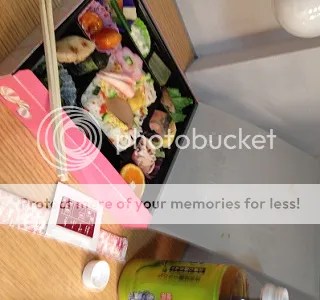
Seeing as kimono were never designed for sitting in western style chairs and I didn’t trust myself not to spill my bentou if I held it while kneeling, I can’t say I retained my Japanese poise and grace backstage. In hindsight, I probably should have tried to embody more of the spirit that came with the garment, shouldn’t I? That’s something I’d like to work on…

Then came our turn to perfom. Over the course of my practices I’ve gotten plenty of experience in making mistakes–and therefore gotten experience in learning how to fix them. This time, however, I did something completely new. Based on the steps I showed in this entry, these graphics may or may not make sense:


I could tell something was wrong, but I decided to continue anyway since that would be the inside fold instead of the outside fold that get wrapped around my waist. Thankfully it didn’t cause any terribly obvious problems (this whole time, I was worried most about making some mistake that would leave me half-dressed), but I was a little slow as usual, and barely finished second to last. In my hurry, I only half-way adjusted the flowers on my back. They should be pulled straight against my back to hide any gaps or tools, but I didn’t pull them close enough, probably leaving some gaps and tools exposed.

After smiling and posing and walking on stage with what hopefully was a little bit of grace, I didn’t get a chance to examine myself before Sensei caught me in the hall and fixed it, so I have no idea just how much of a gap was exposed!

Oh well. Seeing as many other participants were walking around with their biyousugata showing, I didn’t feel too embarrassed by it. I’d like to learn how to dress myself properly without one, though.

My obijime came out well, though. This was a method I accidentally created early on in my practices, and Sensei and I decided we liked it enough to keep it. We called it “Burikko-musubi”: “musubi” is a term for a method of tying things, and “burikko” is slang for a girl who puts on a cute act. The more obvious pun is that it sounds like my name (and as Xiao Man adds, it’s like a combination of our Japanese names!).

After the competitions and while prizes and certificates were being prepared, there were other presentations on stage, including the “Hana-musubi” (flower-tying) my Sensei and some number of others were busy with.

A couple hours later, we returned to the stage for the award results. They were announced in quite ceremonious fashion, including music before each 3rd, 2nd and 1st place announcement, and a dramatic oration of the 1st place certificates, with everyone on stage the entire time. The poor kids were having a lot of trouble standing still by the end of it and were making faces and playing with their consolation medals.

As we stood lined up and waiting for the results they slowly announced, I was both hoping to place as proof of having worked hard for it, and hoping not to so as to take a break from practicing instead of preparing for the national/world competition in Tokyo! They announced everything by entrant number (I was #2) followed by name, so as they finally got to the final announcement for the foreigner category, I was only half-listening. When they said “number 1”, my mind jumped to “Entrant #1? That’s Xiao Man, my practice partner! She won!!”

“Oh, no, that’s not right,” I caught myself after flashing an excited smile at her. “They said first place, not Number 1.”

And then they did say her number. Xiao Man won!

I’m very proud of her (and a little relieved it wasn’t me), but Sensei and everyone who went with us to root us on were treating me very delicately afterward, saying things like “it was really good that you remembered to smile at the judges and greet them properly!” and “she won because you helped her practice!” Hahaha, no! That was all her effort, I just happened to be next to her for a lot of that effort! I suppose it would have been nice to place, but I don’t mind. Not having fixed my obi is a little regretable, but overall I’m very satisfied. I didn’t keep track of where the winners in the other categories were from, but even though we came from the furthest prefectures, it seems the participants from Shimane and Tottori did really well. Good job, San’in Region!

Well, so much for my results in the foreigner category.

I supposed a little proof is necessary that I didn’t act like such a dork for the entire day. I’d like to think I have a little of this Japanese spirit, too!

It’s worth noting that Nihongami takes about as much effort to take out as it does to put up.

My hair has had about as much as it can handle, but Sensei is already talking about next year’s competition in Hiroshima…

UPDATE! I’m starting practice for this year’s competition after all!

I’m back from the kimono contest, and I’ll post about it once I round up the pictures. For now, it’s time for Kamiarizuki!

In 10th month, most of Japan must go without their local kami, because they are all convening for their yearly meeting to decide how they’ll be influencing people in the year to come (more or less on an individual basis). Out here in the old Izumo province, however, we celebrate Kamiarizuki (literally, “the month with gods”) because they gather at Izumo Taisha (the second most important Shinto shrine).

This might sound familiar because I posted about it towards the beginning of October when Matsue was hosting several events to commemorate Kamiarizuki. However, that was the 10th month according to the Gregorian calendar. The old agricultural calendar, however, started it’s tenth month more recently. While it does mean people mistakenly think they are making merry with all the Kami-sama while only the local Kami-sama are present, perhaps that is a good thing–otherwise, how would the Kami-sama be able to focus on their meeting? They come for business, after all!

Even in Japanese, “Kamiarizuki” is a bit of a misnomer. The meeting only lasts for a week! After all, if they were away for one-twelth of the year, that would mean they aren’t doing their usual work for a large portion of the year. In 2012, Kamiarizuki is from November 23rd to November 30th. It starts with the Shingeisai (or Kamimukaesai, depending on how you read the kanji: 神迎祭 (god-welcoming-festival)), followed by days of Kagura dances, and then a seeing-off ceremony.

As I am writing this, the Kami-sama are having their meeting. Last Friday, I went out to Izumo to see the Shingeisai procession from the beach at Inasahama, up Kamimukae-no-Michi (God-welcoming Road), and then on to Izumo Taisha.

It starts with an assembly on the beach with worshippers and spectators watching the opening ceremony to welcome the Kami-sama coming from all over Japan (I find it funny that Inasahama faces the Sea of Japan. Did the Kami-sama take the long way around?). It’s supposedly very eerie when everyone is totally silent.

After that, the potable shrine (a staple item for most Shinto festivals) is silently paraded up the streets for about half an hour until it reaches Izumo Taisha.

That is what you can usually expect from the Shingeisai, it seems. Now for my experience!

First off, it was terribly dark and raining by the time I got to that part of Izumo, so I didn’t even attempt to take many pictures. I took a very expensive taxi from a musuem in a mountainous part of Izumo, and the driver took me as far as he good before the traffic looked too horrid for him to bother going on, right about the front of Izumo Taisha. I then joined the myraids of worshippers/spectators walking down the hill to the beach. It’s not usually so crowded, but this year it happened to fall on a national holiday–Labor Day, meaning a lot of people had a three-day weekend to travel. The gift shops around the shrine and the train station were bustling with business, but almost everything else on the way down was closed. I was glad I had the foresight to bring a rice ball, and that it was too dark for anyone one to notice me munching as I walked.

Once I got to the beach entrace, I was handed a gohei, which is also a common Shinto item.

“Izumo Taisha God-Welcoming Gohei” // Shingeisai of the 24th Year of the Heisei Period”

They were also directly people to stand along the path prepared so as to welcome the gods, but to be considerate enough not to stand on it.

People were more spread out at the beach, but there were so many people lined and waiting by 6:00–an hour before it was scheduled to start–that I started to get concerned about beating the crowd to catch the train home later. Though it perhaps would have been more interesting to stay and, although not being able to see anything above the crowd, hear the silence, I decided to ask around and figure out a place where I could wait for the procession to come closer to the station.

Seeing as most places were closed and it was cold and rainy, I wound up waiting around in a little bait shop and talking with a couple of old ladies for an hour or so. They were the closest place to stop in and grab a packaged snack, get a warm drink from the vending machine that speaks with a Kansai accent.

“Are you usually open this late?” I asked, assuming they wouldn’t have people coming to put fishing equipment at that time.

“No, tonight’s special,” they laughed, and went on to tell me about how things would continue to be bustling with activity for the rest of Kamiarizuki.

“Things are busy around New Years too, aren’t they?”

“Oh, yes. Everyone comes to Izumo Taisha to do their New Year shrine visits. It gets very crowded. And it was busy with Shichi-Go-San recently, too!” they went on. “Come to think of it, there is usually some crowded thing going on. I went for a coming of age visit when I was young, but even though I live right by it I don’t usually go!”

The intersection right outside their shop started to fill with spectators, I thought I should head outside if I was going to see anything (and beat the crowd back up the hill). It was around then that we noticed a bus zoom up the street, and after what looked like a little confusion, the crowd started to follow it.

“I think that was it,” one of the ladies commented.

“Hmmm. Usually they’ll announce in the morning they’re going to skip the procession for weather. And what do you know, it already let up.”

So much for seeing the procession! I had to laugh at how long I had waited around for a bus to pass by, but I’m still glad I went as far as Inasahama to see the crowd and see part of the usual course of the procession. Though I barely beat the bulk of the crowd, I still managed to get a seat on the train back to Matsue!

Enjoy your meeting, Kami-sama! Maybe I’ll join in the work by writing about your discussion topics later this week.

EDIT: My co-worker and I talked about it today, and rather than waiting inside a bait shop, she arrived shortly before the event started and go stuck in the crowd unable to see much more than a few flickers of the bonfire. There were lots and lots of tourist buses this year taking people directly from the JR station to Inasahama, adding to how packed it was! Instead of silence, everyone was recording the event on their cell phones, and after the portable shrine was starting it’s procession to the bus, it was followed by a swarm of people like fans and papparazzi following a movie star–some where even holding signs for the Kami-sama to read. So much for eerie silence! So long as it doesn’t fall on a national holiday next year, maybe it’ll retain the atmosphere it once supposedly had?

Even for all that craziness, I found it interesting that I didn’t notice any other apparently foreign people. Should you plan on visiting for this event in the future, might I reccommend the guest house right on the coast? Unfortunately I’m not finding much more information than the address and the phone number for the Tsubaki-ya (出雲市大社町杵築北2844-45
Tel: 0853-53-2956), but I can tell you they were nice enough to let me use their washroom.


I’ve been practicing twice a week or so for the past two months, and this Sunday is finally the day of the contest! The regional kimono consultants’ contest is for the entire Chuugoku and Shikoku regions, with the top three winners in each category going on to the national (or world, as the case may be) finals in Tokyo on the NHK stage. There are various categories for Japanese women based on the type of kimono, a category for men, a category for children, and a category for foreigners doing whatever style they choose. It sounds like my friend Xiao Man and I will be the only two representating Matsue this time, but we have a little group going to cheer us on.

My furisode (long, flowing sleeves) is rather showy–it’s what young, unmarried women wear to things like their coming of age day, New Years, or weddings. Participants are judged not only on how fast they go and what the finished outfit looks like, but on their manner as they get dressed. Usually, I’m so concerned about finishing on time that I sacrifice a little of this manner, but that won’t leave a good impression on the judges! Maybe as long as I remember to smile (as Sensei constantly reminds us) my flashy and rather ungraceful antics will be endearing? Well, I can hope, or I can do my best to be refined.

Wish me luck! Hopefully I won’t come back with stories about ungraceful mishaps on stage!

Continued from Part 4


Continued in Part 6 (the conclusion)!

Have you ever thought about how your soy sauce is made, or what makes a soy sauce a good soy sauce? I didn’t until I interpeted for a tour at the local luxury soy sauce brewery that produces the soy sauce used at the local luxury inns.

The Hirano Syouyu-ya is located on a street in Matsue with many other old family owned businesses built in the early Showa (post-war) period, where the business store front faces the street and the home is behind it. We started the tour with Hirano-san pointing out some other businesses on the street, and then inviting everyone into his home to see his classic Japanese style living room and garden (a surprising number of people can fit in a narrow space). After that, we went down the alley to the factory entrance behind the house.

Soy sauce starts as a fermentation of soy beans, wheat, and yeast in a brine. After it has thickened up for a few years, it becomes a thick slop called moromi. While he cautioned everyone not to fall in, Hirano-san invited us to taste it.


After the moromi has matured, it gets pressurized to squeeze the liquid out of it. The liquid goes on to become the base for soy sauce. The solids remaining are later used as fertilizer, and they sell vegetables grown with it.

It takes a little more time to mature, and then it becomes the soy sauce we all know and love.

But if the process stopped there, it wouldn’t be luxury soy sauce, now would it? Part of the fresh soy sauce brew gets used as regular soy sauce or gets mixed with different flavors (they do a lot of experimentation with different items, usually other fine seasoners in Japanese cuisine). The rest of it, however, gets put back where it came from to serve as the brine for a new brew of moromi. This results in a much thicker sauce, which is not as salty as the single-brewed sauce. When you take away from of the saltiness, you can detect a much deeper flavor profile. While I am not a soy sauce expert, I noticed a big difference between the single-brewed soy sauce and the twice-brewed soy sauce. Indeed, the twice-brewed sauce is much nicer!

For anyone who would like to know more (and doesn’t mind it being in Japanese), please take a look at the Hirano homepage.

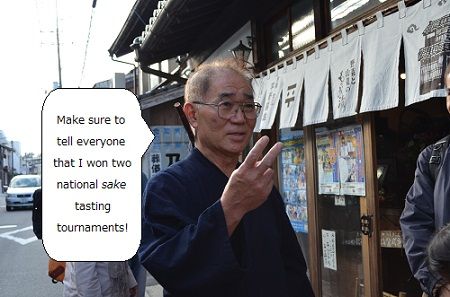
Finally, Hirano-san (a fourth generation brewer with a thick Izumo accent) wanted me to tell everyone a little more about him after the tour had ended (and after he and his wife were nice enough to give us all seasoned sesame seeds–which I love!):

This isn’t to say he brewed the sake himself (though he could with that equipment!), but that he could distinquish which kinds of sake he was tasting. What a cultured tongue he has! He has a taste for jokes too, so it was fun to interpret for him.

A big thanks to Luc and Alaina for letting me use the photos!

Design a site like this with WordPress.com
Get started