
I’ve since recovered, but still enjoying the wide selection of candy-like cough drops. My favorites are plum favored with herbs or ginger-honey-citrus flavored.
Only a little bit longer to go until spring!
March 1, 2013
I’ve since recovered, but still enjoying the wide selection of candy-like cough drops. My favorites are plum favored with herbs or ginger-honey-citrus flavored.
Only a little bit longer to go until spring!
February 27, 2013

I’ve already mentioned him several entries already, as Lafcadio Hearn is a pretty famous person around here. A century ago he was pretty famous around the world for his writings about Japan–especially the San’in region, as he was first placed in Matsue as an English teacher back in the Meiji era, when Japan was beginning to Westernize. He was an Irish man born in Greece who studied and worked in Europe and the United States, but ultimately found his home in Japan. If you’re familiar with the 1964 film Kwaidan, then you’re already familiar with some of his work.
While he lived here in the chief city in the Province of the Gods and took in the sights–many of which we still see regularly or nearby today–he collected the material for Glimpses of Unfamiliar Japan, which was written in 1894. It was the first of his sixteen books about Japan and what made him so well-known, though he had already been a world traveler and writer over the decades beforehand.
When I found out I was coming to Matsue, I made sure to read this book. Now I’ve been here for a while, when I flip back to it, I’m surprised just how vivid and accurate so many of his descriptions still are. To quote P.D. Parkers, one of his bibliographers:
There may be no other city like Matsue or Izumo that can be made so well known to those who have never been ….Surely there must be only a few places in the world that have travel guidebooks as complete as this.
Whether he was better known as a travel writer, folkologist, or anthropologist, his work is important as some of the most detailed accounts of Japan in a changing era. He went on to marry a woman from a local samurai family, become a university professor in Tokyo, and become a naturalized Japanese citizen under the name Koizumi Yakumo–as he is typically referred to within Japan. Biographers tend to agree that his days in Matsue were some of his happiest, and his home–a former samurai residence–and garden that he loved so much are still places you can visit. The Lafcadio Hearn Memorial Museum is right next door.
Besides his old home and sources of inspiration (and in turn, ghost tours and products inspired by Hearn’s writings), Matsue is also home to Prof. Bon Koizumi, his great-grandson. He and his wife are not only the local authorities on any Hearn-related, but they’re also active in Matsue’s Irish culture. I performed at an Irish music performance with them last fall, and will soon go celebrate St. Patricks Day at the Irish pub and parade coming up soon. Matsue’s Irish parade is one of the biggest in Japan!
You can learn more about the Hearn-related events and societies here, or if you read Japanese, you can also find out more about The Hearn Society.
Or you could download his books for free from Project Gutenberg, or directly on Amazon for Kindle users!
February 25, 2013
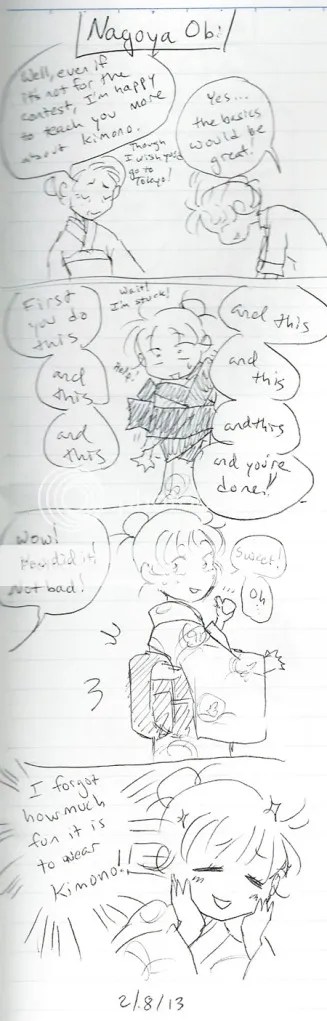
I didn’t win at the regional competition, but kimono have called me back. After all, my skills only lie in dressing myself in a furisode with a biyou-sugata in eight minutes. It’s a nifty skill, but not terribly practical.
While Kimono-sensei really wants to have me participate again this fall in Hiroshima (donning a Japanese hairstyle and furisode again, of course), I’m taking a couple months to learn some casual styles I’d like to be able to do on my own. Seeing as I was never even very good at origami I don’t have a natural talent for this, but I’m doing my best and so far am enjoying it. Unlike practicing for a contest where I need to perform in a hurry, I can take my time with these styles–and I certainly do take my time. I managed to do the basic o-taiko (drum shaped) obi on my own on the weekend, but it took me a couple hours from start to finish. Sigh; I still have a ways to go.
Time though it does take, I still am constantly reminded why I was always attracted to kimono, and I am always finding new ways to appreciate their intricacies. For example, the little way I got my obi wrong with the seam at the top not lining up–that’s not appropriate for me, but apparently that’s a high-class geisha move. Also, the way to fold the obi-age before tying it–it wasn’t simply method, but it had a functional purpose to fold in the extra ends of the obi-age after tying it.
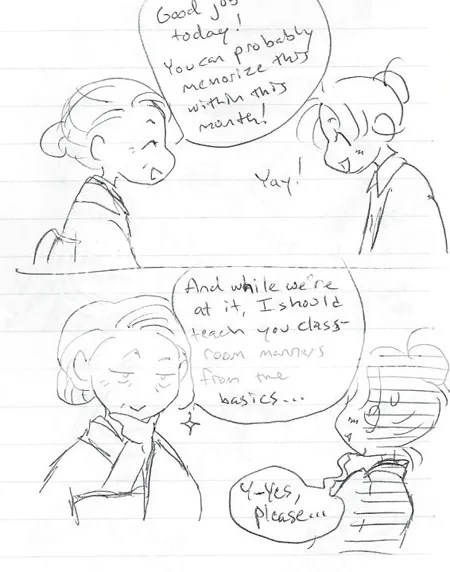
As I keep unraveling the world of kimono, I’m sure I’ll discover plenty more–though for now I’d just be happy if I can dress myself correctly. There is more to learn than just how to put it on, though…
February 23, 2013
If you visit Matsue Castle in winter, you might expect to see some of the following scenes. It is one of the only 12 remaining original castles in Japan, and one of the best maintained with its original materials, so it’s easy to imagine yourself back in the Edo era, seeing almost the same scenery they saw then. For instance, the imposing black castle turned white with snow.

This kind of time travel is completely normal.

Ah, but back in the Edo era, foreigners were not allowed in Japan. I’d be in trouble there!

In modern day Matsue, the castle is a social center that any common people can enjoy. Festivals and events are frequently held on the castle grounds, but any other day, people enjoy the grounds however they please.

Oh? Is it snowing again?

Aha. Yes, it’s definitely snowing again. So much for the view of the city from the castle tower, but this is nice too!

I could see the ducks in the castle moat a moment ago, but the scenery is quickly turning white again…

The weather will not stop the Horikawa sightseeing boat! It runs all year long, but in the winter months they provide heated kotatsu blankets to curl up with while you get a tour of the city. You can do the whole course in about 45 minutes, or you can you get on and get off as many times as you like throughout the day and use it like a water bus. Make sure to bring your foreign passport or foreign residence card for a 33% discount!

Around this time, you’ll probably see this particular variety of camellia all over town. They bloom for a long period of time, and stay very fragrant! The camellia garden and plum blossom gardens on the west side of the castle grounds haven’t bloomed quite yet, but there are many buds right now.


Cold CIRs like me have also become part of the modern scenery around the castle.

February 21, 2013
This is a story from around Daisen.

Once there were two old couples who lived in a small, poor village. The first old man and his old wife lived simply and honestly, and the other old man and his wife were notoriously stubborn and lazy.
One day the first old man went out to chop grass as usual and began to polish his sickle, when he slipped. The old woman heard a terrible noise and feared her husband had fallen down the well, and sure enough, he had. “My dear! Are you alright?” she called down to him.
“I’m fine, but I can’t get out! Send down a rope!”
She lowered a rope down, which he tied to his waist, and she pulled as hard as she could. He soon came up with pockets full of gold coins. The village children all came out to see what the commotion was about, and the old couple shared the fortune with the children. They all lived happily ever after.
The lazy old couple, however, saw what happened and were filled with jealousy. “We could get a fortune that way too,” said the husband.
“Sure, they could get a fortune that way. That old man stays in shape because he goes out early every morning to cut the grass, but I just have a cunning good-for-nothing for a husband.”
“Fine, you want me to cut grass? I’ll go cut grass!” the old man barked back, then picked up a sickle to start sharpening it. He also fell down the well, and shouted to his wife, “Alright, I fell! Now lower a rope!”
She did do, and he tied it on. She pulled him up as fast as possible, but his pockets were empty and he upon emerging his hit his head.
The moral of the story–although you could glean many from it–is not to imitate others.
February 19, 2013
Continued from Part 1


They had names too, but they were pretty lame names if you translate them literally.


Continued in Part 3!
February 16, 2013

Japan is well-known as a country fraught with natural disasters, especially earthquakes, so there is a lot of emphasis on preparedness. Evacuation locations and procedures are very systemized, and throughout the year there are many official disaster training exercises for disaster response professionals and for the general community.
Shimane is no different in that respect, but the San’in region is not as disaster prone as other areas. Seismic activity is relatively low (I have yet to experience an earthquake), and typhoons coming off the Pacific Ocean usually turn into normal rain by the time they hit this area. There are occasional flooding problems and blizzard conditions, but they’re not terribly frequent.
Nevertheless, I do have a basic evacuation kit prepared (which anyone in any place around the world should!), and I try to take part in training sessions both for my own benefit and for the professionals who keep their skills sharp by working with human rescue subjects. While there are smaller training events at the local level, last fall I took part in the prefecture-wide training event in Hamada City, out in western Shimane.

You could watch the helicopter view on some of the TVs.
Besides watching the fire truck maneuvering drills and helicopter rescues over the harbor, I got to ride in an earthquake simulator, go through a smoke tunnel, use a fire extinguisher, and try out emergency food, such as canned bread. My main purpose for being there was to be an injured person who spoke no Japanese and was trapped “inside” a partially collapsed building.

The “building” I was trapped behind–it’s not pictured here, but a car was crashed into it, and they needed to cut open holes in the walls before they could get to us–not to mention rescue the victim in the car.
After the rescue team found me, they brought me to the area the Red Cross and Shimane International Center supporters had set up, where they gave me a blanket and got some basic information from me and treated my “injured” arm. After that, I was loaded into an evacuation vehicle with some of the other evacuees, and we made our escape from the disaster area.

Despite the perilous conditions, we all managed to keep a sense of humor.
But after you evacuate the danger area, where do you go? That’s where the Matsue city level training picked up last weekend. For the third year in a row, the members of the Japanese community and the foreign community came together for an overnight experience at one of the city’s several designated evacuation centers. We had participants from about ten different countries.

Our dinner that night consisted of rice prepared in special individual serving bags, and vegetarian stew prepared by the local women’s association. Breakfast was made up other individual serving items with long shelf lives. At least as far as our locale is concerned, you can expect to be fed for as long as you are stuck in an evacuation center. However, I have food in my personal emergency kit anyway–and so should you!


Normal Calorie Mate (the biscuit in the yellow box) has a shelf life of about a month. This emergency Calorie Mate has a shelf life of about three years.

Here’s some of that canned bread again, as well as special seaweed rice you just need to add water to. The resealable bag doubles as a bowl, and there is a spoon inside. If you add cold water it takes about an hour to be ready, but if you had hot water it only takes about twenty minutes. Surprisingly filling! Not only is this good in emergencies, but the package even suggests taking it on camping trips and trips abroad.
When it came time to figure out the sleeping arrangement, we were asked to do an experiment first to see how we could try to fit everyone in a confined space. Unsurprisingly, we weren’t very good at.
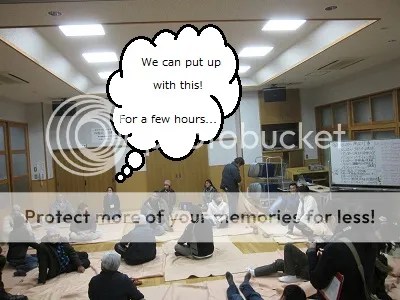
We then moved worked together to build partitions for a little extra privacy, as well as cardboard toilets (although thankfully the indoor plumbing was still working just fine at this particular evacuation). The partitions we used at this center were of a cardboard and plastic variety, but there are other varieties in use elsewhere.

There were also training sessions for performing CPR and using AEDs and using fire extinguishers, as well as a fire truck demonstration from Matsue’s northern fire station.


Thank-you to all of the volunteers who came together to make this training session a success, and huge thank-you to all of the emergency response personnel around the world. Your work is greatly appreciated!
February 13, 2013
For all the J-Pop or singer-songwriter fans out there (or anyone who enjoys some easy, uplifting tunes), I’d like to introduce a musical duo called Kotonoha, made up of a couple native Shimaneians* named Moe and Yuka.
This first video was features western Shimane in the towns of Tsuwano, Masuda, Hamada, and Gotsu.
This one takes place on the Oki Islands.
And here’s one in Izumo.
More information here on the website, though it’s all in Japanese: http://kotonoha.co/

These a few of the places where you might be able to take part in a homestay during the 23rd Japan-America Grassroots Summit in Summer 2013. This is a very good opportunity for any Americans of any age, occupation, or language level to visit Japan and have a very authentic experience, so please look into it and pass the information along to anyone you know who may be interested.
*Or as some of the CIRs and I have taken to referring to ourselves, “Shimaniacs”
February 11, 2013
(Make sure to follow the bubbles in Japanese format, right to left!)

At this time last year, I was nervously preparing for my JET interview… make that over-preparing. While I can’t say the interview went perfectly, it obviously went well enough for me to be here now, which I’m grateful for. I’m very pleased with life right now, but right after the interview I certainly wasn’t! Later on when I got together with a bunch of the other people who had been accepted, someone smiled and recognized me as the girl who was sure she had dishonored all of her Japanese teachers with all of her mistakes and stupid-sounding answers. Thankfully that’s a slight exaggeration, but I certainly was worked up about it for a while with no idea how I did.
My advice to everyone preparing now: relax! If you’ve gotten to the interview stage, your written application has already shown that you’re competent. Let your passion shine through in your answers, however ungracefully worded they may be. As for the CIRs’ Japanese language portion, focus on communicating–which may mean slowing down. The nice old man on my interview panel even made it a point to tell me that during the interview!
Ganbatte, everyone! Come visit me in Matsue when you get to Japan!
February 8, 2013
As I continue to flirt with starting real tea ceremony lessons in a city steeped in tea culture, I’ve nonetheless been enjoying lots and lots of tea. I am especially fond of the flavor of matcha, a powdered form of green tea picked and processed in such a way that it has a higher concentration of amino acids than its steeped counterparts, and since it is ingested instead of left in a tea bag, it delivers a greater antioxidant punch. That’s not to mention the taste–though it may be more fiercely bitter than other forms of green tea, it has a deeper and more complex flavor profile. As you can imagine, it is an aquired taste, but once acquired life gets that much more enjoyable.
Matcha’s partner in presentation is none other than wagashi, handmade Japanese confectionaries, which Matsue is a well-known producer of. Despite how much I like sweets, these were also an acquired taste for me, as I didn’t exactly grown up eating sweet bean paste. But now I’ve acquired that taste and can appreciate their wide variety of shapes, colors, and ingredients! Not to mention the combination of intense sweetness and bitterness when paired with matcha–it really wakes up the senses.
While I still can’t call myself a formal practitioner of wagashi or tea, I can still try. On a bit of an impulse a few weeks ago, I finally bought myself some matcha for personal use and the tools needed to keep and prepare it (and while I was at it I got a set of napkins and a utensil for eating wagashi so that I wouldn’t be caught without them again!). This was brought on by a brief wagashi-making workshop I participated in, and it also gave me a chance to use the dorei pottery I made in Izumo last fall!

My first homemade tea ceremony! Except that I was both the host and guest, so it wasn’t really a ceremony (not to mention all the tools and steps I skipped). It was simply nice to be able to combine the matcha and wagashi flavors at home.
First, this is the tea bowl I’d like to say I made myself when the other Shimane CIRs and I were having a training period last fall, but it was mostly me making a mess and the far more talented Sensei fixing it for me. The little carved design was my own doing, at least.

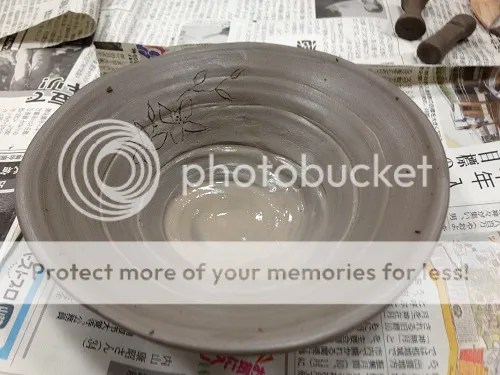


This is more so where my brand of creativity lies…
Furthermore, I made the wagashi myself! Well, the shape of it anyway–in the short class I took part in, the sweet red bean paste and soft colored fondant were already prepared by the people who know what they’re doing. There are longer classes available at the Karakoro Art Studio, which I’m sure I’ll try out at some point. This particular wagashi is modeled on a tsubaki (camellia), which is one of the flower symbols of Matsue.

Click for photo source–this variety isn’t blooming quite yet! There are plenty of another couple varieties blooming around town, though.


I could see myself making wagashi more often than making pottery.

The one in the middle (a chrysanthemum, I think, if not a peony) was prepared by the pros ahead of time, but I made the tsubaki and sakura (cherry blossom). They’re not perfect, but they were pretty anyway~
Since I had a couple more wagashi to work with, the next morning I made it again with the cup I bought at the Watanabe open house late last fall.

It was also nice to already have matcha and a few tools on hand when someone gave me gave me a local brand of wagashi, known as 湖の雲, or “clouds above the lake,” a rather sweet interpretation of the famous sunset scenery at Lake Shinji.


Informal though this little tasting experience was, it was worth a haiku:
In warm hues and tastes
Daylight sweetly melts away,
Consumed in brief time.

 San'in Monogatari