Please enjoy this daily series of comics about my tea ceremony adventures while I’m on vacation! I will reply to comments when I get back.

July 13, 2013
Please enjoy this daily series of comics about my tea ceremony adventures while I’m on vacation! I will reply to comments when I get back.
July 10, 2013
Millions of people on summer vacation around the world will be packed into cars soon and carried across miles and miles–or kilometers and kilometes–of road, faced with hours and hours of boredom, cramped quarters, and crankiness. Out of those millions, there will be a handful of lucky people who will be drive along the coast of the Sea of Japan, and out of the weariness of being the road, they will suspect they are hallucinating when they spot a giant pink octopus.

Rejoice, parents of small children (and anyone else in touch with their inner child)! Behind the strip of restrooms and restaurants, there is a jungle gym!

And a roller slide!


And was that a dinosaur? Yes, that was a dinosaur.

There is more general playground equipment not pictured here–you’ll either have to imagine it or experience it for yourself. Should this excitement happen to wear you out, there is also a covered gazebo overlooking the view of the sea, though there are a number of vantage points around the hill tucked behind Akasaki district’s rest stop by the port. It used to be a town of its own until merging with Kotoura (which is still small town).

Ah, Tottori. Least populated prefecture, most epic rest stop.

July 8, 2013
When it’s hot out, I can think of many refreshing things I’d like to drink. Rice typically isn’t one of them.
I can think of a lot of words people might use to describe sake. “Health drink” typically isn’t one of them.
But apparently they both work.

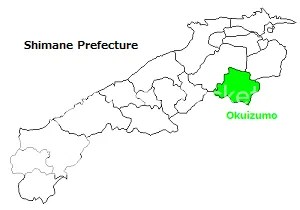
This is amazake–literally, “sweet sake,” as produced by Okuizumo Shuzou (brewery). As mentioned before, Shimane is known for high quality sake thanks to it’s rice and clean water, not to mention the trained hands that handle the process. Okuizumo is especially good for this, as it is known for Nita Rice, which is gathered from locals cropped fitting very specific environmental requirements in order to be considered Nita rice–one of the ultimate rice crops of Western Japan. It’s been awarded the gold medal in national rice competitions for the past three years running.
Like regular sake, amazake it is made from fermented rice, but the process is such that it becomes low-alcohol or non-alcoholic (like this version). It is thick and textured, a naturally milky color, and in many processes it breaks down carbohydrates into simplier, unrefined sugars, resulting in a natural sweetness. Hence, this is used as a base for many other drinks–or even a cure for hangovers, or a base for baby food! This particular variety comes in three flavors (plain, matcha, and cocoa), and you can see much nicer photos here.
This is particularly popular in summer not as only as a refreshing sweet, but as a health drink to replenish your energy when the heat tries to suck it out of you (this is because it’s full of B vitamins–not the fearsome stuff you’d find in American energy drinks!). Whatsmore, because of its unrefined sweetness, it can be used as a replacement for sugar in recipes.
I could a couple of wagashi (traditional Japanese confectioneries) that were made with it. This is youkan, a gelatinous and smooth bar of sugar, agar, and sweet bean paste (azuki, resulting in its typically maroon color, or kidney beans, resulting in a translucent, easily changable color). Vegan and long-lasting though typically free of artificial perservatives, it is one of the oldest forms of wagashi. For these youkan, the plain amazake was used in place of sugar.

The package on the left is for plain amazake-youkan (which had a purpley-maroon azuki color all throughout), and the open example on the right is a citrus-flavored translucent youkan with some azuki paste in the center.

Youkan isn’t usually my wagashi of choice, but I was pleased with them. They were firmer and lighter in flavor than Jello, though just as refreshing and didn’t leave a sticky aftertaste.
I have a bottle of plain amazake waiting for whatever I may use it for this summer… still haven’t decided what to try. Smoothies? Pancakes? Maybe youkan myself is probably out of the question.
July 5, 2013

When Japan was unified at the start ofthe Edo era, Horio Yoshiharu (1542-1611) was appointed the first lord of Izumo Province. Upon arriving, he made plans for a new castle and capital city, and his son Tadauji (1578-1604) suggested the current strategic location of Matsue Castle. While they did not initially agree on the location, Yoshiharu conceded after Tadauji died of a sudden illness. With Yoshiharu handling things despite his retirement, Tadauji’s son Tadaharu (1596-1633) succeeded leadership at a very young age. Alas, he died leaving no succesors, and control of the domain was left to another short-lived clan after that.
July 2, 2013

As interpreted by Mizuki Shigeru (statue located in Sakaiminato).
Another youkai* that comes from the sea, this one has typically been sighted around the Hirata area of the Shimane Peninsula (now a part of Izumo City).

Not to be confused with a mermaid (a big distinction is made in this part of Japan), she is the hideous half-fish, half-woman “wife of the sea” (or the wife of Umibouzu, a sea monster that has been spotted throughout Japan). She is capable of living on land for several days at a time and even speaks the local dialect, and she walks around carrying her offspring with her. With fish scales all over and long, human-like hair, it is said that she took the form of a women who had drowned in the sea. More specifically, in Iwate Prefecture in northern Japan, she was said to have brought to shore the corpses of fishermen supposedly killed in a storm at sea, and their wives were so distraught that they threw themselves into the sea–only to turn into Uminyoubou themselves. Another story goes that a young boy lost his father when he was very young, and his mother went missing. Years later the boy became a fisherman, and when he went out to sea, an Uminyoubou appeared. She had tears in her eyes and said, “You’ve grown up well.”
In the Izumo sightings, she is said to enter peoples’ houses while they are out, and holding her baby in one hand she uses the other hand to steal and eat salted fish, which she shares with the baby. Apparently she prefers it salted rather than catching it fresh herself.
There was also an account of a man in Uppurui (which would later be a part of Hirata), who returned home early and noticed the Uminyoubou from outside as he approached his house. He peered in and saw her and her baby eating the fish, and she grumbled, “Where is the man? I wanted to eat him first.” Sounds a little like an old mountain lady we know.
* – “Youkai” is a blanket term for a Japanese monster. It may or may not include demons and ghosts, as these have their own terms, but they also get included in the general mix of inhuman creatures who make up much of Japanese folklore and who are responsible for mysterious happenings. Kami (gods) are similar in that they are spirits who influence our daily lives and may be angered or pleased, but while a kami might be considered pure, a youkai would be a more impure, occult creature–many look like deformed humans or objects, and this strangeness can make them quite unsettling. However, that also makes them interesting, and has driven people throughout history to name and classify them.
June 29, 2013
When someone visiting me in Matsue says they want to go drink tea, I usually drown them with a list of options for places to go enjoy some wagashi (traditional Japanese confectioneries) and matcha (powdered green tea, the type used in the tea ceremony). To say it has a thriving culture here would be a bit of an understatement.
That said, most places that cater to casual visitors don’t have any expectations of the recipients knowing the formalities of tea or the complex taxonomy of wagashi. They are served as simple hospitality; a way to relax. Usually this takes place within view of beautiful garden or within a tranquil temple, but the weekly Matsue Chafe takes places within an old-bank-turned-craft-fair. Welcome to Karakoro Kobo!

In addition to handmade works and other souvenirs on sale throughout this public gathering space, this place is known for workshops such as making magatama jewels (also a big thing in the Izumo region, worth touching on another day), making silver wedding bands, or making your own wagashi. The Chafe is held every Sunday with two servings of matcha and wagashi for 500 yen, including serving it with the whisk if you’d rather try frothing it up yourself.


The name 茶ふぇ (“Chafe” (chah-feh) ryhmes with the Japanese word for cafe, “kah-feh”) is a play on words, as 茶 means “tea”. Relaxed hospitality is of prime importance to hosts. While there is a seasonally decorated tea room to observe and ladies in kimono preparing the tea in back, guests mingle at benches and tables, and engaged in conversation. This too is a pun: the Japanese word for chatting is しゃべり (shaberi), but they use the term 茶べり (chaberi). Chit-chat or tea-talk, however you want to spin it.
I had my first cup of tea served warm, and it came with a freshly prepared Karakoro wagashi original.

This is a namawagashi, a malleable, moist type typically made with plant ingredients and molded around a sweet, smooth azuki center. They typically come in motifs that mimic nature, and this is based on a loquat, called “biwa” in Japanese. (It just so happens there is similarly shaped lute-like musical instrument with the same name.) They dusted some cinnamon on the end of this wagashi–it was a nice touch that offset the sweetness a bit!


The cup featured good old (or should I say new?) Izumo Taisha.

It is hard to walk into Karakoro Kobo without walking out feeling a little more arts-and-crafty, especially when the hosts come by with bamboo leaves and say, “Let’s make sasabune!”


Tada! It’s a little toy boat. There is a little fountain to float them in, too.

Or you could use them to serve the higashi (dried sweets) with the second cup of tea. I had mine served cold in this crab cup. Ironically, I had spied a bunch of river crabs on my way there that morning.


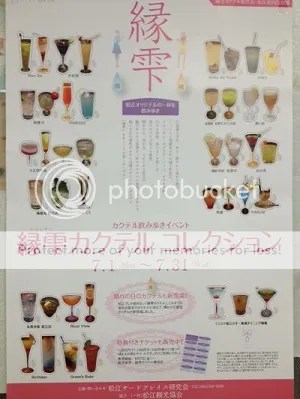
From now until the end of the rainy season (the end of July), they are holding a special Enishizuku Chafe. Many bars and clubs around town are also participating an Enishizuku Cocktail Collection, offering limited time cocktails on rainy days and sunny days throughout the month of July. My interests lie more in tea than in alcohol… then again, I didn’t become a tea drinker until I was 19–the first time I had matcha it was so bitter I could never imagine growing such a taste for it. Come to think of it, I didn’t develop a taste for coffee until very recently. Maybe my taste for alcohol is coming soon.
Back to the Chafe, I was soon joined by a pair of twin two-year-olds. They were at that cute stage when they’re talking, but with baby-talk pronunciation. When I asked how old they were, they said “Nisshai!” instead of “ni-sai”, and as they shared their second of helping of higashi with me, they said “Oneechan, doJO!” over and over (instead of “Oneechan, douzo”—“Here you go, Big Sister!” It’s so nice when I’m still referred to as ‘oneechan’ instead of ‘obasan’…). What really surprised me was how they drank the matcha with such relish! The bitterness doesn’t bother them at all, and when I asked about the caffeine, their mother laughed and said they’ll still usually go right to sleep. They’re obviously better adjusted than I am.

As if sharing higashi wasn’t cute enough, when I was headed elsewhere I pass by them on one of the many bridges throughout where you can catch a glimpse of the Horikawa Yuuransen, the sightseeing boat that goes through the canals of the castle town all year long. They were waving and shouting things likes, “Where are you going?”.

The passengers on the boat found them just as adorable as I did. By the way, that’s Karakoro Kobo in the background.
June 26, 2013

It had a bit of a late start here, but tsuyu–the rainy season–is now upon us. Gray through the days are and uncontrollable though my hair is in all the humidity, there is a bright highlight to this season: ajisai, aka Hydrangea. These were some of the first flowers to be taken from Japan to Holland for study, however they were quite surprised when the deep blue flowers they saw in Japan grow into a firey pink once they planted them at home. This is because hydrangea have different colors depending on the pH level of the soil. Acidic soil will lead to blue flowers and alkaline soil will lead to pink flowers, but there is any range of blues and pinks and purples and whites in between.

This flower also has numerous possible meanings in modern hanakotoba (the language of flowers), some of which make sense with the color-changing tendancies: Capriciousness, arrogance, a persevering love, an energetic girl, ruthlessness, wantonness, a boastful person, betrayal, or even “you’re cold” or “you’re beautiful, but so cold!” Just by looking at this collection of meanings I can just imagine what kind of romance they might signify.
Of course, flower language isn’t a terribly old thing in Japan–it has a lot of its roots in Victorian flower language, so it’s taken on a lot of those meanings since Westernization. This native Asian shrub has been brightening the rainy season for centuries, and is the flower of choice to decorate the graves of the Matsudaira clan in Matsue.
Gesshouji is known as the hydrangea temple of the San’in region, and is is where the feudal lords who ruled over Matsue for 10 generations (following the short-lived Horio and Kyogoku ruling clans) are buried. The first of this Matsudaira line, Shogun Tokugawa Ieyasu‘s own grandson Naomasa, ordered Gesshouji named in honor of his mother who is buried there as well. Naomasa’s is the largest grave there, but the 7th generation lord, Harusato (aka tea-loving Lord Fumai), also has a rather will decorated grave, and a special grave for used tea whisks. A ceremony is head every April on the anniversary of Fumai’s death to bury the used tea whisks and thank them for their service.

The other Matsudaira lords are also buried through the foresty temple, which each grave decorated in its own unique ways (including special motifs for Fumai’s lesser-known sake-loving son).


Tranquil though it is, the graves are hundreds of years old, so as I was observing the flourishing hydrangea…



…my peaceful state of mind was quite suddenly interupted by a mis-step.

Had anyone had witnessed it I’m sure they would have laughed at my face.
But enough about me. How about more hydrangea?


There is plenty more to say about this temple than just one post will justify. It’s best just to see it for yourself–they provide an English guide, as well as tea and wagashi (how could they not with Fumai buried there?), and a small museum of Matsudaira clan artifacts. That, and my camera ran out of battery just before I sat down to tea this time. This kind of atmosphere, thick with the scent of flowers and rain, is best enjoyed in person, is it not?

Of course, this entry doesn’t even begin to touch on Gesshouji’s most fearsome ghostly residents… that is a story for another time.

He’s waiting quietly… and I think he may be grouchy because of that.
June 23, 2013

Fun fact: In addition to the naginata, the prefectural martial arts hall offers classes in wrestling, archery, sword use, and even ping pong and ballroom dance, but they do not have karate classes. This is what I originally went in looking for, so it was sort of by happy accident that I started practicing the naginata instead. That said, I love it!
June 20, 2013
サーチナの皆さまへ:私のブログを紹介してくださり、ありがとうございました。これからも頑張って山陰地域についての面白いことを英語で紹介致します。皆さまもぜひ、出雲地方に来られて出雲ぜんざいやぼてぼて茶を試してみてください!
Sweet red beans have been used throughout east Asia in a wide variety of culinary specialities, especially for desserts within Japan. Lightly crushed or smoothed to a paste, “adzuki” or “azuki” fill everything from bread buns to ice cream to pancakes to pounded rice cakes (mochi) to many, many different kinds of wagashi (traditional Japanese confectionaries). Rather than just a filling, they are also enjoyed in soup form. In the colder months, especially around New Years*, Japanese people throughout history have enjoyed the soft beans floating in a sweet warm broth or poured over a large, soft piece of mochi, or served cold in summer as a precursor to something like a refreshing and thick ice cream, but there is some confusion across the country as to what exactly this is. Is it oshiruko? Is it kameyama? Or is it zenzai?
This is much like the great pop/coke/soda debate in the US (for the record, it’s soda). Likewise, let’s set the record straight on zenzai.

A soup of mixed texture–bean paste as well as partially crushed small red beans–resulting in a jam-like consistancy, with at least a couple balls of soft mochi within. This is Izumo Zenzai.
Since it is typically written phonetically as ぜんざい, there is even some disagreement over the term “zenzai”–is it of Buddist origins(善哉), or Shinto origins? Out here in the Province of the Gods, the story has been recorded thus since at least the start of the Edo period in works of literature like “Gion Monogatari” and “Baison Saihitsu”.
As mentioned in previous posts and stories, all the gods in Japan come together at Izumo Taisha during the tenth month of the old calendar. While this is called “Kannazuki” (神無月、the month with no gods) in the rest of Japan, it is called “Kamiarizuki” (神在月、the month with gods) in the Izumo region. Having a bunch of gods among you is worth celebrating, and they did so with this dish: gods-are-here-rice-cakes, 神在餅. An alternate pronunciation of these kanji is “jin-zai,” thereby making this “jinzai-mochi”. However, Izumo dialect is known for having a bit of a slur and a drawl–or rather, like many other dialects in Japan, has completely different ways of pronouncing the same words. Therefore this was not pronounced “jinzai” as in standard Japanese, but “zenzai”.
Since the meeting the gods are having is all about en-musubi (binding fates for all humans with all nature, or more popularly understood as romantic matchmaking), zenzai also takes on a bit of an en-musubi meaning and is yet another way to indulge in en-musubi around the Izumo region.

En-Musubi style zenzai is typically served with a white ball of mochi and a pink ball of mochi. White and red (or pink) are colors typically associated with en-musubi.

Pretty easy to see where Kyomise is.
It’s a well known dessert (or any-time-of-day snack) out here, especially at the Izumo Zenzai chain across the Shimane Peninsula. They have music about zenzai, they have an official zenzai day (October 31), and they even host academic courses about zenzai. I’m pretty willing to say they’re the authorities on this dish if anyone is. This is the location in the Kyomise shopping district south of Matsue Castle.
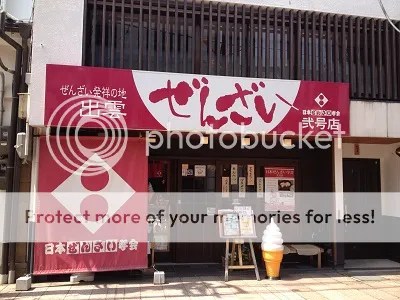

They don’t just serve zenzai here; but a number of other desserts. Notice the door handles? If you slide the door all the way open, they make a heart that says “en-musubi.”

Zenzai can be prepared in different ways depending on the weather and on your tastes. I love matcha with almost anything, so I opted for zenzai in matcha served cold.

It comes with some pickled sides to refresh your taste buds so you don’t get overwhelmed with the sweetness.
It’s a nice little place to rest a spell, or buy some en-musubi souveniers, including instant zenzai or chopsticks. Yes, rabbits are a big thing here. I’ll be explaining that in the next Kojiki mythology manga installment.

Of course, there are also disagreements between different regions of Japan on just what “zenzai” is. Was it originally sweet, or salty? Is it beans in broth? Is it beans over mochi with no broth? Is it beans over shaved ice?? At least there is some national distinction on what Izumo Zenzai is if it even has its own sandwich modeled after it.

*Zoni, a traditional New Years dish, varies according to the region in Japan. In Tottori and Shimane prefectures, it is typically made with lots of small red beans–very zenzai-like.
June 17, 2013

Not my kirigami illustration, click for source.
This is a story with variations throughout Japan (there must be a lot of very grateful cranes). This version is from Daisen Town in Saihaku District, Tottori Prefecture. It references Matsue City and Yodoe Town, which is now a part of Yonago City.

In some far away time, at some particular place, there was a little old man and a little old lady. Every day, the old lady would pull cotton to make two bolts of fabric, which the old man would take to Yodoe to sell. With the money from the first bolt he would buy rice; with the money from the second bolt he would buy more cotton. Thus was how they subsisted.
One day, as usual, the old lady finished her work and said to her husband, “Dearie, I finished two bolts ‘gain. Please take ’em to Yodoe and exchange one for more cotton.” Also as usual, the husband set out to do just that.
On his way, he noticed a crane flapping its wings helplessly as it struggled in a trap set up at the edge of a feild. Aw, shucks, that there poor bird is gonna die like that if nobody lets it go! he thought. But if I set it free, the fellow who set that trap is gonna be left empty-handed. Aw, man, what t’ do?
Well, I got these two bolts’a fabric. If I leave one’a them for the trapper, and then he’ll be happy and the bird’ll be happy too. That’s all there is to it.
Setting half of his load down at the trap, he released the crane, and it happily burst into flight and got away.
Then the old man continued his journey to Yodoe. He was supposed to use one of the bolts to buy more cotton, but since he was now only carrying one, he passed on the cotton and only bought a meager amount of rice instead. On returning home he explained to his wife how he left the bolt to save the crane and therefore couldn’t buy cotton on which they would rely for income, and she kindly replied, “How nice. You did such’a good thing t’day.”
As they sat down to eat their humble dinner that evening, they were visited by a very pleasant-looking woman. “Please excuse me,” she said as she invited herself in.
“Yes?” they responded.
“I’ve somehow found myself all the way out here, and I’m terribly lost. Ah! I don’t know this place and it’s gotten dark, so would you mind if I spend the night with you?”
In the reply, the two said, “We’re happy t’ let you stay, but we got no more rice or anything.”
“No, I do not require rice or anything. I’ve brought some,” she said. “Would you mind lending me a pot?”
They did so, and she brought out a paper bag full of rice which she boiled, and then implored them to eat with her. They thanked her and said, “We usually make a gruel or soup outta our rice to stretch it out, it’s been so long since we ate it like this!” They were quite pleased to partake of it.
The following morning when it should have been daybreak, the sky was dark with heavy rainfall. The girl asked if she could stay with them another two or three days. “You can stay as long as you want,” said the old man and old lady.
“Then I would like you lend me your inner room for two or three days. No one else is to enter, or even so much as crack open the door!” she ordered, and then disappeared into the inner room.
Naturally, this made the old couple very curious, and they figured it wouldn’t hurt just to slide the door open a smidge and peer on her. Upon doing so they saw not a girl, but a crane sitting at the weaving machine and pulling out its own feathers, which it then wove into beautiful, sparkling fabric. “Ah! Well I’ll be! That’s the very crane that was caught in that trap!” the old man whispered to the old lady.
Three days later, the girl emerged from the room holding a bolt of fabric. “Um,” she started. “Take this bolt of fabric to a vendor in town and sell it, alright?” So saying, she immediately turned into a crane and flew away.
The old man did as she instructed and brought it to a vendor in Yodoe. “Nope, this won’t do. I can’t buy this!” the vendor refused. “There’s so way I could afford somethin’ worth this much. Try takin’ it t’ the Lord’a Matsue instead, he might be able t’ give you a good amount for it!” Therefore, the old man went out to Matsue to seek out the feudal lord.
The lord granted him an audience, looked over the cloth, and then exclaimed, “This is excellent! It’s made of crane feathers, isn’t it? I had been wanting some fabric like this, but since no one sells any, I couldn’t buy any.” The lord gave the old man a very, very great sum of money, which he happily took home.
Though they had made a meager existance on producing a small amount of fabric every day before, they could now could afford to take days off and still eat well. They were quite happy, and never had to taste such suffering ever again.

 San'in Monogatari