Although the legend of the White Hare of Inaba (Inaba-no-Shirousagi) takes place mostly in eastern Tottori, the Izumo region celebrates the story in its myth and En-musubi-filled atmosphere. For instance, there are a handful of gift shops around Matsue and Izumo specializing in stones, especially Izumo magatama comma-shaped jewels. These tama were often produced in the region out of local Izumo agate, and are a very characteristic souvenir, so you find them in the major tourist areas–in front of Izumo Taisha, or around Tamatsukuri Onsen (literally “jewel-making hot springs”), Matsue’s samurai street Shiomi Nawate or Kyomise shopping district. However, you never find one of these stores without little stone rabbits sold right next to the array of magatama.

Click photo for source and shop info (Japanese)


Click photo for source and shop info (Japanese)


Click photo for source and shop info (Japanese)

Speaking of Tamatsukuri Onsen, the resort area in southern Matsue is not only lined with fancy hotels, charming shops, and free foot hot springs in the river and its own En-musubi power spot, but it also has little statues featuring legends and characters from the Kojiki, such as this one of Onamuji and the white (or hairless) hare.

“But… but I have no money to pay for medical services. I’m a hare.”

Matsue is full of En-musubi power spots, both old and from only 1999 or so. A more recent example of a spot that everyone visits to collect their luck and take a photo at is along the banks of Lake Shinji on the grass lawn between the Shimane Art Museum and the water. It’s a very, very short walk between this famous spot and the perfect sunset viewing spot, so these “Lake Shinji Hares” get a lot of attention.

Because I see them all the time, both in print and in person, I never think to take pictures of them. The day I did go to take pictures of them, though, my camera was doing something weird and they all got over-exposed. There’s this sense of doom that the hares are taking over.

There is a custom of giving shijimi clam shells from Lake Shinji to the second rabbit for good luck in matchmaking.

“Give… me… your… SHIJIMIIIII…”

I don’t get it either.

The legend is also celebrated with a large statue on the ground of Izumo Taisha Grand Shrine. Hmmm… but what would little Onamuji be doing at Izumo Taisha?

Click photo for source.

Two thirds of the Kojiki myths take place in the San’in region. Though most of them take place in the Izumo region (primarily modern the cities/towns of Izumo, Matsue, Unnan, and little bits of Okuiizumo and Yasugi), the White Hare of Inaba–Inaba-no-Shirousagi–takes place primarily on the eastern end of modern day Tottori in what used to be known as Inaba Province. The name makes my inner Persona 4 fan smile, but the name typically only remains as a general area name rather than a town itself (though there are districts in larger cities in other prefectures called Inaba, too). The white hare itself is originally from the Oki Islands, which you can read more about in this entry. Izumo still has a guest mention in this myth, as Onamuji and his 80 brothers are originally from Izumo.

While the actual location of the hare’s entry point on the mainland and godly encounters are fairly definitive, I haven’t found any materials indicating his point of departure from Oki. Based on the point of the island located closest to the Tottori shore, Daft Logic says it would be a 109.449 kilometer journey in a straight line. What’s more, if the hare’s fur was already white, then it would have been winter at the time. Talk about a brisk journey! And how about counting those sharks/crocadiles? If we were to assume a meter for each of them, then that’s 109,449 sharks/crocodiles. I think it’s fairly safe to assume the hare wasn’t counting.

I decided to have this blog cover the whole San’in region instead of just the Izumo region specifically to include this story in the Kojiki narrative, but I have to admit I still have yet to visit eastern Tottori, the Oki Islands, or for that matter, anything west of Hamada in Shimane. The Izumo region is where I gather most of my material, and I’m a touch biased. I meant to take my own photos though, really! For this entry, you’ll have to bare with borrowed photos, and I’ll focus on other sights when I eventually get to Tottori-shi and the Oki Islands myself.

First off, a huge thank-you to Bernice at Made in Matsue for letting me use some of her photos. Please check out her entries for more photos of Hakuto Beach and Hakuto Shrine.

Hakuto Beach is where the white hare was said to arrive, lose his fur, get fooled by the 80 brothers, and finally have his encounter with Onamuji. The place where the potential suitors met Yagami-hime is likely close to there, and though it is not explicit, it’s probably okay to assume she lived in or somewhere around Menuma Shrine, which is dedicated to her.


Thanks, Bernice!


Thanks, Bernice!

Hakuto Shrine, the shrine across the road from the beach, is said to be the specific place where the hare met Onamuji and healed himself in the Mitarashi Pond. As this is a shrine dedicated to the hare, it is also an En-musubi shrine, as well as a shrine to go to ask for healing from skin diseases. This also the sight of the most photographed statue of Onamuji and the hare (there are a handful of other statues in the Izumo region, too).

Thanks, Bernice!


Thanks, Bernice!

According to this 6 minute Japanese video about visiting the shrine, a special En-musubi custom of the shrine is to purchase a bag of white stones (five for 500 yen), and try to toss them on top of the stone torii gate. If it lands on top, your wish will be granted for sure. Otherwise, just leave the stone with the rabbit for good luck. This is just one of many, many special shrine customs in addition to the usual omikuji, ema, and omamori customs common to just about any Shinto shrine. En-musubi customs are especially popular.

Those are the primary points to cover for where the legend actually is said to take place. The Izumo region, though it is home to Yamata-no-Orochi and Yomi legends as well as legends I haven’t even touched on yet, doesn’t let the Inaba keep its claim to Kojiki fame. No, the hare has left its mark everywhere on this side of the region. Apparently it was a well traveled little hare, but if it hopped across over 100,000 beastsworth of sea, I supposed it’s not surprising it if made a tour around other parts of ancient Japan.

Let me start by saying naginata armor is a big investment, and nonetheless I had been thinking about buying my own anyway, though struggling over what to do with it when I eventually leave Matsue. However, the teachers at the Shimane Martial Arts Hall knew of my interest in eventually taking part in competitions and rounded together some used armor for me! At this point, I still lack a helmet/mask similar to the ones used in kendo, but I have a torso-guard, gloves suited for changing your grip on a long weapon, and shin gaurds for the ankle strikes.

So far I’ve only practiced in armor a few times, and have yet to spar. The main difference being that my partners–usually elementary school girls who are far more experienced than I am–hit my ankles directly instead of having me block them. I still need to gaurd my head, but since they all have helmets, I hit them directly when we practice. Of course, this has startled my friends who have come to watch my practices.

I can’t tell you how many mostly-disembodied eyeballs are found in gift shops around the San’in region. They’re popularity is all thanks to the influence Mizuki Shigeru has had on popular conceptions of youkai, a somewhat frightening, somewhat endearing cast of Japanese goblins and ghouls. He is most famous as the manga-ka who wrote GeGeGe no Kitarou (introduced in this entry last Halloween), but he would introduce himself first as a world explorer and folklore researcher. Wherever I go looking for youkai information, I always find his name in the works referenced! As beloved as his comics are and as much as you see them everywhere around here, his life has been very unique and merits special introduction.

The manga-ka/explorer/folklorist himself, either surprised by his fame or surprised by… well… who knows what.

Mizuki Shigeru (whose real name is Murai Shigeru) was born in 1922 in the port town of Sakaiminato in the little part of Tottori nestled close to the Shimane peninsula. There was an old lady who helped take care of his household, and she was very religious and told little Shigeru about the monsters that lurked in their midst. He was captivated by these stories, also remembers being captivated by an illustration of hell populated by demonic creatures. As you can imagine, it was the kind of art deemed not appropriate for children, but once seen, children may carry it with them forever.

Little Shigeru listening to ghost stories from “Non-Non-Ba” (Religious Granny).

He encountered real terror later on when he was drafted into the military in 1942 and sent into combat on Papua New Guinea. In addition to watching his comrades die, he caught malaria, lost his left arm in an air raid, and become a prisoner of war. While everyone else was growing thin in their poor wartime conditions, his commander found it odd that young Shigeru seemed so well-fed. This was because he had a knack for getting along with the natives. He got along so well, in fact, that they offered him citizenship, land, and a bride.

He was highly tempted to accept their offer, but the military doctor guilt-tripped him into returning home to see his parents once the war ended. He did so with the intention to return to life with the natives on Papua New Guinea, but his post-war predicament back in Japan prevented him from doing so. Instead, the one-armed man worked in a movie theater until 1957, when he made his debut writing super hero comics. Later, he began writing the early adventures of his most famous character, Kitarou.

Like any good Japanese citizen at the time, his accepted an arranged marriage. Her name is Nunoe, and I believe she is from the nearby town of Yasugi. Together they scraped by through poverty and manga deadlines, and at some point, Kitaro exploded with popularity. With its catchy theme song and years and years of anime remakes about the montrous encounters of the title character and his band of regular cast members (everything from what remains of his father (an eyeball), a floating bolt of cotton, an old couple, a cat girl, and a rat man), you could say that it’s like the Scooby-Doo of Japan, except that–as far I know–Scooby doesn’t have an airport named after him. Kitaro is the kind of thing that pretty much every Japanese person has been exposed to in one remake or another, and it is particularly celebrated in and around Sakaiminato, Mizuki-sensei’s hometown.

In addition to his years of research, manga, and fame in regard to youkai, he has also written historical manga about the atrocities of WWII, and has recently been releasing his manga take on the Kojiki (I only noticed this after I started writing my own. As you can imagine, it makes me feel quite inadequate). Busy though writing manga probably keeps him, his interests do not keep him in Japan. Although he is one of the most thorough researchers of youkai in Japan, he has also traveled all over the world studying folklore and making friends with the locals. His fame has drawn more attention to his life story, and the the memorial museum dedicated to his life and works has exhibits about both his world travels and collections, as well as his life story illustrated by both photographs and illustrations from his autobiography. The museum also brings to life his research on Japanese youkai, and even has a model of what his house was like when he lived and struggled there with his young bride. There was even more interest generated in their lives when she released her own autobiography, “GeGeGe’s Wife”, which later had two live action adaptations.

As of my posting this on Halloween 2013, Mizuki-sensei is 91 years old and resides in Tokyo, still busy as ever. He sometimes returns to his hometown and provides original illustrations on the walls of his memorial museum and along the road of youkai statues and youkai-themed products and costumes characters that lead from Sakaiminato Station to the museum. I already admired him and had heard the basics of his life story before paying a visit there, but I left with a much deeper appreciation. Theoretically, since he’s still alive and comes back to visit, I suppose it would be possible to meet him someday. But what would I say or ask first to such a wizard, besides “this lowly worm is unworthy of calling herself a comic artist and purveyor of culture in your great presence”? I get the feeling he’d laugh that off, though.

Matsue is considered a rather large city in the sparsely populated San’in region, and life in the center of town is easy. I have a ten minute walk to work or to Matsue Castle, and a plethora of grocery shopping options that are easy to get to. A car ride twenty minutes in any direction, however, will take you the outskirts of town where life is simplier. Nature is abundant, as are farmers. Agriculture is still a major industry for this reason, and it’s hard to see remnants of Japan’s burst bubble because the bubble economy didn’t reach this region much. In many ways, Shimane and Tottori seem to follow their own train of history which goes at a more leisurely pace than the better-connected areas of Japan. On that note, the Chuugoku mountain range makes it unlikely a bullet train route will ever be built out here.

In addition to being a place where rustic nostalgia paints the landscape, this is also the land of myth. Many of the Kojiki myths are tied directly to the geography of this region, and I’ve spent a handful of weekends getting my JET friends in the inaka–the rural areas–drive me around to go hunt down places associated with the Kojiki myths. On one particular September afternoon, I met up with a friend in Shinji, a southern district of Matsue on the banks of Lake Shinji which borders the town of Unnan. While driving along to where we think we’re going to find the shrine in my guidebook, we make small talk.

“So, how’s life in the inaka?”

“It’s good.”

“Ever see any tanuki around here or anything?”

“No, this is my third year, but I’ve never seen a tanuki. I’ve seen monkeys chilling by the side of the road, though!”

“I see nutria where I live sometimes, but never monkeys!”

Around this time of year, the rice is harvested when it turns the right shade of gold. Throughout the inaka of Japan, you’ll also notice the air is hazy with the smell of burning waste from the harvest.

When the maps on our phones are no longer helping, we look around on foot. We can’t find the shrine, but we can see the figs are ready for picking soon! These are a local product of the Izumo region (some Japanese friends in bigger cities didn’t even know that figs were grown in Japan).

We finally asked for directions from a group of ladies who were taking a break from their harvest, who very cheerfully informed us we were on the wrong side of the hill. Shimane is known for having record numbers of centenarians, and these ladies are perhaps the oldest looking people I have ever met in Japan. Furthermore, they spoke with the thickest Izumo dialect I have heard yet. Through toothless smiles and leathery skin they point up the road and give us detailed directions, and off we go, much better off having asked.

It took a bit longer than we expected, but we found the shrine, and I gathered material for a future post to go with a future manga myth rendition, with only a few autumn mosquito bites to show for it. As we were heading off to go meet up with friends for a dip in the onsen, I got one more glimpse of Shinji’s charming sights.

“STOP!!!! IT’S A TANUKI!! BACK UP! LOOK! LOOK, WE FOUND ONE!” – Buri-chan, the shotgun driver

Not everything in the inaka is so charming, though. Unlike my encounter with a mujina/nopperabo, however, I have photographic proof of this disturbing encounter! It’s as if she follows you all the way from Unnan back through Shinji, waiting on the side of the road just to jump out and startle you.

This is what I’m used to seeing. This happy child is something I’ve encountered all around Japan, a friendly warning to drivers to watch out for children who might dash out into the street. Brightly colored and noticable, he seems to do alright at his job.

But one day, she appeared.

It’s a good thing I wasn’t driving, or I might have crashed in surprise to suddenly see a disturbingly unhumanlike human suddenly accost me from the side of the road. She wasn’t just in one place, either–she was everywhere, lurking along the sides of innocent looking streets. As I was started to adjust to her presence, suddenly we really did see a real child standing at the side of a neighborhood road with a similarly wide stare. Though this was a good little girl who did not dash out into the street to give us the heart attack of our lives, both the driver and I were startled that time to see something live in the place of this soulless girl we had expected to be standing there.

She’s watching you…

Despite the San’in region being a land of ghosts and goblins, I’m not a very superstitious person. That said, I did have a freaky experience once at my local convenience store. As I was leaving, I saw a large man standing right behind me reflected in the glass door, but there was nothing remarkable about his face. He looked like an anatomically correct human, but his face seemed to be missing human features. It was too brief a moment to even react, and before I could even turn back to get a better look he had walked the other direction and all I could see was his back.

Perhaps in Western ghost-story-telling tradition this sounds a little lame–so I didn’t get a good look at a reflection that suddenly showed up behind me. Big deal! And what kind of setting is a FamilyMart for a ghost story anyway? However, people familiar with the folklore of Japan have immediately responded, “ah, so you saw a mujina!”

If I had to find a term for what I saw… then yes, it would be a mujina or nopperabo!

The terms tend to be used interchangably, but they are not the same. A mujina, the name you tend to hear most often, is referring to a tanuki-like (but not necessarily tanuki) mammal, who shapeshifts into human figures in order to deceive humans. A nopperabo is more human in origin, the main characteristic being that they have blank skin for faces. Part of the reason mujina may be in wider use as a term for a faceless being is because of Lafcadio Hearn’s influence on Japanese tales and their retention today, however close or not close they may be to the originals. While he is widely credited in Japan for committing to public memory many ghost stories, many modern Western Japanologists are critical of his work partly because of his less than reliable grasp on the Japanese language. He collected ghost stories from all over Japan, but many of them were told to him through his wife Setsu, who didn’t speak much English. It is possible that what he wrote of the mujina in Kwaidan (1904) was actually supposed to be about nopperabo.

…But she continued to weep, hiding her face from him with one of her long sleeves. “O-jochû,” he said again, as gently as he could, “please, please listen to me! … This is no place for a young lady at night! Do not cry, I implore you! [O]nly tell me how I may be of some help to you!” Slowly she rose up, but turned her back to him, and continued to moan and sob behind her sleeve. He laid his hand lightly upon her shoulder, and pleaded: “O-jochû! O-jochû! O-jochû!… Listen to me, just for one little moment!… O-jochû! O-jochû!”… Then that O-jochû turned round, and dropped her sleeve, and stroked her face with her hand; and the man saw that she had no eyes or nose or mouth, and he screamed and ran away.
Up Kii-no-kuni-zaka he ran and ran; and all was black and empty before him. On and on he ran, never daring to look back; and at last he saw a lantern, so far away that it looked like the gleam of a firefly; and he made for it. It proved to be only the lantern of an itinerant soba-seller, who had set down his stand by the road-side; but any light and any human companionship was good after that experience; and he flung himself down at the feet of the old soba-seller, crying out, “Aa! aa!! aa!!!”…
“Kore! Kore!” roughly exclaimed the soba-man. “Here! [W]hat is the matter with you? Anybody hurt you?”
“No, nobody hurt me,” panted the other, “only… Aa! aa!”…
“Only scared you?” queried the peddler, unsympathetically. “Robbers?”
“Not robbers, not robbers,” gasped the terrified man… “I saw… I saw a woman, by the moat; and she showed me… Aa! I cannot tell you what she showed me!”…
“He! Was it anything like THIS that she showed you?” cried the soba-man, stroking his own face which therewith became like unto an Egg… And, simultaneously, the light went out.

(Source and complete passage here. “O-jochû” is a polite form of address for a lady you don’t know.)

One of the other big local names that is famous world-wide for recording creepy stories is Mizuki Shigeru, the manga author of Gegege-no-Kitaro and many other thoroughly researched works. In his hometown in Tottori, Sakaiminato, is home to over a hundred bronze statues featuring Mizuki’s characters and his interpretations of Japan’s varied cast of youkai. This is his take on a nopperabo.

Click for photo source (Japanese)

A notable difference many people bring up between Japanese ghost stories and Western ghost stories is that they are more about creepiness than horror. Ghostly encounters do not necessarily have to spell your doom (though many do), but they are bothersome at some level or another. I can understand the creepiness of mujina/nopperabo as they are so humanlike, but any striking or even only slightly noticeable difference will send off messages in our brains that something is very wrong. If you’re looking for new ways to freak yourself out this Halloween season, search around the internet for things in the Bukimi-no-Tani.

If you’d rather just learn about some interesting tales of creepy things without needing to burn bothersome images into your memory, then read Lafcadio Hearn‘s Kwaidan or any youkai-related work of Mizuki Shigeru. As I was opening WordPress to write this entry I also noticed Cristy at Takeshita Demons had just made a nopperabo reference as well in a recent entry, and Hyakumonogatari Kaidankai is always a good source for youkai talk, too.

Just one variation on an iconic shot.

Despite being Matsue’s most festive month, October is passing me by and I’m not making it to many events due to being busy elsewhere or too busy doing things at the events to hold a camera! That means I have nothing to show for this year’s Little Mardi Gras parade and live jazz events to celebrate the 20th anniversary of the Friendship City relationship between Matsue and New Orleans (besides saying it was great), and only have my memories and few photos of last year’s Dai-chakai and Do-gyoretsu Drum Parade.


October is also one of the only times of year when you can set foot on an iconic piece of Matsue, Yomegashima, the only island on Lake Shinji. Stretching 110 meters east to west and 30 meters across, the island near the southeast bank of the lake and looks like a round slab of flat island that flung onto the surface of the water and stayed there. Actually, that is the scientific theory–possibly lava from someplace like good old Daisen? That would make it very similar to Daikonshima, the volcanic island on Lake Shinji’s sister lake Nakaumi that is famous for its peonies.

Yomegashima is not famous for its scientic origins so much as for its legendary origins, though. It is said that a young bride was married off to a cruel family across the lake, and unable to bare it any longer, she decided to runaway and go back home. In her hurry, she took a short cut across the ice that had formed on the surface of the lake, but just as she was close enough to see the lights of her home village, the ice broke and she fell in and drowned in the icy waters. The gods that were watching took such pity on her that they made the island spring forth in her honor. Hence, it is called “Bride Island.”

I don’t know how long it’s been called this, though–back in the 8th century when the Chronicles of Ancient Izumo was being compiled, it was called something more like “Snake Island,” but it was already called “Bride Island” by the time Lafcadio Hearn arrived at the turn of the 20th century.

The poor drowned bride doesn’t always need to be lonely, though! I went just after the rain had cleared on a day last October when they were sending boats out (they did the same this October too, but I was busy!). Local guides explain scientic and legendary aspects of the island to visitors, and then you can take your time to wonder its 240 meter circumference and then stop and enjoy some matcha (because that’s what all the cool people do out here).

The view from the shore


The view from the boat


The view from the island

One of my first impressions when I arrived was how flat it was and that there were shijimi clam shells underfoot. It’s the most famous of the seven (tasty) wonders of Lake Shinji.


While apparently not totally resistant to waves on stormy days (unless those were very athletic shijimi), the island has been protected by rows of Jodei-ishi, designed by Kobayashi Jodei, a famous craftsman of the Matsue domain in the Edo period when Matsue was actively ruled by the samurai class. The material is Kimachi stone, which is still taken today from the Kimachi area of southern Matsue to carve into lanterns are other such decorative items. The Jodei-ishi that surround and protect Yomegashima today are the same stones that were placed there in the Edo era, and photographic evidence from the Meiji and early Showa periods shows that they were also placed around the Sodeshi Jizo, a pair of Jizo statues by the shores which are almost as iconic as Yomegashima itself in Matsue’s famous sunset scenery.


As for some human efforts made to ease the loneliness of the mythical drowned bride, early photographs show that there originally wasn’t much on the island at all, but early in the Showa period a couple of citizens donated a large number of pine trees so that a small forest grows there now. At the front of the forest, facing the sunset viewing spot on shore, is a torii gate so as to dedicate the island as a shrine to the goddess Benten.

I’ve been to the island by boat, but there is also an annual event you can sign up for to walk out to the island. They set up a walkway just below the surface of the water. I’ve missed this twice, but I hope next time both to try it out for myself and see what a trail of people walking on water would look like! With my luck I won’t have my camera with me, though.

While matcha (powdered green tea) a higher grade of tea than steeped tea, not all matcha is created equal. While thin matcha, o-usu-cha, is gathered from the top handful of leaves of shaded tea bushes at only their peak in the season, o-koi-cha (thick matcha) is gathered from only very tip-top leaves. When prepared you use a lot more of this very fine powder to make a paste-like tea, as opposed to the more liquidy–but already very thick and green–o-usu.

The way o-usu and o-koi are served in the tea ceremony also differ. In o-usu, everyone gets their own cup to finish to the last drop, whereas in the very, very thick o-koi-cha, everyone–or at least a good handful–of the guests drink from the same cup, taking three sips at a time. The tea master prepares it based on the number of guests receiving it, and normally you would try to adjust how much you drink so that everyone gets a fair amount without leaving anything leftover–which means that sometimes the last person much drink three large mouthfuls and enjoy both all the benefits of such strong tea as well as all the side effects of the additional caffeine.

Given the difference in price, people usually save o-koi-cha for special occasions (though this is considered “the true taste of tea” by many enthusiasts) and serve o-usu-cha for everyday matcha use (and here in Matsue, it really is everyday use). I only get to enjoy the thick stuff as part of my lessons, which happen to be late at night.

Continued from Part 4


Onamuji’s adventures will continue in later stories from the Kojiki. In November, be on the look out for photos of places where this story took place, as well as the influence it still has on the San’in region! The white hare is everywhere.

Learn about the sites associated with this legend!
White Hare in Tottori
White Hare in Shimane

Or start reading the next story!
The Kunibiki (land-pulling) legend starts here.
(Or you can skip ahead to Onamuji’s next appearance)

Or see the Kojiki a.t.b.b. masterlist!
The Kojiki Myths in Manga Form

This is a post about some of the things that run through my mind while I’m practicing folding an obi for a kimono–specifically, while I’m folding one as fast as I can in preparation for a on-stage kimono dressing competition.

This is what it’s supposed to wind up looking like:

But it starts more like this:

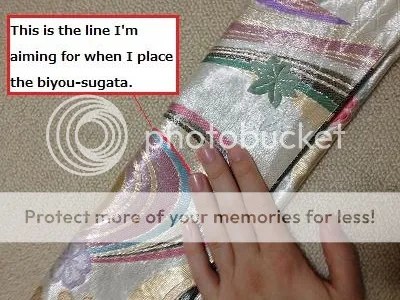
That funny-looking tool called a biyou-sugata is not commonly used in normal kimono dressing. Rather, it is a tool that allows you to fold an obi on the floor in front of you and then mount it on your back, so it is used for teaching purposes or competition purposes. One of the very first steps in folding your obi is to place the biyou-sugata in the appropriate spot on your obi, as all the other folds will be fastened to it.


I couldn’t help but laugh at myself when I finally figured out why I was getting déjà vu, especially since while I’m working in a hurry I’m a little concerned about the fabric wriggling away from me and messing everything up. Not that it has a will of its own, I think I just have lingering frustrations of never even being able to fold origami very well as a kid. Perfectionism has strange ways of messing with your mind.


A bunch of fancy moves and folds and snaps later, it’s ready to mount to myself. By this time, I should be wearing twenty-something pieces of under-layers (not exaggerating!) including a towel to bulk up my waist and achieve a tube-like shape, the kimono itself, and a thick elastic band around my torso on which to mount the biyou-sugata and finished obi shape.

Just the band itself would not be adequate, though–there are two sets of strings to fasten and then hide (the pair on top immediately, and the pair below as a 3rd step), the length of the obi to wrap around the waist entirely, the obi-jime cord that fastens decoratively in the front, and the obi-age sash that is worn along the top of the obi (see photos above). These are fastened in succession, and while it should all look completely in the end, it doesn’t always work as well when I’m practicing in western style clothes (specially without the towel, in which case I can’t even fasten some of the strings in the proper location).


These photos are mostly taken during a practice I had with a friend who will be taken part of the first time, so Kimono-sensei had me briefly demonstrate the fukura-suzume (“stuffed sparrow”) style I did last year. I mostly remembered all the steps, I just didn’t remember to add all of my tools!


Without the proper layers, it won’t even stay up without me holding it! Every piece has a purpose.

You can see more details on the process for folding a fukura-suzume style obi on this entry from last year.

As mentioned before, this is my second time taking part, so I’m trying something new. This year I’m going with a bunko style obi, specially a butterfly-style one. It just so happens the ends of my obi this year had a black butterfly pattern on the back, but showing the reverse side of the obi isn’t really appropriate for festive kimono. If it’s just a little bit, though, that’s a little room for creative leeway. Hence, there’s just a little part of the black reverse side showing on obi. Hopefully it’s just the right amount to say “I did this on purpose because it’s chic” instead of saying “oops”. I once heard that with kimono, someone with a good sense of style will follow all the rules, but then choose one or two little rules to break. With any luck the judges have heard the same thing.

The really hard part with this one–which is cleverly avoided by the fukura-suzume–is that the two sides of the obi that wrap around the waist need to line up evenly, forming a nice diagonal line leading up to the bow they meet. If the length of this part of the obi is too short, it won’t even tuck in correctly, and if its too long (rarely my problem) then the bow will be too narrow. Even worse would be having the piece of the biyou-sugata attached to the end of the obi stick out at the bottom! Eek! In this case, lacking the proper shape-forming lower layers, I wasn’t able to achieve that evenness.

Another bit of déjà vu occurred to me last night as I was trying to hurry up with the process and hold everything in place while I was still actively trying to gather the fabric into the right shapes. Leaning over my piece of art I was trying to salvage and apply force with both hands and wondering how many precious minutes I had already wasted, I thought, ah, now this feels like practicing CPR.

Hopefully I won’t be quite so frantic on stage.

Design a site like this with WordPress.com
Get started