It’s Kouyou season!

Kouyou (紅葉) literally means “red leaves,” and while maple leaves do tend to take center stage, there are plenty of shades of other colors to enjoy as well. I had a little free time yesterday so I took a walk around the castle grounds, and was very refreshed to see all the different colors and how the fallen yellow leaves contrast the black stones, and how the green and red leaves contrast the black castle, and how bright they all were against the grey sky. I took the time to take note of what kinds of trees were in which places so can look forward to seeing them again in future seasons. For now, there are still more colors to come–it’s nice that autumn takes its time here!

Kouyou is not simply of a matter of noticing the leaves are changing–Japan has nature-viewing down to a science.

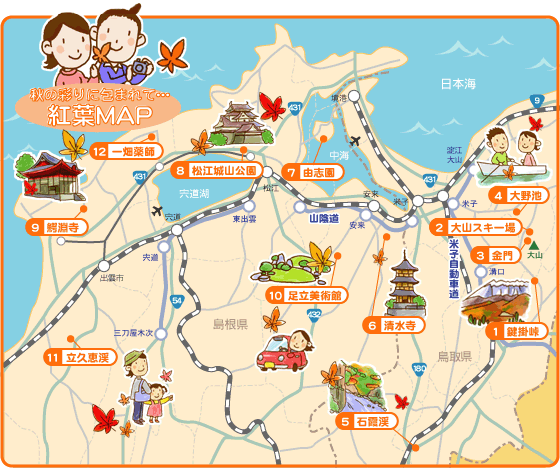
As much as I like noticing the leaves throughout town, there are certain spots that are very well known as leaf-viewing spots (thank you, Luc, for assembling the list corresponding to this map!):

1. Kagikage Valley 鍵掛峠(かぎかけとうげ)
2. Mount Daisen Sky Resort 大山スキー場 (だいせんスキーじょう)
3. Kinmon Gate 金門 (きんもん)
4. Lake Ono 大野池(おおのいけ)
5. Sekka Valley 石霞渓(せっかけい)
6. Kiyomizu-dera Temple 清水寺(きよみずでら)
7. Yuushien Garden 由志園(ゆうしえん)
8. Matsue Castle Jozan Park 松江城山公園(まつえじょうざんこうえん)
9. Gakuen-ji Temple 鰐淵寺(がくえんじ)
10. Adachi Museum of Art 足立美術館(あだちびじゅつかん)
11. Tachikue Valley 立久恵狭(たちくえきょう)
12. Ichibata Yakushi Temple 一畑薬師(いちばたやくし)

While there are stunning pictures of these places around the net…


…I’m still fond of the little places nearby.

Continued from Part 3

Continued here in Part 5!

There are multiple stories of Yamanba: “Old Mountain Ladies.” Some of these hermit ladies, like the kindly old Yamanba of Nishinoshima in the Oki Islands, are welcome visitors. Nishinoshima’s Yamanba would supposedly come down from the mountain around the start of winter, and teach the villagers how to weave fabrics and fish, before disappearing again towards the end of winter.

Then there were the feared Yamanba, like the one from this story from the Izumo region.


A long time ago, there was an Ushigata–that is, a merchant would would take goods from village to village on an ox. On this particular day, he bought some fish at the coast to sell inland. As he reached a mountain pass on Sanbe (the highest mountain in Shimane Prefecture), he was approached by a hideous Yamanba–her hair like silver, her gleaming eyes bulging, her mouth wide as if torn ear to ear, and her ghastly teeth large and sharp. “Hey, you,” she addressed him. “Gimme one of those fish. But should ya’ refuse…”

The Ushigata screamed and turned to run. As he picked up speed, the ox tripped, so he left it behind as he ran faster and faster as if falling. Soon he found himself with no place left to run, and he panted heavily as he looked for some place to hide. He spotted a little hut, and rushed in. “I’m sorry, but please help me!” he shouted. “I’m being chased by the Yamanba!”

He found, however, that the house was empty. Though he felt a little awkward entering someone else’s home, he had no other choice, so he hid himself in the rafters. Soon, he heard a growling voice outside. “Drat, he got away. I ate the fish an’ the ox, but I really wanted t’ eat that man!”

Oh no, I’m in her house. I’m done for! Kami-sama, tasukete kudasai–Gods, save me! he thought and held his breath.

As the Yamanba entered, she sat down next to the stove and wondered aloud, “Now should I sleep ‘er should I grill some rice cakes and then sleep?” Deciding on the later, she stuck some rice cakes on sticks by the fire. “Hmm. Does these smell like rice cakes, ‘er do they smell like human?” With a terribly sucking sound, she sniffed the air, then dozed off.

When he smelled the roasting rice cakes, the Ushigata realized he was terribly hungry. Feeling sure that the Yamanba was asleep, he used a long pole he found in the rafters to stab the rice cakes and pull them up so he could devour them. Soon after, the Yamanba woke up and noticed they were missing. “Where’s my rice cakes? Somebody stole my rice cakes! Who done it? Who’s there?” She then started to rummage around the hut looking for the thief.

Then, the Ushigata held his nose and quietly spoke like a Kami. “It was I who ate your rice cakes. Hi-no-Kami–the Fire God!”

“Ohhh, Hi-no-kami. Well, if a Kami ate it, there’s no helpin’ it. I’ll just go t’ bed. Letse, should I sleep in the rafters, or should I sleep in my cauldron?”

The Ushigata was hiding in the rafters, so of course he could not let her sleep up there. Using the Kami voice again, he said, “The cauldron is best.”

Thinking that it was a Kami who told her to do so, she climbed in the cauldron to curl up and sleep. The Ushigata took this chance to quietly climb down from the rafters. As he heard her terrible snoring, it occured to him that he should take that chance to rid the world of such a foe. He found a large rock outside, rolled it inside, and then put it on top of the lid of the cauldron.

The noise woke up the Yamanba momentarily. “I hear rumble-rumble birds singin’ out there, but it’s still night time!” So saying, she went back to sleep.

The Ushigata then proceeded to add firewood underneath the cauldron. Hearing the noise, the Yamanba woke up again, this time saying, “I hear rustle-rustle birds singin’ out there, but it’s still night time!”

Now, the Ushigata light the firewood, and as it started to grow, the Yamanba said, “I hear crackle-crackle birds singin’ out there, but it’s still night time!” Just as she said this, the fire roared, and the Yamanba tried to jump out of the cauldron. She was trapped by the rock on top, and screamed and thrashed around, but soon she grew quiet.

Once there was no sound coming from inside the cauldron, the Ushigata opened the cauldron and peered inside. There, he saw a giant old wolf with a mouth so wide that it looked like it was torn ear to ear, and it was burned to a crisp. Since then, no one ever spoke of running into the Yamanba.

Photo credit to my colleague for this photo taken near Sanbe this weekend! This is on the west side of the mountain (note the cows!). The “feminine” side, he explained, as opposed to the “masucline” east side where all the skiing spots are.

This doesn’t quite cover it, seeing as I get comments pretty much every time I put on my sunglasses. Granted, this might be the last we see of the sun for a while here! After all, the kanji for Izumo (出雲) could be interpreted as “where clouds come from.”

Does Gegege no Kitarou ring any bells for anyone outside of Japan? Here in the San’in region, he’s a very familiar face.

If I had to draw a comparison, then Kitarou is like the Scooby-Doo of Japan. He’s been around for decades as the star of a cartoon filled with ghoulish creatures, has had multiple incarnations over the years, and enjoys a wide audience. However, as far as I know, Scooby can’t shoot his knuckles like missiles. And Scooby probably has more left of his father than just a walking eyeball (that’s not Kitarou’s missing eyeball!). Not to mention Scooby probably doesn’t have a whole city covered in statues and memorabilia of him.

Scooby probably doesn’t have an airport named after him either.

Kitarou’s creator, Mizuki Shigeru, is from the port town of Sakaiminato in Tottori Prefecture. They will find any way to put Kitarou and other youkai (monsters) on anything.


There is more to Sakaiminato than just Kitarou, but a first glance around town would imply it’s just Kitarou. For instance, one of the first places you’ll see after leaving Sakaiminato station is Mizuki Shigeru Road, which has 133 statues of Kitarou, other youkai Mizuki-sensei has compiled research about, characters from other Mizuki series, and Mizuki himself. Almost every business on Mizuki Shigeru Road either is full of Kitarou merchandise or finds some way to incorporate Kitarou into the theme. A normal barber shop is very quickly a youkai barber shop, and a bakery sells bread shaped like Kitarou characters. And because anything goes as long as it has Kitarou, you also find places like this:

Of course no normal item would be acceptable. If it can be made to fit the theme, it will fit the theme! You see these water bottles being sold everywhere, but I only saw this warning once. Even if you can’t read Japanese, you can probably figure it out.

I haven’t actually seen that much of Gegege no Kitarou myself, but I know it well enough to have thoroughly enjoyed visiting. It would have been faster just to take a bus from Matsue, but I took the trains–and even once you get to Yonago station, you know you’re on the right track.

He’s best known for the various versions of the anime “Gegege no Kitarou” but he was the hero of several different related manga Mizuki-sensei wrote (which is not to say he was in every manga!). With a character design consistent but flexible enough to appeal to newer audiences, Kitarou is a classic (although frightening) hero–rather calm and collected, he does his best to beat the bad guys with his set of powers and comrades, and he generally gets along with everyone. Medama-Oyaji–his eyeball father–is also rather popular. Purely because his name means “Rat Man,” I have a soft for Nezumi-Otoko too.

I also learned a lot more about Mizuki-sensei himself, though I had heard the basics a few years back. His introduction, however, merits a separate entry some other time.

Of course, no introduction to Kitarou would be complete without hearing the theme song. Thankfully they’ve retained the same song (just in updated styles) throughout the various Gegege remakes over the years.

And on that note, Happy Halloween!

Continued from Part 2

Continued here in Part 4!

There’s usually something different printed on my yogurt lid every morning, but this one made me laugh.

This is called an omikuji. It may be safe to say they inspired the modern fortune cookie.

You can typically find them in any Shinto shrine (or Buddhist temple), and pay a hundred yen or so to draw a number, and then receive a corresponding fortune. They usually range from “little luck” to “great luck” (with the infamous “bad luck” or “curse” every so often–the first two times I tried omikuji, they were both bad luck!). The rest of the paper will usually have a more detailed fortune about love, money, health, and what not, but the overall luck rating is a very easy theme to imitate. There are countless promotions and toys and things to buy that will randomly assign a luck rating.

Interestingly enough, it seems Izumo Taisha doesn’t print overall luck ratings like the aforementioned, but they will say something breifly about your wishes coming true (願望), your public works (土木), marriage prospects (結婚), illnesses (病気), moving/relocation (移転), finding lost items (失物), trade (売買), feng shui direction (方位), travel (旅行), as well as some overall advice for the year, perhaps about specific things to try or avoid. While other omikuji I’ve seen may drabble on about these topics to make them general enough to fit any one, Izumo Taisha is refreshingly direct: “You won’t find it. You have the advantage. East is good. Good.”

I’ve always heard conflicting instructions about what to do with an omikuji: “take it with you for good luck!” or “don’t take it out of the shrine!” or “you have to tie it here to dispell the bad luck!” or “don’t tie it here, or it will come true!” or “if you don’t tie it here, it won’t come true!” Frankly, I think you’re only half-way partaking in omikuji customs if you don’t tie it at the shrine. It seems that in general, leaving it at the shrine will dispell bad luck and increase good luck–the thought on bad luck being that if you tie it to a pine (matsu: 松) tree, the bad luck will wait (matsu: 待つ) there at the shrine instead of following you. Given how many omikuji you see at any given shrine and how comparatively few curses there are, I’m thinking most of the good luck waits at the shrines, too.


My yogurt says I have great luck, and that good things will happen today. Perhaps to make that come true I merely have to sort my garbage/recyclables correctly. What I find funniest is the necessary disclaimer at the bottom: “This has nothing to do with an advertising campaign.”

As mentioned in this entry, I am learning to dress myself in a furisode (long sleeved) kimono within 8 minutes for a regional contest (regional covering the Chuugoku and Shikoku regions in Western Japan). It is a full day of competitions for women in different kinds of kimono, men, children, and then the foreigners all grouped together in whatever style of Japanese dress they choose. Of course most of them (or their teachers) choose to go with flashy styles.

As promised, I have pictures to show what a biyousugata is–that is, the tool I use to fold the obi in front of me in a hurry instead of just standing up and doing it as I wear it (the typical approach). Seeing as they are mostly used for teaching and competition purposes, biyousugata aren’t typically included in a set of normal kimono tools (of which there are plenty). I suppose after learning the basics with this I might be able to learn normal methods more easily, but I haven’t tried yet–and for the next month and a half, I don’t have time to attempt that!

I start by arranging the tools to fold the obi–as well as the tools to fasten the obi to myself, which are not pictured here. The first thing to do is set the biyousugata and obi in place together.

Seconds later, it looks like…

Then it starts to look like a football with flowers. Or an elephant.

After some other ninja-like moves, it’s complete!

Sensei says I need to trim my obi-making time down by at least a minute (though altogether, I need to trim my time down by about 4 and a half minutes! It would help if the elastic to keep my collar in place wouldn’t snap off!). But of course, when I hurry I tend to skip steps or make it sloppy.

This one I took a whole 4:23 to fold…

This one I did 33 seconds faster, but can you tell where I messed up?

Been practicing about five weeks now, and there are five more weeks to practice. Ganbarimasu!

Yes, this is really what I do for work. CIRs wear many hats, but little do most people know that ninjutsu is part of the job description, at least when it has to do with creating tourism promotion material.

We happened to do this on a day when what looked (and sounded) like a couple hundred kindergarten students were visiting the castle. There were large groups peeking over the bushes and chanting ‘nin-JA! nin-JA! nin-JA!’ altogether to get our attention, and then countless voices from within the castle, ‘look, there are ninja! There’s ninja! Ninja, ninja!’, and then as we posed closer, ‘Hey, those aren’t real ninja…’

A big thanks to the talented Jinjer Templer for taking the photos!

Design a site like this with WordPress.com
Get started