The height of someiyoshino cherry blossom season is about over, but there are other varieties of cherry blossoms that bloom a little later. A number of them are in Suetsugu Park, right by Matsue City Hall, so I took a windy lunch break to go take a look.

This type is called Goza-no-ma-nioi, which I’d roughly translate as “the scent of sitting”. That said, I didn’t detect much fragrance, but the bunched blossoms are neat.

Eigenji: pillowy white blossoms, still not much fragrance.

Fugenzou: large, multi-layered blossoms. Still not much fragrance.

At last, I found a couple of very fragrant trees! While there were slight differences in their scent, they both smelled like cherries (which makes sense). Other varieties that I detected fragrance from didn’t strike me as having such a pleasant, fruity smell, so I rather enjoyed these.

I’m not sure what these white ones are called, but I liked them anyway.


Rather large and fluffy petals.


A very pale pink, if you’re looking for it in the younger blossoms.

Out of all the types of cherry blossoms I’ve seen, (I don’t have pictures of them all–there are still more blossom types all over town), I’ve decided youkihi are my favorite. They have more petals, more color, and more fragrance than many others. This is, however, only personal sentiment–cherry blossoms are appreciated for more than these attributes, and the someiyoshino can’t be topped when it comes to the beauty of scattering petals. That’s okay, the youkihi are still around to enjoy one they’re gone!


When I got back to the office after lunch, I found some sakura mochi left on my desk, as someone had brought them to distribute around the office. I’ve been seeing them here and there since February (a little early, but better early than late so as to foretell the coming of the season!).

Basically, they are a soft, thin, lightly flavored mochi (pounded rice) sort of pancake filled with sweet, smooth azuki bean paste, and held together by a cooked, salty leaf. It’s okay to eat them with or without the leaf.

Full bloom cherry blossom viewing photos here and here, while other varieties are here.

I mentioned in the previous entry that I practice the naginata. This is not just for fun in the martial arts hall–I have to protect Lord Horio!

As you can see, the job of a CIR can cover a wide range of activities. Well, not that this was for work, but being placed in Matsue means that I get to take part in things like the annual Warrior Parade which reenacts the moving of Lord Horio and his troops into the new domain of Matsue in 1611. There were several different roles and groups, and I was placed among the lady warriors, meaning I got to look menancing in peach and wield a prop naginata (though dancing with one is different from training with one, both methods are quite fun!). Directors from across the country came together to help train a couple hundred budding samurai for the event, and we started practicing a couple months ago.

The parade was set to take place on Saturday, April 6, during the height of cherry blossom season–especially around Matsue Castle, the finale spot. The weather on Friday was perfect–warm, sunny, not much wind.

But that perfect weather was the problem. Due to the warmth, there was plenty of moisture in the air, and there was a very foreboding weather forecast. We knew ahead of time that there was a strong likelihood of rain on our parade–and not just rain, down pour. On the final practice the night before the parade, the resourceful directors announced the back-up to do it in indoors.

Indoors!? I thought. We can’t spread out across the streets and march across the city? That does not fit my mental image of this event!! I wished really, really hard for sunshine, as I’m sure many of the others did, too.

On the day of the parade, the rain started as soon as I stepped outside in the morning. We all gathered several hours before the parade so we would have time for getting into costume and taking pictures (a huge thanks to all the volunteers who got everyone dressed!), and everyone was still in high, hopeful spirits. With everyone stopping each other for pictures, it felt like everyone got together for a samurai convention or something.


Lord Horio’s wife and daughters had really impressive, detailed wigs, but I didn’t get a chance to snap a picture of them personally. These ladies danced with cherry blossoms branches.


Our group leader and sub-leader looked even cooler than the rest of us! We shall proudly follow them into battle!


Last minute practice sessions–and last minute routine changes!


However, the weather was getting worse and worse.

Late in the morning, they called the outdoor parade off and decided to hold it inside the rotunda instead, though our one practice of the cramped rotunda version the night before had been far less than graceful.

A whole parade in this space? No!! I was so disappointed I wanted to cry.

Crying, however, would not have been a fitting reaction for a warrior, so we all pulled together for more flexible strategy. It took adjusting our the movements we had been practicing for months so as to not injure the crowded audience (or each other!), and even in the moments before we took our turn performing, our group leader whispered new instructions to everyone that we had never brought up before. Samurai must think on their feet, and obey with loyalty! Our performance mostly went well, I think.

These pictures will kind of give you idea about the naginata routine.


Thanks, Jin-san!

Thanks, Jin-san!

Of course, I stopped taking pictures once it was time to go on, but the amazing Jin-san has a gallery here. Watch the video he put together, too:

At the end of the performance, the directors (all grown men) were all crying because they were so moved–at least, I hope that was the case!

Good job, everyone! Let’s do our best next year and be prepared for sunshine!

Matsue CIRs double as ninja and as samurai.

By shouting “men” I’m not shouting that I must attack the masucline gender. Rather, like in kendo, men (面) is a strike at the face.

I’ve been practicing the naginata at the Shimane Prefecture Martial Arts Hall for six months now under the tutelage of a few teachers, including the #1 ranked competitor in Japan for two years running (she’s quite cool!). While not as well-known as kendo or kyuudo, the naginata also has a long history closely tied with warrior history. While it’s hard to say exactly where it started (some sources say it’s based on the weapon General Guan Yu used in China’s Three Kingdoms era), one of it’s most famous wielders in Japan was Benkei, who had a lot of ties out here in the San’in region!

In the Warring States era, warriors used this sort of sword-on-a-stick to reach horseback riders, but as the country transistioned into a time of peace over the course of the Edo era, it gradually became the weapon of choice for samurai women, should the time ever come when they must protect the home. It was considered ideal for women because they wouldn’t have to be too close to their opponent, and despite its reach, it can be used in narrow spaces. As women started to receive education outside of the home as Japan was westernizing, they frequently learned how to use the naginata as part of their physical education. While it sounds like it may be a male-dominated sport outside of Japan today, in general, it seems to be more popular with women here. In my class, for example, we only have two male students. (Conversely, the judo classes are pretty skewed in the other direction!)

While it’s okay to practice in regular street clothes, most of my classmates (albeit most of my classmates aren’t even half my age!) wear traditional style clothes for practice, including the pleaded trousers know as hakama. Hakama also have a rich tradition of use in many places, but the ones used for martial arts practice are thick, washable material that’s okay to get a little rough in. They can be a bit drafty, though–I always wear something underneath–and they don’t carry the same forced-formality as a kimono. Case in point, some of my young classmates fool around by sticking their arms down the slits at the slides and then flapping them around like wings.

Continued from Part 5


Continued in Part 7

I’ve been seeing these manjuu (sweet dumplings) everywhere since arriving in the San’in region.

Turns out they’re a souvenir based on the Dojou Sukui, a 300-year-old comical dance about digging for loaches, but the silly fisher is distracted by things like mud splashing in his face or getting bitten by a leech or his loaches getting away. It’s a well known folk dance all over Japan, but it’s strongly associated with the city of Yasugi. The dance is usually performed with the cries of a-ra-essassa! from “Yasugi-bushi” (“The Song of Yasugi”) as an accompaniment.

Yasugi in relation to Matsue

There is a performance hall in Yasugi where you can watch this dance (and get lessons, I think), but when getting there is a little difficult, there’s always Youtube:

This is just one example. While the basic elements of the jolly dance remain the same, the expressions vary depending on the performer. One very famous performer is Yasuo Araki-san, a very spirited 86-year-old man who has performed this dance all around the world. He speaks at least Japanese, English and Russian, and you can read his English blog intro here. He also shakes hands at any opportunity! I lost count of how many times we shook hands in the two times we’ve met, and when the car I was in was driving away and he couldn’t reach my hand through the window like the passengers in back, he flashed me a peace sign.

I had the pleasure of learning this dance from Araki-san, as well as a short zeni-daiko (coin drum) dance–this is a local instrument that’s bit like a decorated paper towel roll with tassles and filled with coins. Learning the basics of the Dojou Sukui dance didn’t take long, but it requires a little silliness.

We're going on a loach hunt, we're going on a loach hunt!

We’re going on a loach hunt, we’re going on a loach hunt!

Dump the mud out of your basket to find those tasty loaches!

Dump the mud out of your basket to find those tasty loaches!

That silly loach, trying to get away!

That silly loach, trying to get away!

I'm bringing home so many loaches! Won't my mommy be so proud of me! ...Hmm. "Loach" doesn't fit in this American rhyme very well.

I’m bringing home so many loaches! Won’t my mommy be so proud of me! …Hmm. “Loach” doesn’t fit in this American rhyme very well.

Araki-san said my footwork was really good. I wonder what that says about my loach-catching abilities? He enthusiastically encouraged me to go over at any time for more lessons, and I received his official letter of recommendation, as well as a couple pieces of supplies for performing this dance when I leave Japan someday. If I could put together the outfit, it might be fun. We didn’t use them this time, but the dance is performed with a 5-yen coin tied under your nose! …I have no idea why. It seems I still have much to learn from Araki-san.

It's usually a thank-you present, it seems...

So it was just a little debacle about using the wrong stamps, whatever. I was more surprised when they called me afterward, having tracked me down by just the first name written on the cards. Then again, seeing as I have post office bank account and this being the neighborhood post office, maybe my face helped too.

Little did they know I loathe polka-dots.

Quite an exciting item to receive! But what could be inside?

I am offended! I demand sponges to clean up this mess.

Yes indeed, I received apology sponges. It’s not the most exciting gift box, but the collective value of the items was probably more than they overcharged me in postage.

As an American, I’m typically happy just to hear a heartfelt apology and leave things be, and I don’t typically mind when people in the service industry make honest mistakes. It happens! In Japan, however, no matter how quickly the offended party may offer forgiveness, the offending party must err on the side of being overly apologetic rather than inadequately apologetic. One of the things that may come to mind is ritualistic suicide of the samurai class. Although seppuku could be handed out as a dignified punishment, this was also done out of one’s own volition to express one’s fault for having offended their lord. In the early Edo period (roughly starting 1600 AD, or around the time of Matsue’s founding as a new castle town), laws had to be enforced about when this style of apology was appropriate, otherwise the samurai class would all too enthusiastically start to kill itself off. That being said, I wouldn’t want to over-simplify the matter of seppuku and its meanings and uses, so I strongly suggest reading Inazo Nitobe’s “Bushido: The Soul of Japan” for an English explanation of samurai ethos aimed at Western audiences.

Although it of course should be taken with a grain of salt, the Japanese Culture Lab has a video to help explain some of the modern methods of apology.

Got all that? Get your sponges together, and let’s all do our best to show our remorse Japanese style next time! I mean that in the most admirable of ways–apologies are an art form.

Not only is it sakura season, it’s hanami season!

Literally, it’s flower-seeing (花見), but hanami is not only a matter of seeing flowers–it’s a matter of going somewhere special to have a picnic and appreciate nature with your friends. Pack your plastic tarp, get some beer, and get some food from the local vendors, it’s time to relax! Assuming you don’t have allergies, anyway.

My friends I went to the town of Unnan, specially the area known as Kisuki. It’s one rated as one of the top 100 cherry blossom viewing spots in Japan. Accordingly, it’s well prepared for flower-viewers with manju (sweet dumplings) of all kinds and street food vendors everywhere from the parking spot to the picnic spot. That being said, though, they don’t detract from the sight and atmosphere.


The main spot for the cherry blossom festival is along the Kuno River, a stream that runs along the Hii River. The rest of the town remains fairly quiet, at least from my observation as we were driving around later.

Tree tunnels!


This is where we sat, too.

There are cherry blossom good all year round in Unnan, including fancy scarves and other items dyed with different parts of the flowers and the tree. The last time I was there, my friend bought me a little jar of perserved buds. They’re used for making a brew to drink on very special occasions (such as weddings), but can also be eaten as is. They’re surprising salty! I thought they might be nice with crackers and cream cheese, so I brought all these things for our picnic.

I figured out later than they go well with Nutella, too.


And riceballs! I’ve also heard they make good additions to sugar cookies. Maybe next year.


The hot water makes them open. These are yae style blossoms, apparently!


Carbonation, however, does not make them open. It was worth a shot.

The biggest mistake we made with our hanami was bringing too many things for the picnic. By the time we got to the Okuizumo winery for lunch, none of us were hungry anymore!

Despite being so salty, they don’t have much fragrance. Always worth trying to find a scent anyway–the flowers are really soft, more so than many other kinds of blossoms!

More varieties of sakura here and here.

“When, in spring, the trees flower, it is as though fleeciest masses of cloud faintly tinged by sunset had floated down from the highest sky to fold themselves about the branches. This comparison is no poetical exaggeration; neither is it original; it is an ancient Japanese description of the most marvelous floral exhibition which nature is capable of making. The reader who has never seen a cherry-tree blossoming in Japan cannot possibly imagine the delight of the spectacle. There are no green leaves; these come later: there is only one glorious burst of blossoms, veiling every twig and bough in their delicate mist; and the soil beneath each tree is covered deep out of sight by fallen petals as by a drift of pink snow.” — Lafcadio Hearn, ‘In a Japanese Garden’

One doesn’t have to be especially well-versed in Japanese culture to know that the cherry blossom–the sakura (桜)–holds a special place in the Japanese heart. While in China they are likened to the physical beauty of a woman wearing pearls (this is the root of the written character, originally written 櫻), and in western flower language it was associated with a good education, in Japan it’s laden with not only associations with inner and outer beauty and purity, but also with life itself–specifically, its transience. In a number of ways, it was especially representative of the samurai–as it is first among flowers, so the samurai should be first among men, and if both the flower and the man must be short-lived, they should go out with a bang (or petal-blizzard, as the case may be).

While it is still a reminder of transience, in modern times it serves as a reminder to go out and have a picnic.

Right now, you can’t go anywhere without seeing cherry blossoms of multiple colors and varieties, though the 5-petal pale colored ones are most abundant (a variety called someiyoshino).


These are yae style blossoms with lots of fluffy petals.


This type is called oshimazakura and is pure white. It has a fragrance unlike most other varieties.

The first time I went out of my way to see the cherry blossoms was at Senju-in, a temple northeast of Matsue Castle on a hill overlooking the city. It is famous for a shidarezakura (weeping cherry tree) that is over 200 years old, and is typically one of the first to bloom around the area. If you go during the day the temple will serve you tea, but if you go at night, the canopy of blossoms quivering softly in the wind are lit up, and you can enjoy the view of the city as well. In addition to the shidarezakura, the temple also has a someiyoshino and a yaebeni-shidarezakura (which blooms later in a more of a crimson color). I went on a very still, quiet night, and while the cherry blossoms don’t have much fragrance themselves, the scent of incense and the flowers at the gravesite lingered in the air, and it was also a perfect night for moon viewing.


I wonder if the other flowers get jealous?


Of course, this is only one of many famous sakura spots. Another popular place to take the day to relax is the Tamatsukuri Onsen area, where there are about two kilometers straight of someiyoshino cherry trees along the Tamayu River.

The Matsue CIR ninja are on patrol to make sure visitors do not get attacked by falling sakura shuriken! That is, until we take a break at the ashi-yu (hot spring foot baths).

Special thanks to Jinjer Templer for this shot! Check out his nightime Tamatsukuri Onsen cherry blossom pictures, too.

More full-bloom cherry blossom viewing pictures are here.
More varieties of sakura here and here.

Continued from Part 4


Continued in Part 6

To follow up the previous post about camellia, one of the first things I ever learned about them was that unlike most flowers, they don’t just lose their petals little by little.

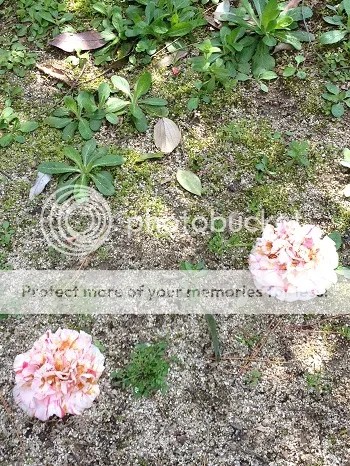
Although some varieties do shed petals somewhat profusely.

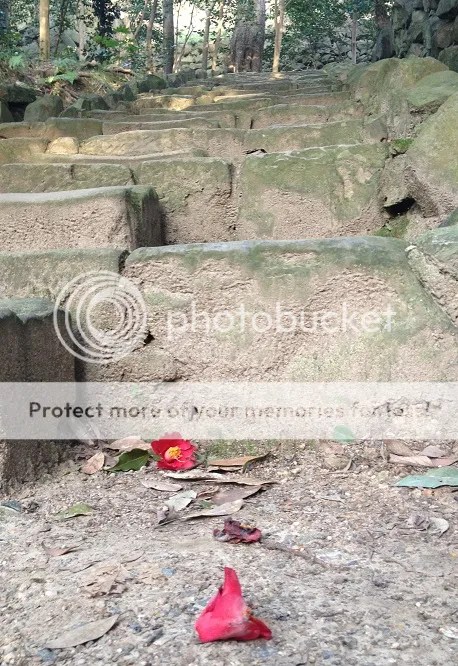
Rather, most of them just roll off the tree in their entirely and hit the ground with a plop–pottori!–and this reminds some people of heads. Therefore, the darker association with camellia is that they can signify an untimely, sudden death.

Of course, there are plenty of other flowers with morbid meanings, and it’s not as if this is the first thing that comes to mind people see these flowers. In the Edo era, when the castle town of Matsue was founded, these bushes were planted in abundance because their oil was used for polishing katana–nowadays it mostly used for polishing hair. Some people might also be reminded of the 1962 Akira Kurosawa film Sanjuro and their use as a plot device in that movie (not to mention part of the title character’s on-the-spot name).

Whatever the association might be, where there are camellia bushes (or trees, as the case may be!), there are fallen blossoms on the ground, and I rather enjoy them. It’s hard to say why–maybe because it’s interesting to see where they wind up, or maybe it’s similar to how people feel when they see cherry blossoms scatter?


Design a site like this with WordPress.com
Get started