I had always liked rice–although for most of my life, that meant wild rice of some variety, or if it was white rice, then it was the kind you could just throw in the microwave, add soy sauce to, and mix up with whatever meat or vegetables are being served with it. Why, I even recall making a single serving of microwaved white rice to eat as a snack sometimes. That became harder to do after my first trip to Japan, where the rice is served and kept a shiny bright white, eaten with something on top in the same bite such as a pickled vegetable or crumbled seasoning, or simply as it is–because it’s good exactly as it is. It is wonderful exactly as it is. I don’t really need to stress the importance of rice in Japanese culture here (because I’ve already done that before), but suffice to say people care about it being served properly, and although all rice is supposed to be good, some rice is simply better than others, and many prefectures are fierce about their pride in their rice. Nita Mai (“Nita Rice”, from a district of Okuiizumo town called Nita), is one such variety of luxurious tasting rice–I received some as a gift instead of buying it myself to try. And yes, the cool summer nights and clean water do indeed make for special rice. Makes for special sake, too.
November 9, 2014
Nita Rice
Posted by Buri-chan under Buri-chan Anecdotes, Local Anecdotes | Tags: food, rice |[4] Comments
October 28, 2014
Hiking in Oni-no-Shitaburui
Posted by Buri-chan under Local Anecdotes, Mythology | Tags: Izumo Fudoki, nature, Okuizumo, oni |[11] Comments
The title is a bit of a mouthful, and it’s also in reference to a mouth–the shita in Oni-no-Shitaburui means “tongue.”
Why? Because the ogre (oni) is flapping his tongue around like water.

See the face?
Welcome to one of my favorite hiking spots in the San’in region, found in the heart of Okuizumo!


Click for map source (Japanese). Also, recall Kanayago Shrine and the Goddess of Iron Working.
This is a roughly 3km long V-shaped valley, with a boulder-filled river at the bottom of the V.


Knowing the legend of the goddess Tamahime and the wani (crocodile… shark… thing) that loved her as recorded in the 8th century Izumo-no-Kuni Fudoki records, I went looking for what was left of this lovestruck and stuck beast.


This rock was supposed to be mean something… but I totally forgot what!


Rather than the archaic word wani, the area is now named after a Japanese beast of a different variety, an oni. They are horned creatures sometimes translated as “demon,” but I would prefer to call them ogres. Just because they don’t typically get along with humans throughout folklore doesn’t mean they’re evil, after all. But even if they’re misunderstood, you probably wouldn’t want to run into one all alone in the woods.
This particular oni is stuck in the river, and people say that this rocks looks like its face. Some people also loosely explain the name change as that the wani turned into an oni, but I don’t have any sources for this–it seems more likely that people just say that to tie up loose ends.

Though many locals know the love/hate story about the spot, the oni term is its common name, so after a nice hike you can enjoy lunch at nearby places with names like “Oni Soba” (because Izumo Soba is big here under any name).

Wait… what is that?

Aaaaaahhhh!!!!
Just another day in the myth-filled inaka.
October 24, 2014
The Fudoki a.t.b.b. – Beauty and the Crocasharkagator
Posted by Buri-chan under Historical Anecdotes, Mythology | Tags: animals, Izumo, Izumo Fudoki, kami, kojiki, shinto |[4] Comments
This is local mythology that fits in alongside the Shinto legends known throughout the country, but it was recorded in the Izumo-no-Kuni-Fudoki (Chronicles of Ancient Izumo, 713-733 AD) as opposed to the Kojiki (711-712 AD) or Nihonshoki (720 AD). The manga this time is a single installment, and we’ll take a look at the associated geography in the following entry.

Don’t forget who Okuninushi is! He’ll continue to be important.
Why the ropes? That’s in reference to Kunibiki (start reading that story Fudoki story here.)


Recall that we first encountered these creatures in the story of the White Hare of Inaba. We’re fairly comfortable calling them sharks (in modern Japanese, same), but the word used in the archaic context is wani (translated from modern Japanese, “crocodile”).


Learn about the sites associated with this legend!
One of my favorite hiking spots in the San’in region, Oni-no-Shitaburui–where the crocasharkgator is stuck!
Or start reading the next story!
The rapid expansion of Okuninushi’s love life and rule over the land
(Note: This is local mythology that fits in alongside the Shinto legends known throughout the country, but it was recorded in the Izumo-no-Kuni-Fudoki (Chronicles of Ancient Izumo, 713-733 AD) as opposed to the Kojiki (711-712 AD) or Nihonshoki (720 AD).)
Or see the Kojiki a.t.b.b. masterlist!
The Kojiki Myths in Manga Form
October 20, 2014
A Sense of October in Matsue
Posted by Buri-chan under Local Anecdotes | Tags: art, boats, drums, edo, festivals, kamiarizuki, Matsue, matsue castle, suitoro, tea, yuuransen sightseeing boat |[8] Comments

The lantern I made for Suitoro 2013, featuring Matsue Castle, the Horikawa Sightseeing Boat, and my own spin on “Enishizuku.”
When asked about the best times of year to visit, I usually tell people to come to the San’in region–especially the Izumo region–in May or October. Everyone knows that cherry blossoms are spectacular throughout Japan in April, but I think the more impressive flower displays are in May. As for October, that’s Kamiarizuki.
The Japanese calendar has classical names for every month, and October is typically known as Kannazuki (神無月), “the month without gods.” However, only in the Izumo region is it known as Kamiarizuki (神在月), “the month with gods.” Put simply, this is because the many thousands of kami from throughout Japan are congregating in and around Izumo Taisha for a meeting.
Just to be clear, the Japanese calendar is sort of whack and many holidays are not celebrated according to the times they were originally meant to be celebrated. Kamiarizuki, although the phrase nowadays typically is in direct reference to Gregorian October, is not even a month long. Futhermore, it changes every year according to the old calendar. In 2014, the meeting of the gods is from December 1 to December 8. There will be events going on at Shinto shrines–most notably and especially Izumo Taisha, of course–over the course of that time, and many pilgrims do flock to these events.
But like the divide between religious Christmas and mainstream Christmas, the mainstream celebration of Kamiarizuki is festive and quite noticable, and even more of the public takes part in this. After all, it is a whole month long, and there are even free shuttle buses to and from Matsue Station specifically for everything going on around the castle.
In Matsue especially, October also implies Suitoro, the lantern festival. Hundreds of lanterns–everything from square paper lanterns decorated by children or by local professional artists to stone lanterns carved out of Kimachi stone–are placed around Matsue Castle every night the weather permits, and on the weekends they extend out to the surrounding streets, including around the Shimane Prefecture office and along Shiomi Nawate, one of the top historic streets of Japan across the moat from the castle mountain.
Besides the Matsue Castle Grand Tea Ceremony I already posted a handful of entries about, there are many events both during the day and during the evening on weekends. Some occur every year, others change slightly. For instance, the Samurai Residence (home to a middle-ranking samurai family which the street, Shiomi Nawate, is named after) is usually open late and has free evening admission so that people can enjoy concerts held there.

The backdrop for the concerts at the Samurai Residence
Matsue Castle also has later admission to enjoy the view of the lanterns, and the Horikawa Sightseeing Boat which cruises around the historic moats all day long runs a special night course to enjoy the view from below. The stage set up at the main entrance to Matsue Castle usually has some form of Kagura dance as well as other San’in region performers. Food stalls from local restaurants? But of course.
Last weekend I checked out an outdoor cafe and art exhibition set up to enjoy alongside the concerts at the Samurai Residence in which everyone working there was dressed in Taishou era style clothes, and then walked along the lantern-lit moat to go see a concert at Matsue Castle. Still, along the way, there was such a sence of peace in the glow of the night air–cool, but not yet frigid, quiet, but not silent. Groups of people–including families with teens, families with small children, families with grandparents leading the way most enthusiastically–were coming and going. Single wanderers, like myself, passed here and there, listening in to other’s conversations as acquaintances ran into each other.
“Oh! Fancy seeing you here!”
“Yes, I live close by, but you imagine that this is my first time to come enjoy Suitoro this year? Haha.”
“I came last weekend, too. Will you be going to the concert tomorrow?”
“I probably can… did you ride the boats yet?”
“Not yet… tonight I came for the shakuhachi concert.”
“Ah, I wanted to see the cafe! I think I’ll try the plum lemon tea.”
It’s like going out to enjoy the Christmas lights, only it’s not from your car, it’s up close and in person. It’s not just about the lights–it’s a chance to appreciate what others have created. Each performance, each booth and stall, each and every single handmade lantern, all unique and produced from the heart.
While walking along the moat, eyeing the lit-up boats and the reflections of the lights from all around on the water’s surface, whereas on the other side of the street the Edo period walls are lit just as much as necessary, I cannot help but wonder how many artists have passed that street in its hundreds of years of history.
Ah, but then again, I am an artist—and I have likely walked that street hundreds of times by now myself.

Another view of the lantern I made last year–yes, that is Lafcadio Hearn, who also happened to be an artist and took many walks along Shiomi Nawate.
Back home somewhat early that night, I could still hear the sound of October in Matsue–enormous do drums echoing through the city, as the neighborhoods break out their treasures from the store houses, pass the sake around, and practice the flute and drum tunes for a parade that has been celebrated since the Edo period–Do-gyoretsu. It rumbles like a distance thunder, but unlike the thunder, the beat goes on as it always had in the past. But we don’t live in the past–the familiar beats and echoes of the drum parade accompany the lantern festival, a modern traditional as much a part of local character as Kamiarizuki itself.


Yes, those are filled with sake.
——
Yesterday was Sunday, October 19th–the third Sunday of October, and therefore Do-gyoretsu, the drum parade. It was hard to spot the people I knew–it’s hard to tell if there were more participants or spectators, as it draws such a crowd. Furthermore, the weather was sunny and warm, perfect for a parade.
By the evening, however much the sounds of the drums lingered in after parties throughout the neighborhoods, the atmosphere of Suitoro took over again, and the night had just as perfect weather as the day. Windless, cloudless, and comfortably between warm and cool.
A perfect night for tea.
The local junior college tea ceremony club had set up a special event this weekend in cooperation with the special night-time Horikawa Sightseeing Boat canal cruises. Besides getting the enjoy the view of the lights along the streets, trees, and surface of the water, the boat was also lighted with its own lanterns and even a flower decoration attached to one of the posts, and there was just enough space for eight guests, two boat operators at either end of the boat cooperating in low-light navigation, and two students in kimono with a tea space set up for preparing tea.
In the low light it was hard to appreciate the appearance of the Horikawa boat themed wagashi and the individual tea cups, but the quietness of the night made everything else more noticable–the warm, autumn taste of the chestnut included in the wagashi, the fragrance of the charcoal used in the ceremony, the smoothness of the tea, and the subtle motion of the boat. I’ve ridden this boat countless times and could give the whole tour myself instead of interpreting, but it nonetheless felt very surprising and mysterious to see the 400-year-old stone walls of the castle, take a sip of tea as the boat was turning, and then see the lanterns decorating the street when I took the cup away.
The boat was full of people I didn’t know, and for once I was totally engaged in conversation on account of being the foreign face at a tea ceremony, and the others talked among themselves, perhaps assuming I couldn’t understand. A couple ladies with thick Izumo accents were trying to remember where the best soba restaurant on Shiomi Nawate was (came from just out of town, likely), an older couple were asking the boat operator when they’d be bringing out the kotatsu this year–ahh, November 10th, I see–(they were likely Matsue locals), and at last the quiet middle adged man asked if the tea ceremony on the boat happens all the time–what’s more, are these lanterns always there? He had immediately painted himself as a tourist–and as luck would have it, this Kanazawa native showed up on a perfect night for tea and lanterns! The older couple went on to tell him that if he thinks the boat ceremony is nice, he should have been there for the Grand Tea Ceremony and couple weeks beforehand.
I decided just to hold my tongue for once and let it look like I’m not the know-it-all I am. The silence was a welcome break from my usual chatter-filled, cultural exchange lifestyle, and I was content to simply observe the passing October moments.
October 17, 2014
Matsue Castle Grand Tea Ceremony–as seen by a guest!
Posted by Buri-chan under Buri-chan Anecdotes, Local Anecdotes | Tags: Matsue, tea, wagashi |[8] Comments

Although there will be special tea ceremonies in the Matsue History Museum on Sundays until November 2, the main Matsue Castle Grand Tea Ceremony 2014 events were on the first Saturday and Sunday of October, with 11 different schools set up around the castle area. I was serving in the Omotesenke tent on Sunday, so I spend Saturday trying out a few different ones.
Despite the approaching typhoon, turnout was good. The people engineering the tents were quite professional, and when the rain and wind started getting harsher on Sunday, they had us patched right away. The weather was very good on Saturday, however ominous the sky was looking early that morning.

I started with the very first seating of the day at Houenryu, a school that has been doing a British-fushion style tea ceremony with koucha (red tea, or black tea, as most of the West calls it) for the past few years, but decided to go back to its sencha (steeped green tea) roots this year. Not all Japanese tea ceremonies use matcha (powdered green tea), after all!
This school tends to use a large array of flowers, though they’re sort of paying homage to their koucha displays even though they toned it back a bit for the sencha this year. There are pine trees throughout this level of the Matsue Castle mount, so many of the schools incorporate them into their design.


Rather than western style tea cups, the tools had more Chinese style. Unlike most other sencha styles, they give everyone a teapot to pour their own second cup (they merely refill the water at the appropriate time).


Although served in advance, the wagashi (traditional Japanese confectionery) is consumed after the first cup of sencha so that you can appreciate the natural sweetness of the tea with a clean palette, and then taste its bitter tones in the second cup. The wagashi‘s motif is changing leaf colors, though unfortunately I didn’t capture much of the green side in this photo–visually, it was my favorite wagashi I had that weekend.

I had to take a break later in the morning to go to something else I had scheduled, but thankfully I had some time to stroll through the shops and food stalls, and take a look at some pottery from all over Shimane prefecture.

Back in the early afternoon, there were longer waiting times, but you can typically make a reservation for a later ceremony–I got to use all three of my tickets, but even as a single guest instead of with a group, I’m glad I checked in advance what times were open instead of pushing my luck! I stopped in for some matcha next at the Urasenke tent. I practice Omotesenke, and they are like the two major branches of the tea ceremony. Similar, but opposite in subtle ways (or so I’ve been told).
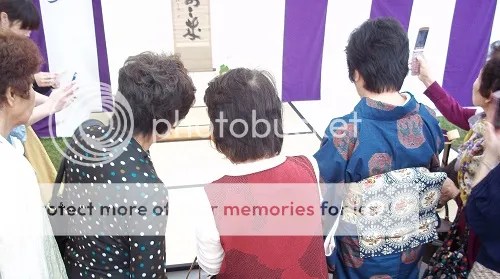
Like most of the tents, they had some treasured tools set out to observe in the waiting area, as observing tools and decorations is a big part of the fun (at the end of each of the ceremonies, everyone crowds around to observe (like shown below), which is why part of the ceremony involves cleaning your tools off after you’ve used them.


Unfortunately, I am not well-versed enough yet to be able to tell you why each of these tools is special. The tea masters are supposed to know all that, though, and there typically is someone explaining all of the tools and decorations and their meanings while the tea is being prepared, but by the time the wagashi come out I’m usually too distracted to listen. I was distracted by the pretty pattern on the bowl they were served in, too.

I wish I could say I noticed for myself what parts of Ura are different from Omote, but like I said, I was typically distracted by other details of the experience–like the tastiness of the frothy tea.

Since I can usually get my fill of matcha anyday in Matsue, I tried out another place for a sencha ceremony in the afternoon–this time, Urakuryu (not related to Urasenke). Besides a wreath with a display of seasonal vegetables, they also had a flower arrangement with pomegranates which I liked.

The explanation of how to appreciate sencha was really nice at this, as was the tea itself. It was on the astringent side of the favor profile, though.


They also had my favorite wagashi of the weekend. It was soft and light in flavor with a soft texture, and just a hint of citrus flavor. I could get hooked on these–too bad they’re one of the many wagashi designed specifically for the Grand Tea Ceremony and not available at all times!

At least there will still be a few more special Sundays at the history museum!
October 16, 2014
Grand Tea Ceremony, Part 5
Posted by Buri-chan under Buri-chan Anecdotes | Tags: cultural training, Matsue, tea |[5] Comments

I’ve served in an all-day tea event before at Ichibata Yakushi Temple by carrying the tea and sweets (o-hakobi), but the Matsue Castle Grand Tea Ceremony is one of the Top 3 (all three share this title, no one thing is chosen as Number 1) tea gatherings in Japan. Although I had done part of the preparing of the tea (o-temae) for my tea school’s private Hatsugama (New Years tea ceremony), this was my first time doing it in front of strangers–up to 50 of them at a time, though we served hundreds of people in one day.
I’ll admit, the tension was somewhat lower during this last ceremony. We had a decent number of people, but there were all tired and concerned about the wind and rain that was picking up outside the tent. The shoukyaku (guest of honor who drinks the tea prepared in front of everyone instead of the tea prepared in back) this time was a very talkative lady, so I guess that made me feel more relaxed as well. She also recognized me from when I attended the tea ceremony in the tea room floating on the Matsue Castle moat a few months ago, too, so I got to start my o-temae with an extra smile and bow to say, “Yes, that was me. Hello again!”
But really, the lack of tension and the tiredness from the full day of ceremonies, made me more relaxed than I had been during my previous two o-temae. I hate to put it this way considering how a lot of the tea ceremony revolves around caring about your guests having a good time, but to some extent, I didn’t care as much anymore–I still wanted them to enjoy themselves and the moment, but I just didn’t care as much about making mistakes and being caught (and judged) for them, and I was working somewhat automatically instead of running through nental checklists of everything to keep in mind at every step. Perhaps I achieved some state of “no mind” because I wound up unlocking my potential for a smooth and graceful o-temae.
I could tell I did a good job (however unappetizing–but cleaner–the cup of tea I wound up making was), and afterward when I enjoyed a cup a tea I had many people from the other schools who were watching tell me how good it was (after not having enjoyed such comments earlier in the day after my more nervous attempts). While chatting with one of the teachers next to me, I asked about the chatty shoukyaku–turns out she is another Omotesenke teacher, and she had been in charge of the Omotesenke tent the day before! She also had glowing praise for my o-temae, but afterward I made sure to go over and say hello (especially now that I knew who she was), and amid all the praise, I had to ask about the taste of the tea.
Her expression and tone changed a bit when she replied, “Well, I’m used to cups of tea like that…”
For as pretty as my performance was, the core of the ceremony still escapes me–I didn’t manage to make a tasty cup of tea!
Surprisingly, most of my lessons don’t focus very much on the actual preparation of the tea. We’ll address the amount of matcha powder to put in, the amount of water, the angle at which to hold the chasen (tea whisk) and the amount of time to stir, but taste is not really the measure of success. You can tell just by looking at the color and the froth on top whether or not you’ve made a good cup and can be happy to serve that to your guests, but there is something very disappointing about a dark green liquid with some random collections of bubbles on top on visible clouds of powder floating within. If I could hold the chasen more upright and stir it longer I feel I could make much better tea, but I was too concerned about form and the taste and texture were sacrified.
Well, I’m back to regular practice again for a while, and will be moving on to thick tea instead of thin tea soon–I expect to learn a lot more about the tea stirring techinque!

This photo was taken in the Urasenke tent, but the Omotesenke tent in which I served was set up in a similar way, so that the shoukyaku can see everything you’re doing.
Tomorrow I’ll have some photos from the places were I simply enjoyed the ceremonies as a guest–this makes me so glad it’s a two-day event.
October 15, 2014
Grand Tea Ceremony, Part 4
Posted by Buri-chan under Buri-chan Anecdotes | Tags: cultural training, Matsue, tea, wagashi |[2] Comments

I’ve served in an all-day tea event before at Ichibata Yakushi Temple by carrying the tea and sweets (o-hakobi), but the Matsue Castle Grand Tea Ceremony is one of the Top 3 (all three share this title, no one thing is chosen as Number 1) tea gatherings in Japan. Although I had done part of the preparing of the tea (o-temae) for my tea school’s private Hatsugama (New Years tea ceremony), this was my first time doing it in front of strangers–up to 50 of them at a time, though we served hundreds of people in one day.
Although most people only served once–twice if they were lucky–I wound up performing o-temae three times. By the end of the day the guests were dwindling, and we were already running out of the wagashi we had specially prepared and switched to some extras from one of the other tea schools. There was a huge lot of us in back with different jobs to do all day long, but we started the day with a cup of matcha, and made sure to end it that way, too. In the second to last serving there was only a handful of people (the rain and wind from the typhoon really started picking up towards the end of the day), so we had half the people serving go take a break and enjoy being served. Over the course of that seating, though, we had person after person after person dwindling in, which made o-hakobi with half the staff pretty confusing! Even the people who had finally had a break wound up drinking quickly so they could slip back and help make tea for all the late-comers.
After that one ended we figured the other half of the staff would take their break for the last serving, but I didn’t mind waiting until after the official part of things to have my cup–after all, no sense being understaffed when more people might wander in for that last-chance serving. Furthermore, I figured someone else would finally take a turn or have a chance to take their second turn doing o-temae, so I wanted to make sure that would go smoothly for them. But behold, no one felt like it and they were happy to have me do it.
So off I went to do it a third time! I’m afraid I might have exchange work to do next year, so there’s a good chance this is was my only chance–and I certainly got every drop of experience I could out of it.

The back-up wagashi we had (which I enjoyed the day before in the Urasenke tent), called “Unka” (Clouds and Flowers).

Look! The an is pink!
I’ll recap my serving experience a bit first, and then share a little about when I just went around as a guest the day before and tried out some other schools of tea!
October 14, 2014
Grand Tea Ceremony, Part 3
Posted by Buri-chan under Buri-chan Anecdotes | Tags: cultural training, Matsue, newspaper, tea |[4] Comments

I’ve served in an all-day tea event before at Ichibata Yakushi Temple by carrying the tea and sweets (o-hakobi), but the Matsue Castle Grand Tea Ceremony is one of the Top 3 (all three share this title, no one thing is chosen as Number 1) tea gatherings in Japan. Although I had done part of the preparing of the tea (o-temae) for my tea school’s private Hatsugama (New Years tea ceremony), this was my first time doing it in front of strangers–up to 50 of them at a time, though we served hundreds of people in one day.
We had three Omotesenke schools all working together on Sunday (other schools were in charge on Saturday), so in rotating out between a large handle of people performing o-temae, we had arranged for me to go somewhat early so as to have a higher chance of getting a second turn in the afternoon. That second chance just came much, much sooner than expected.
For as many mistakes as I have managed to make in practicing tea, this was the biggest mess I had ever made after having put the matcha in the tea cup. When I poured the hot water in, a bunch of matcha splashed out against the tatami, and there was a thick, paint-like layer of green around the cup above the tea itself–the tea probably was full of clumps, too. The majority of guests are served tea prepared by an assembly line in back, including people wiping the cups to make them look prettier–unfortunately for the shoukyaku (guest in the seat of honor) this time, he probably had the worst of thousands of cups of tea served that whole weekend!
I’ll recap my serving experience a bit first, and then share a little about when I just went around as a guest the day before and tried out some other schools of tea!