I wound up having summer vacation days to use not even two weeks into my new job, so I took my first trip out of the region then to go visit family and friends in the Chubu region. The fastest way to get there was by first going from the Matsue JR station to Okayama, where I transferred to the Shinkansen (bullet train). In order to get to Okayama, I took the Yakumo Limited Express.

“Yakumo” is a district in the southern part of Matsue. This was also the Japanese name author Lafcadio Hearn adopted when he became a naturalized Japanese citizen. “Koizumi” was his wife’s surname, and “Yakumo” was a bit of a hat-tip to the region. The train was established in 1972, and is operated by the JR (Japan Rail) West, and runs from Okayama from the Hakubi line, then switches to the San’in line in Yonago and goes on to Izumo. The Yakumo runs once an hour (15 of them per day), with an average speed of 77km/h (about 48mph).

(Please don’t mind the red circles, as this is a borrowed map I edited.)

I enjoyed watching the map on my smartphone continually update my location (where it had service, anyway) so I could see how it weaved its way through, east and west, east and west, and gradually north. The San’in Region can take a notoriously long time to reach because there aren’t any routes that go straight to, say, Matsue. Instead, the roads and train tracks weave through and along the Chuugoku Mountains, which are shaped so that developing towns and cities within doesn’t work very well. Instead, you’ll see many small towns and villages nestled in the little valleys scattered throughout.

When going from Okayama City (down in the San’yo region) to Matsue, the train first weaves through parts of Okayama prefecture along the Takahashi River, until it reaches Niimi (still in Okayama). After a mountain pass, it runs into western Tottori, and runs along the Hino River until you get closer to Daisen. All the while, it switches off between single line and double line train tracks, and frequently stops to let other trains pass by. The journey takes about three hours (okay, a little less than that. Just a little).

Here is a brief video of the Yakumo as it reaches parts of the Hakubi line:

Saw this in a Shimane Prefecture newspaper today:

Rough caption translation: Kento (the baby) says: “Last July I went to a summer festival and watched Kagura. My big sister cried, but I was fine even when a fox held me! I want to go see Kagura again someday!”

There are Kagura performances all over Shimane, and this one took place in Oda.

Kagura is an ancient form of dance with roots in Shintoism. The dances retell the stories of legendary gods. I’ve seen it in certain forms, but not a formal performance in a shrine yet. The time will come, and I’ll write more then!

This is a folk tale from Yoshiga Village, in southwestern Shimane Prefecture. It mentions a Jizo, which can be thought of as the patron Buddha of children (particularly deceased ones). Jizo statues are fairly recognizable, not just for his merciful face, but for the red scarf he wears. Jizo statues are found throughout Japan, and this is only the first of the Jizo stories I’ll be covering. Lafcadio Hearn, a famous author who lived in Matsue in the 1890’s, also wrote extensively about Jizo.

A long time ago, there was a boy whose mother had died. When he was about six years old, his father married another woman, and when his father was away, his step-mother would not let him eat any food. When he was out and about and saw others eating, he would sigh to himself about how tasty the food looked, and then he would return home and ask, “Mother, could I please have some food?”

“No, no, you can’t have any food right now, foolish child. Go out and play, and don’t say such silly things.”

And so he continued to go without food while his father was gone. Again and again he would ask, but to no avail, until one day his step-mother replied, “Fine, fine. If you want to eat so badly, take this riceball and feed it to the Jizo down there. If the Jizo eats it, then I’ll let you have some food. But if the Jizo doesn’t eat it, you can’t eat anything either.”

Overjoyed, the boy took the riceball and ran down to the Jizo. He cried, “Jizo-sama, Jizo-sama! I beg you, please eat this riceball. If you do, then I can eat something too! But… but if you don’t eat it, then I’ll never be able to eat while my father is away!” As he started to sob, the statue reached out a stone hand and took the riceball, with a crunch crunch he began to eat it.

The boy ran home and told his step-mother, “He ate it, Mother! He ate it! Jizo-sama ate the riceball, so I can have some food too!”

However, his step-mother replied, “Don’t say such stupid things! It’s impossible for a stone statue of a Jizo to eat a riceball! No matter what you say, I’m not giving you a thing!”

“I’m not lying!” he pleaded. “Come see for yourself! Get the old lady next door to come see, too! Quickly, while it’s still eating!”

Unable to calm him down while he was making such a fuss, they went along with him and say that the stone Jizo was still eating eating the riceball with a crunch, crunch, crunch.

The boy’s step-mother was shocked. “I’m such a horrible person!” she cried. “I never gave him any food, and told him to feed the stone Jizo even though I knew it was possible. Little did I think Jizo-sama would actually eat it! From now on, I’ll make sure to feed this child!”

From that time on, she always fed the boy, and she began to love him and treat him as her own child.


This is a famous Jizo in Matsue, “Oyukake Jizo.” It semi-literally translates to “the Jizo to pour hot water on.”

Can you say you have been bitten by one?

No matter how much you study Japanese language and culture, there will still be times when you find yourself completely unsure of proper behavior. All signs around me pointed to petting the penguin (or attempting to), but there is that hanging doubt: maybe it’s just common sense not to, and I lack that sense?

It’s the everyday things that make you doubt yourself the most. Do I say “excuse me” to the cleaning lady when I leave the bathroom? Do I grab the slippers that were offered to me last time, or wait for them to be offered again? Where in the world do I buy a train ticket from a stop with no ticket vender and no one even attending the stop except for a bunch of spiders?

That last one was exactly my question after I finished up my day at the Matsue Vogel Park. At least it’s fairly easy to get to because the train stop is right at the edge of the parking lot. I went expecting more of a botanical garden than a zoo, but you really do go more for the birds–unless you dislike birds, in which case you go for begonias and fuchsia, or the musical performers in the atrium.

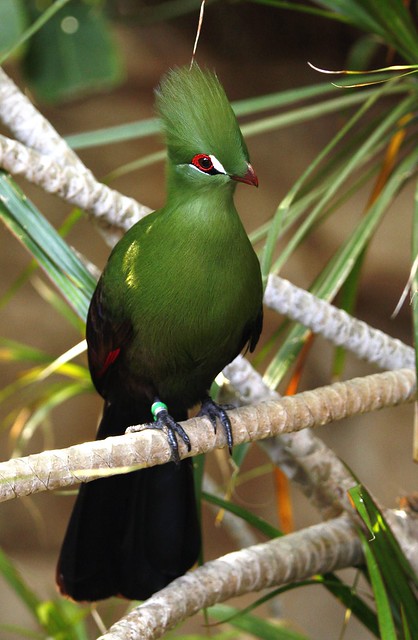
Thankfully I like them all, and I got a full day of sketching in, though it doesn’t take terribly long to walk through the entire park–especially since it’s all covered, so rainy days are fine too. There were lots of birds I had never seen before and that I certainly took a liking to–my favorites were the green turaco and white great rhea.

You can enjoy penguins in the parade (without petting them, they finally mentioned then), and you can also feed a variety of birds. I fed a toucan, an African cape penguin (not the one that bit me), and a pelican.

Their costumes change according to the season
Who needs a parrot when you can have a toucan?

The place is probably best known for their owls, though. Quite a variety! I saw the other shows, but I missed the indoor owl show.

An old story from Yonago, which takes place around Daisen, the San’in region’s highest mountain.

An elderly couple lived in an old hut at the foot of Daisen and kept horses. They were exceedingly pleased when one horse gave birth to a handsome foal. As they were settling down to the bed that rainy night, they were unaware of the thief who waited in the rafters for a chance to steal the foal, and the wolf that waited in the hay to eat the foal.

Lying down in bed, the old man said to his wife, “The most fearsome thing in the world, dear, is Koya-no-Mori.”

“That’s right. Koya-no-Mori is more dreadful than even thieves or wolves. When the sky turns such a dark color, I start to worry about it coming at night.”

“It certainly is terrible. When the Koya-no-Mori comes, we won’t be left with much of a place to live in.”

Unbeknownst to the wolf, Koya-no-Mori means ‘leaks in the old hut.’ As the wolf listened, he became indignant. “What is this Koya-no-Mori, and how could it possibly be more fearsome than me?” he thought.

Then, the old man felt something against his back. “Oh no, the Koya-no-Mori is here!” he cried, and he and his wife sprang to their feet.

“Oh! It’s here!” thought the wolf, and he ran outside to meet whatever foe this was.

The thief, waiting in the rafters, noticed something dash out and thought, “the foal is running out of the hut—now is my chance!” Without a second thought, he leapt out and grabbed onto the wolf’s back and clung on.

The wolf was thoroughly startled, and tried to run away as fast as he could, thinking, “The Koya-no-Mori! It’s got me! It’s got me!”

Trying to take shelter elsewhere, the terrified wolf ran up the mountain with the thief clinging to his back, and as it increased its speed, the thief held on tighter. Once daylight finally came, the thief noticed how thick it’s hair was, and saw that it was not a foal he was riding, but a wolf. Himself terrified and unsure of how to get off, he noticed a hole in the ground near the base of a tree, and at once he let go and was flung down the hole.

Relieved but still terrified, the wolf ran to find his animal friends in the mountains and tell them about the dreaded Koya-no-Mori. They were all filled with fear as they listened to his account of his encounter with and narrow escape from the monster, and at last the wisest among them, the monkey, spoke. “You said you flung it down a hole. You should show us where this hole is so we can investigate.”

The animals all cautiously followed the wolf to the hole, from which came the sound of horrendous moaning. “Wh-wh-what should we do?” the animals shuttered and asked the monkey.

Trying to hide his own fear, the monkey bravely put forth an idea. “I’ll lower this long tail of mine down into the hole and grab it, and when I bring it up here, we’ll all gang up on it and beat it up.” (Back then, Japanese monkeys had very long tails.) The other animals agreed, but remained nervous. However, when the monkey felt that there was indeed something down there, he yelped and all the other animals screamed and ran away.

As the thief felt the monkey’s tail, he mistook it for a rope and thought he was saved. He grabbed it tightly and yanked.

“The Koya-no-Mori! It’s going to eat me!” the monkey screamed, and with a swift yank he ran away, leaving his tail behind with the thief.

Since then, Japanese monkeys have not had long tails.

EDIT: Some photos of modern day Yonago (with Daisen in the background).


Izanagi and Izanami

Start reading the story of Izanagi and Izanami here!

How did the city of Matsue get its name?

First, let’s take a look at the kanji: 松江
松: pine tree
江: bay, inlet

It would be too simple to write this off as “Bay of the Pines,” because someone had to think of that at some point. There are two possible stories.

The first took place in 1534, 70 years before the founding of the city, when a man named Oomori Masahide (or Tadahide? we aren’t sure…) from Fukui Prefecture went on a pilgrimage to Izumo Taisha (the second most important Shinto shrine), and left records of where he had been. He wrote, “On the second day of the fifth month, I reached Izumo’s ‘Bay of the Pines’ (Matsue) area.” This area was likely around the mouth of the Iu River in Higashiizumo, where there were pine planted around the “Brocaded Bay.” The area was named for this scenery.

You can see flying fish in Matsue all the time, but these flying fish only come out once a year.

The Iu River in relation to the rest of Matsue

However, that’s a pretty narrow area, and even today, a good 20~30 minutes drive from, say, Matsue Castle. The other story (and probably more common one) goes that Matsue’s founder, Horio Yoshiharu, was given the following advice (more or less) from his trusted Buddhist monk friend, Shun-Ryuu-O-Shou: “So, Yoshiharu, I was looking at the scenery around Lake Shinji, and it reminded me of the scenery around the Songjiang (淞江) area in China. The character for ‘Song’ (淞) is pretty much like ‘pine’ (松), you know? They sound the same, too! Anyway, Lake Shinji also has the same sea bass and water shield plants that their river does, so I was thinking, you should totally name this place ‘Songjiang’ as well! Just write it as 松江, and it will be pronounced ‘Matsue’ in Japanese instead of ‘Zunkou’ (like 淞江). Cool, huh?”

Most of my research points to this being the modern day Songjiang district in Shanghai. In general, the natural scenery in Matsue still resembles that of southern China. My biased opinion is that it’s more like Hangzhou than Shanghai, though. Since they are Friendship Cities, someone else must have thought so, too.

Either way, the connection between pines and water is pretty clear.

As an introduction to this blog, it seemed appropriate to use one of my first experiences on the job here–my first job in Japan. My Japanese is generally functional, but not above these kinds of slip-ups. This is only the first of many!

It is worth noting, however, that I do love bushi–perhaps more recognizably known to English-speakers as samurai. As luck would have it, there is a history of them here, and therefore plenty of material to work with for this blog!

Design a site like this with WordPress.com
Get started