Please enjoy a few December views of Japan’s highest ranked garden–ten years running!–while I’m organizing photos from the kimono event. These are a few snapshots from my first visit to Adachi Museum of Art, in Matsue’s neighboring town of Yasugi.

Giving the number of shuttles that go directly to and from the museum, you can get there by taking shuttles directly from Tamatsukuri Onsen, Kaike Onsen, Yonago Airport, or Yasugi Station (the next station east of Matsue on the express lines, or four stations down on the local line). As easy as it is for individual travelers to make it there on their own (especially foreign travelers who get a half-off discount on admission!), you can expect to see a line of tour buses out in the parking lot on any given weekend. As such, my friend and I got there at 9am to try to beat the crowds. When we parked outside there were only two buses, but by the time we left there were at least ten!

The garden, a series of small self-contained worlds, varies both by season and by time of day. I visited during the later part of kouyou (autumn leaf) season, and the surrounding mountains of Matsue and Yasugi were all warm hues even on the grayest of days. At this early hour of December 1st, the sun was still relatively low in the sky, so there were slanted rays of light to peak through the leaves in the eastern gardens and cast a heavy shadow over the western dry landscape while illuminating the background mountains. Depending on what kinds of pictures you’re trying to take, the morning light can be a blessing or a curse.

This garden leads to one of two Japanese styles tea houses. The museum also has a restaurant and another cafe, all of which provide different views of the garden. One of the tea houses, Juraku-an, boils the water for the tea in a pure gold kettle.

Many Japanese gardens attempt to create a miniature version of a more vast landscape, with the arrangement of motifs mimicking patterns in nature. The large rocks are mountains, while the white gravel is a river coming forth from the mountains.

The natural mountains of Yasugi also make up part of the garden landscape. This peak is Mt. Katsuyama, where the Mori clan set up camp while battling the Amago clan. The war between these two clans influenced much of the western edge of Honshu before Japan was unified under the Tokugawa shogun’s rule.

Just because they use gravel as a water motif doesn’t mean they can’t use real water, too.

At the far right side of this picture in the distance, there is an artificial 15 meter waterfall–a part of the garden which you can see from outside the museum! The Kikaku Waterfall was constructed in 1978.

This was the only snap shot I could get of the pond garden on the east side. The sun was reflecting so brightly off the surface of the water that you can’t see anything in my other ones! With the naked eye, it was hard to look beyond the shimmering surface at the lively fish for very long.

With my simple point-and-shoot camera I didn’t bother trying to get any perfect shots. Even when setting up the shots I did take, it was hard to decide what to try to include and exclude, as even a little change in angle and zoom will result in a different looking world. You’re really only able to take in the world of the Japanese garden with your own eyes and physical perspective, and it was much more exciting to be there in real life than to see photos. There are parts of the pathway to sit and see the framed view of the garden that make it appear like certain styles of landscape painting, or like the scroll of a tea room in the tokonoma (decorative alcove). In place of a scroll in that room on display, they had a window.

In order for the garden to take on an active, immediate level of art, it must be perceived. It is best perceived in person, as your perception changes with every step, and every unique view provived throughout the course of the art museum. As part of the active perceptive space, you continually pass between views of the living garden and series of Japanese paintings, especially collections of Yokoyama Taikan‘s works.

Yokoyama Taikan. “Distant Landscape” (1957). Click on the picture to go to the Yokoyama Taikan page, or on his name to go to the Wiki page and learn more about his style and contribution to modern Japanese painting.

While everyone talks about the garden and posts pictures of it everywhere, it’s still a perfectly good art museum even if it wasn’t part of the garden world. While I didn’t feel the need to go home and plant a maple tree, I did feel the itching desire to go home and sketch birds sitting on plum tree branches.

Sakakibara Shiho, “Japanese White-eyes and Plum Blossoms” (c.1939). Click on the photo to read more about the “Fragrant Flowers” exhibition, Winter 2013.

In addition to the Japanese landscape, portrait, kachou (flowers and birds) and series of other natural subject matters in Japanese style, there are collections of things like ceramics, paintings from modern travels around the world, illustrations for children, and statues. Thanks to the Google Cultural Institute, you can view some the collection here. I discovered Ide Yasuto and Yoshimura Seiji, a couple of promising, imaginative artists who were featured in one of the exhibitions and were honored with the Adachi Museum of Art Award.

Obligatory “I was here” snapshot.

I remember taking–or rather, voluntary sitting in on three mornings a week–an elective class about kimono from a guest professor. I was so excited that the class offered because I already loved kimono and had (been) dressed up in them any chance I could get, but I wasn’t especially knowledgable about them. Early on in the class, the teacher admitted than she didn’t really like modern kimono partly because they’re such a pain. Hearing that dampened my spirits a bit. Aren’t art forms like that worth being a little fussy about? (Say I with my lazy comics like this one.)

Now I think I understand what she meant. There is a fascinating history behind kimono and a complex world of them them in modern Japan that is not limited to old ladies and tea ceremonies and coming-of-age ceremonies. I have ever-deepening admiration for the people who choose to wear them and incorporate them into their lifestyle and innovate with them. However, yes, they can be a bit of a pain.

This contest is a special case because I don’t get to take my time to make sure everything looks nice (in the case of a tea ceremony, I give myself lots of time to do it over again if I think that’s necessary). I’m doing this for the sake of kimono culture instead of wearing kimono for the sake of doing other cultural things or just for the sake of wearing clothes. I’ve been practicing a very specific method on a tool for such an occasion, and it is a method which is not widely applicable, and sometimes it feels a little silly.

Sometimes I really don’t want to practice, especially when it means it takes me an entire hour to do a single practice. By that, I mean 9 minutes for the actual practice (should be aiming for 8!), and 51 minutes for setting up and putting things away. Hence, I try to practice three or four times every time I have to do all that preparation. With the exception of the plastic bag under the zori sandals, I walk out on stage with all 33 of these items on my person, of which only 11 are visible (or supposed to be visible, anyway).

And this is before you add hair accessories! Not to mention hair product and make-up…

Furthermore, I was doing really well with my practices until last week. At one of the beginning stages of folding the obi, I need to grab a specific point to set the length of the part of the belt that goes around my waist, which I had been doing automatically until I tried to adjust the length. Then I started overthinking it and have gotten stuck at that early point every time! Now I’m also dropping the finished obi when I try to mount it on my back, and turning parts of it inside outside while fixing it. As the contest draws closer, I’m getting more and more creative with my errors.

There is a part of me that can’t wait to be done with this contest, but I still have my own casual kimono for normal tea ceremony use. It still requires many parts, but while I’ve been borrowing items from my teacher(s) I’ve slowly been able to assemble the other necessary pieces, as well as mix and match with a few other used obi for different seasons. I keep an eye out for sales. Even when I find a really big sale on them, though, I am reminded of how much financial commitment a kimono lifestyle requires. I’ve admired kimono since middle school and dreamed of the chance to own my own, however simple. Myself of only a few years ago would be estatic to know I’m dressing in such nice furisode at least once a week, and would have been sad to hear me whine about how much time and effort it takes. When I think about how this competition might be my last chance to wear such a nice ensemble, the tiredness melts away a bit and I start growing fonder of it again.

Pretty. Pretty, pretty silk. Pretty patterns. Pretty much a giant hassle, but pretty nonetheless.

The Shikoku-Chuugoku region competition is on Sunday. Wish me luck! I’ll post the results after I have a chance to organize the photos.

My wagashi intake has skyrocketed this year.

Only some of the selection at Kougetsu-an; the really fancy stuff is behind the glass counter (not pictured). The chrysanthemums in the display case here are sugary and edible.

I’ve somewhat given up on–or rather, had to redefine–that New Year’s resolution to consume fewer sweets. Ha! What I was thinking? Well, I suppose there are a lot of good reasons to try to hold this up, but I’ve instead chose to focus on saving fancy desserts for special occasions and enjoying them more mindfully. While I’ve had some very sweet special occasions that merited visiting my favorite fancy Western dessert cafes (and then some), I consume wagashi (Japanese style confections) more often. It’s not unusual to have several per week, as Matsue is one of the three famous wagashi producing cities of Japan. It is a part of the local culture, and besides my exposure to them in daily life, I also started tea ceremony lessons in April. Therefore, once a week, it’s not unusual for me to have two or three of them in a single night.

Not all wagashi are the same sculpted little namagashi masterpieces, though! Many do not have a seasonal motif at all, or are made with a much wider range of ingredients, or they came across more like snack food. While there are a handful of especially famous local chains around town, there are also many small family-size shops with their own original lines of sweets. Kougetsu-an is one of the younger establishments, having only opened in the 1980s.

This is the kind of place where I stop when I need a unique little gift, such as these grape mochi–large, fresh sweet grapes covered in sticky rice coating. The juiciness and chewiness worked very nicely together.

While not unique to Kougetsu-an, they have my kuzu-yu of choice. This is a thick, sweet, soup-like concoction that runs a little smoother than honey made from kudzu vine starch, and has been historically used not only as a comforting sweet, but as a medicine thought to help with headaches or common colds (I’ve tried a more medicinal variety as well, but didn’t enjoy it).

They are contained in single serving pouches like so.

Simply dump the starchy contents into a heat-safe glass, add 100ml of boiling water, and stir. Notice in this variety there are salty little cherry blossoms, like the edible ones sold in Unnan. In such a sweet broth, the saltiness is a welcome contrast.

Got your genki back? I do! Highly recommended for cold winter days. Throughout Japan, kudzu starch is used not only for kuzu-yu, but for firmer wagashi or as a thickening agent in other recipes.

Matsue’s neighboring town of Yasugi is most famous for the renowned Japanese style garden at Adachi Museum of Art and the bumbling but endearing Dojou-sukui folk dance, but got Amago-clan samurai history to boast of, as well as a number of traditional crafts. I had originally heard about the indigo-dyeing classes, but I wound up trying Yasugi-style weaving (Yasugi-ori) first, one of a handful of local styles.

I was invited to the home of a family that produces Yasugi-ori, a style of picture-weaving that originates in the Edo era. After getting to see a handful of their completed projects, I went to the workroom next to the house to try it out myself.

They had one of the looms set up with basic white warp threads (the ones pulled taunt on a loom that you weave through), and had dark indigo and white weft threads (the ones you weave with to fill the pattern) ready for me. They are not limited to these traditional colors in their weaving, nor are they limited to the thick cottony threads prepared. Yasugi-ori was originally made in silk, but today you can put in whatever ribbon you think would have an interesting color and texture–theoretically, anyway. Most people would be surprised when if they went to buy Yasugi-ori and didn’t see the traditional face of Kannon in white and indigo! Another characteristic of Yasugi-ori is that the picture gets stronger and more distinct as you use and wash an item.

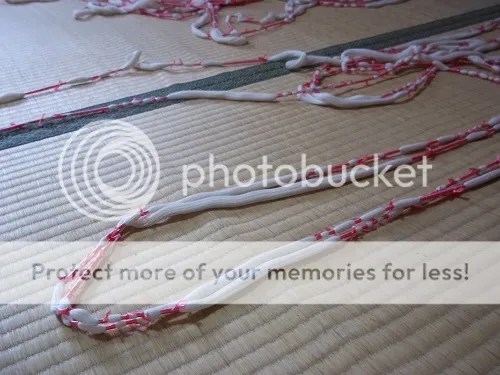
To make the picture-patterns, they start by preparing the weft threads for indigo dyeing. It starts with a number of spools of white string…

…which is hung from the ceiling…

…then woven around this thing.

I was told that this is where they divide portions to make a picture. Being easy overwhelmed by crafty things (I’m more comfortable with two dimensional art, thanks!), I can’t really fathom how this process actually works, but the result is that the areas that are to remain white are bound tightly so as not to left any dye seep through.

These threads are long are you can drag them across the room or make a large pile of them, but if you arrange them correctly, the picture-pattern begins to emerge.

Ta da!

In this piece (something to drape over a mirror when it’s not in use), the warp threads are all dyed indigo so as to soften the effect of the white blocks. In other styles, they might dye both the warp and the weft to result in a more stark contrast. You could also use different shades of indigo on a singe thread if you’re patient enough to dye one, bound again, and then dye again… but I am not this patient, so I can say nothing else about the process.

I did finish a little cloth of my own, though! It’s too big to be a coaster for a cup, but I can put it under flower vases and stuff to be decorative. I was so focused on not getting tangled up at first that I was stuck with a very, very simple pattern, but once I got going I regretted that. Once I got the flow of the loom, I could have gotten so much more creative in my pattern! Oh well. I suppose I could always go back and weave more, though I don’t expect to reach Kannon-levels of details.

My first attempt

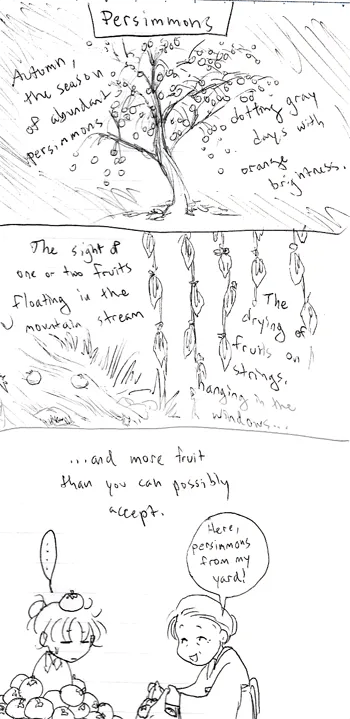
A kaki is a fruit I never really had much exposure to until coming to Japan. This marks my third autumn spent here, and also marks my third time being gifted with gobs of the stuff.


They say persimmon trees alternate through good years and bad years. In a bad year you’d be lucky to get five of them, but in a good year you’re luckier if you can find enough people to take them off your hands who haven’t already been gifted with everyone else’s persimmons. This is just my perspective on it, though, seeing as I’m only on the receiving end and I can’t say they’re my favorite fruit. Other people get very excited for persimmon season because they love their soft flesh and sweetness.

Perhaps because of the abundance of fruit that would be a pity to let go to waste, people throughout Japan prepare the persimmons for sun-drying (these sun-dried fruits are then also generously gifted to everyone). Though this is common through my experience of central and western Japan, not all persimmons are created equal. The little town of Higashiizumo is not only famous for the entrance to the underworld, but for its hoshigaki (dried persimmons).

Click on the pictures for photo source (Japanese).

This webpage is all in Japanese, but the pictures express well enough how much a part of the way of life the drying of persimmons is there, as well as all the creative persimmon-flavored things they make. I recommend the chocolate covered dried persimmons.

To wrap this up, here is a tongue-twister likely written by someone trying to get rid of their excess persimmons:
隣の客はよく柿食う客だ
Tonari no kyaku wa yoku kaki kuu kyaku da
(My neighbor’s guest is a guest who eats lots of persimmons)

Later that day, the room would be filled with guests listening to the pouring rain and thunder while warming themselves with tea.

It’s just after 7am on a cool, clear November morning. I’m wearing a kimono and sweeping the wooden veranda of a temple up in the mountains. Ah, it hits me. Looks like I found the Japan I always daydreamed about.

It started with the view of the sunrise over Lake Shinji as we were gathering our tools up to the temple–usually I only see the sunset view!


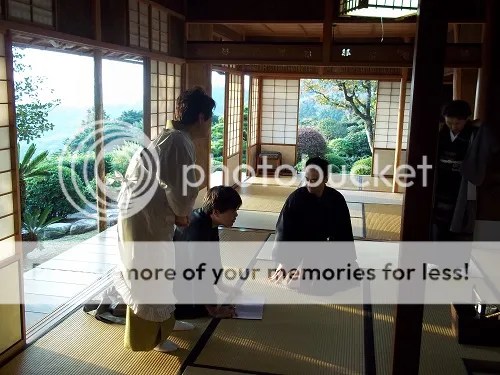
This was my first time serving in a tea ceremony gathering, having only formally attended one for the first time in June. Over the course of 13 successive ceremonies throughout the day of 15 to 35 guests each, I was not preparing tea myself, but serving the tea and sweets to the guests. I was nervous at first, but it soon became automatic. This took place in the tea room overlooking the eastern gardens of Ichibata Yakushi, a temple in the mountains of Izumo between Lake Shinji and the Sea of the Japan. Established in 894, it is dedicated to Yakushi Nyorai, the Medicine Buddha, and has been attributed with miracles of healing throughout the centuries, especially in regard to eye-related health. This is the head temple of the Ichibata Yakushi Kyodan independent school of Buddhism, which has at least thirty other temples throughout Japan.

In my personal experience, I’ve noticed this temple has a very dedicated and faithful following, and they are very enthusiastic to educate foreign travelers about the temple. The head priest is proficient in English (or so I hear, since we were both too busy with other things to have any conversation), and at least based on my observation is concerned, it seems this temple is active in the Izumo Shinbutsu Pilgrimage. You’ll hear of many Buddhist pilgrimages in respective areas of Japan that may focus on a particular school of Buddhism, listing by number all the temples in that particular pilgrimage. Pilgrims are typically spotted wearing white outfits and prayer beads they collect from each temple and hiking with walking sticks. For most famous temples, common visitors will drive most of the way! Either way, it’s common to see a line of shops along the route with specialities to offer pilgrims and common visitors. At Ichibata Yakushi, it’s manju (filled sweet dumplings).

The Izumo Shimbutsu Pilgrimage, however, is somewhat unique in that it combines both Buddhist temples and Shinto shrines. The Izumo area has historically leaned more towards Shintoism than Buddhism and segregated the two, whereas throughout most of the rest of Japan Buddhism has at times held more influence, or in practice there was little distinction between the two (they’ve been formally segregated since Japan started Westernizing). The basic idea behind this pilgrimage is that there is no reason different shrines and temples–different religions–should not bind together in prayer and holiness for the sake of world peace.

That said, each shrine or temple on the pilgrimage has its own unique history and dedication, and it’s own following of sorts. For instance, Mizuki Shigeru‘s Non-Non-Ba—the “religious granny” who taught him about the strange unseen world when he was a child–was an adherent to this temple. As such, there have been a couple recent additions to the statues of Buddhas around the temple.

A famous character from Mizuki Shigeru’s “GeGeGe no Kitaro”, known as Medama Oyaji. This is what remains of the title character’s father, and you see this eyeball in all kinds of creative places. I suppose it makes sense to have him at a temple known for eye health.

One of the many Ichibata Manju shops on the path up to the temple

Anyway, back to the tea ceremony! Or rather, a break I took from it in the afternoon when the crowds were thinning. Every year, Ichibata Yakushi–like a handful of other temples, including Gesshoji Temple in Matsue where tea-loving feudal lord Matsudaira Fumai is buried–performs a ritual to burn old chasen (the bamboo whisks used in the tea ceremony) and thank them for their service. I went out to watch and they were happy to let me take pictures, and happy to let people who had no idea what was going on to come and attend the brief ceremony. Everyone was handed a pray book to follow along with the chanting, and after buring the incense and offering thanks, everyone was invited to toss a few chasen in to be burned.


Yes, I can read it aloud, but no, I don’t have a deep understanding of it.


Head Priest Iizuka


Immediately after that, I returned as quickly as I could to help out in at least one more ceremony for the day, but as soon as I arrived I was whisked away to the hall by one of the teachers. Oh no, I thought, am I going to get lectured for taking such a long break while everyone else was working so hard? Instead, she led me into a tiny, dimly lit room where the people organizing the tea ceremonies events for the day were sitting in a more intimate space, using another set of tools that hadn’t been shared with the succesive guests, and eating some fluffy wagashi that had been brought from Nara. This teacher had wanted to share with me the quieter side of tea ceremony asthetics and engage in conversation with the tea master and me. They were many sentiments and I heard before and share, at however shallow a level of understanding I may have. This part of the conversation sticks out in my mind, though:

“It’s so nice that we get to use such old works of art like this.”
“Yes, it’s surprises me sometimes that these aren’t kept in museums to preserve them.”
“The chawan tea bowls you see in museums have gone to waste. They’re tools. If they aren’t being used, they’ve lost their purpose.”

For more Ichibata Yakushi blog pages in English with prettier pictures:
Connect Shimane: Ichibata Yakushi Temple
More Glimpes of Unfamiliar Japan: Ichibata Yakushi revisited

Just one of many, many pieces of sand art, the majority of which are in motion.


So long as it’s sunny, November’s not a bad time to go to the beach. That’s when you get to see it without anyone else around, and all that lingers are footsteps in the sand. I went to Kotogahama in Oda city futher west in Shimane, and though my friend are I were the only living beings in plain sight, there were little echoing sounds following our footsteps.

These are exactly the sounds we came for–the singing sands! Kotogahama is one of the top three beaches in Japan for this curious phenomenon. When you step on the dry, clean sand, it is said to sing or cry (the Japanese name, 鳴き砂 (nakisuna) is written with the character for singing like a bird, but it is synonymous with 泣き砂, “crying sand”).

There is a legend about that on this particular beach. Back in the epic partly historical, partly legendary Genpei War, one of the gravest naval battles, Dan-no-Ura, took place in 1185 on the western tip of the main island of Honshu. Amidst the confusion, a princess of the defeated Taira clan was lost at sea, but washed up on the shore here. The villagers nursed her back to health and took care of her, and she would express her gratefulness to them and her sorrow at the defeat of her clan by playing her koto at the beach. When she died, everyone was so sad that even the sand began to cry. She is remembered as Kotohime (Koto Princess) and the beach was named after her (Koto beach). This is the basic version of the story, but there are numerous variations.

The sand itself is a lot of fun to go stomp around on, and makes the clearest sounds when you step directly downward on it rather than sliding around. You can also put it in a bowl and make it sing with a pestle.


Not far from the beach is the Nima Sand Museum, and the glass pyramids are quite noticable from the highway. This museum played a prominent role in the hit shoujo manga and live action drama “Sunadokei”/”Sand Chronicles.” You wouldn’t think a museum about sand would be so interesting, but we spent a long time there because there was so much to see and do.

Samples of sand from the western shores of Shimane

Samples of sand from around the world, including garnet sand from the South Pole and “Sand of Disappointment”!

Microscopes set up to get a better look at samples of sand from around the world

There was a whole line of timers set up to show how long it takes other phenomenon around the world to occur.

The museum is most famous for its largest hourglass, which times a whole year. Not only is this the largest in the museum, but it is the largest in the world. Every year they recruit roughly 100 people who were born in the year of whatever zodiac animal is coming up next, and five minutes before the new year they start pulling the ropes to rotate the enormous glass. There are many factors may affect the rate at which sand falls, such as the temperature of the glass. If the top portion of the glass is warmer, the sand will fall more quickly, and if the bottom is warm, the sand falls more slowly. Therefore, in order to maintain accuracy, it must be kept in an environment with climate control, which is why you don’t see hourglasses of this size outdoors (or anywhere else, for that matter).

This is how much sand falls per day


This is the size of the tiny nozzle through which it falls

Although the singing sands of Kotogahama get a special focus in the museum of sands of the world, they do not use sand from Kotogahama in this hourglass (yearglass?). Instead, they use the much finer grain sand of Osodani in Yamagata Prefecture. If they used the large grain sand of Kotogahama, the hourglass would need to be three times as large, and current technology is unable to make an accurate hourglass of that size possible!

The museum is filled with different kinds of sand art, as well as a basement area of optical illusions and a handful of areas to experiment with some sand and non-sand art yourself. There are is a Bohemian arts center next door that offers glass-art classes as well. I came away with a much deeper appreciate than I had ever had before for a part of the world I never think about much, and now the twinkling sound of squeaking sand will never leave me.

Okay, so this comic is actually from a month and a half ago, seeing as I’m running out of practice time for the kimono dressing competition. During the hot and humid months I had only been practing folding the obi, but once it was cool enough to wear all the necessary layers I donned my kimono for this year’s competition.

I had been feeling good about my practices until that point. Somehow, I had forgotten what a pain it is to move around in furisode.

I’ve worn heavier kimono before, such as cotton-padded and elaborately woven uchikake bridal kimono (wore over the rest of the outfit) and Heian era style 12-layered juuni-hitoe, and the first things people ever say when they see the pictures is “wow, that must have been heavy!” This surprises me since it never really bothered me. Sure, they were heavy, but not bothersome when you’re elated at the chance to wear them. Plus, I was just doing things on stage or taking pictures for fun. I didn’t actually have to function in them, and I certainly didn’t have to fold an obi in mere minutes while wearing them.

Although the furisode is weighty because of its shin-length sleeves (made weightier by the silk under-sleeves), it’s certainly more managable than the excessively decorative uchikake and juuni-hitoe, but… I take that back, modern furisode can also be excessively decorative if you have that kind of money to spend of them–they are still managable enough for a skills competition. My kimono is also heavier this year than last year because it’s made of chirimen silk instead of rinzu silk.

Rinzu is a sleeky silk, and very shiny:

Click for photo source (Japanese)

Last year I found this relatively easier to move in without feeling terribly weighed down, but this might also have been because I wasn’t using silk inner-sleeves. You can get away with not using them at this level of competition, but I figured I may as well do it in proper form and have the inner layer this time. They are supposed to be only somewhat visible, but sometimes one layer of sleeves falls out of the other layer and you see entirely too much of them.

The pattern I had last year was very busy, and therefore if I had a weird wrinkle or something it didn’t stand out too much. My kimono this year has a much more subtle pattern which is only on certain parts of the kimono (the bottom, the sleeves, and the left shoulder) rather than all over it. Therefore, if my layers don’t match up quite right, it’s easier to tell!

It’s made of a slightly heavier chirimen material, typically a crepe-like silk. Besides kimono, this fabric is used for making all kinds of Japanese-y goods, which you’ve most certainly seen if you’ve ever been to Kyoto. There’s plenty of chirimen crafts throughout Japan, like these shijimi clams (a speciality of Lake Shinji here in Matsue).

Well. Just a few more weeks to practice. Still need to shave my time down a bit, but more importantly, I need to make sure my folds and layers are neat so the deep red chirimen won’t display my mistakes to the world!

This was a story I heard at Matsue’s Izumo Kanbeno-Sato, told in a very charming setting with illustrations and a talented narrator.

There once was a lonely old man who nonetheless was a very hard worker. Every day, he tended to his fields, without complaint. One day, he found a red cap in his fields, but there was no one around who could have dropped it. Taking a better look at it, he heard a tiny voice. “Dear Ojiisan,” it addressed the old man respectfully, “you’re a very hard worker. I’m a god, and I’ve been watching you. Take this hat as a gift. It will allow you to hear all things, and it will bring you good fortune.”

Gratefully, he accepted it, keeping it on his person. After finishing his labor for the day, he sat under a tree to take a nap, but couldn’t sleep because the crows above him were being so noisy; kaa, kaa, kaa, kaa. “Those crows!” he grumbled. “How can anyone fall asleep with all that ruckus?” Kaa, kaa, kaa, kaa, kaa, kaa.

It then occurred to him to try out the cap he had been gifted with. Doing so, the cacophony subsided, and he could hear human speech coming from the birds above: “The poor village headman over there. Did you hear? He’s terribly ill, and none of the human doctors can figure out what to do to cure him.” “They have no idea it’s because of the snake that died in his storeroom. It’s just a pile of bones by now, but being stuck in there is causing it so much grief that the headman has been sickened by it. It would be such a simple matter to give the snake a proper burial, and then the headman would be healed.” “Yes, but there is no way to tell the humans there. What a terrible misfortune.”

The old man immediately set out for the neighboring village to help the sick man. It took him several hours on foot to crossed the mountain, but he was accustomed to hard work and fatigue did not slow him. When he arrived, he asked to visit the village headman, but his attendants regretfully told him he was too ill to welcome an visitors. “Every doctor has tried to heal him, but to no avail. We’re at such a loss.”

“That’s why I’m here. I know how to heal him.”

“By all means, please! Save our headman!”

He met with the sick man and told him off the snake that died in his storeroom, and that it should be handled appropriately. The villagers found the bones, and then made a proper grave and offered rites to the spirit of the trapped snake. The headman was soon back on his feet, and was eager to express his thanks, giving the old man many gifts to take home with him. Satisfied with his successful good deed, the old man accepted the gifts and returned to his lonely mountain dwelling, where he continued his usual work.

Months later, messengers from the village came seeking his advice on behalf of the village headman’s daughter, who had taken ill. The doctors had tried everything, but could not determine the cause for her illness or the right way to treat her. The old man grabbed his red cap and followed them, eager to help if he was able to.

Upon arriving, he stood outside of her quarters, put on his cap, and listened. All he could hear, however, was the counter of the girl’s labored breathing. He was distressed that he had no way to help, but continued to wait in the village. The night, he did not hear any gossiping crows; only the sound of the trees rustling in the wind. Basa basa basa basa basa basa… basa basa basa basa basa basa…

When he put on his cap, he heard the gingko tree say to its companions, “It is with great regret that I must part with you all…” it said weakly and quietly… “but headman’s daughter’s quarters were built upon my roots. My roots are now damaged, and I will soon shrivel and die.”

The other trees were crying. “It’s so unfair,” the pine replied. “You’re still so young! If only they would tear down those quarters and allow your roots to heal, you could still have a long life. The headman’s daughter would be saved that way, too! But humans are too foolish to know that.”

The old man immediately informed the village headman what he must do to save his daughter. They demolished her quarters, and treated the gingko’s roots. Soon enough, both the tree and the girl began to regain their strength. When the girl was her usual cheerful self again, she insisted that she and her father hold an audience with the old man. “You’re so kind, Ojiisan. You’ve rescued both me and my father,” she said. “There must be some way to repay you! Please tell me anything you want.”

“I have already accepted your gifts before, and my needs have always been met,” he replied. “Although I have managed, I live a very lonely life.”

“Then stay here with us! We’ll adopt you as my grandfather,” she offered. Her father enthusiastically agreed, and the old man felt so welcomed that he couldn’t refuse. He moved in with them, and they all lived very happy, fulfilling lives.

CIRs are all entrusted with translations from time to time, and in an office with multiple English-speaking CIRs, we try to keep our translations consistent. Sometimes we don’t, though–occasionally when working on the same project, we’ll notice some parts are in British English while others are in American English, too. In talking with other CIRs, I’ve noticed there are big projects to make a compilation of all the commonly referenced sites and road and stations and their official English (and otherwise) translations, because different sources may translate them in different ways. These projects are often started out of the CIRs’ own initiative, I’ve noticed.

In my own translations of the local sites of the tea-loving city of Matsue, I liked having a couple of sempai to discuss translations with, especially when we’re all so used to the Japanese terms. One day we needed a quick name for a the Daichakai (大茶会), one of the three biggest tea events in the country hosted at Matsue Castle every October. This year, schools of 11 different styles of the tea ceremony (everything from your usual Urasenke and Omotesenke, to the local Fumai style, to styles that use sencha (steeped green tea) and koucha (black tea) instead of the typical matcha (powdered green tea)) all had tents set up around the Matsue Castle grounds, as well as the nearby Meimei-an teahouse.

At this Daichakai, you buy a ticket–or set of three tickets–to be used at any tent (or tea house), and each one has a reception area and a waiting area, and then you are invited in to the tables and chairs (or tatami mats–for simplicity’s sake, I’ll just focus on the tents at the castle). There is a display of flowers and a hanging scroll set up, as well as an area where the tea master will prepare the tea and everyone can watch. Another practitioner of the school will usually explain what is going on, and what tools are being used, and the characteristics of the confectionary being served. This way, both people who are well-versed in the world (art? way?) of tea as well as completely beginners can enjoy the ceremony.

The ceremony is kept short, with most of the tea being prepared in the back and only the tea for the guests of honor prepared on display. In my Omotesenke school, my classmates were timed during practices to keep it short enough that people do not get bored, but long enough that people get the atmosphere they came for–roughly 8 to 10 minutes. After everyone has had their sweets and tea, the guests are welcome to observe the tools and decorations and ask questions about them on their way out of the tent, and then they move on to the next style of tea to try out while the following guests take their seats. Given the amount of caffeine one consumes, I suggest seeing two schools in one day and seeing a third the following day! The practitioners preparing the tea also get a chance to enjoy other styles, as usually one school of a given style will practice it only one day, so they can browse around on the other day of the weekend festival.

So… what would you call this in English?

A chakai is literally a “tea-meet” and “dai” makes it a “big-tea-meet.” You can call it a tea ceremony, but it’s many, many tea ceremonies in one big festival, but “ceremony” sounds a little stiff and “festival” sounds a little too rowdy. You could go with “tea party” but I think it has different connotations in English–it sounds more like tea time with friends in Western style as opposed to the more ritualistic tea meeting of Japanese style.

We’ve tentatively been using “Grand Tea Ceremony” as a semi-literal translation that sounds a little better than “Big Tea Ceremony,” but I don’t really like the flow of it. I supposed anything can sound normal once you use it enough, though. Got it, everyone? Starting talking about Matsue’s Grand Tea Ceremony all the time so we hear these words everywhere! Or, since this is still flexible, does anyone have any smoother suggestions?

Design a site like this with WordPress.com
Get started